
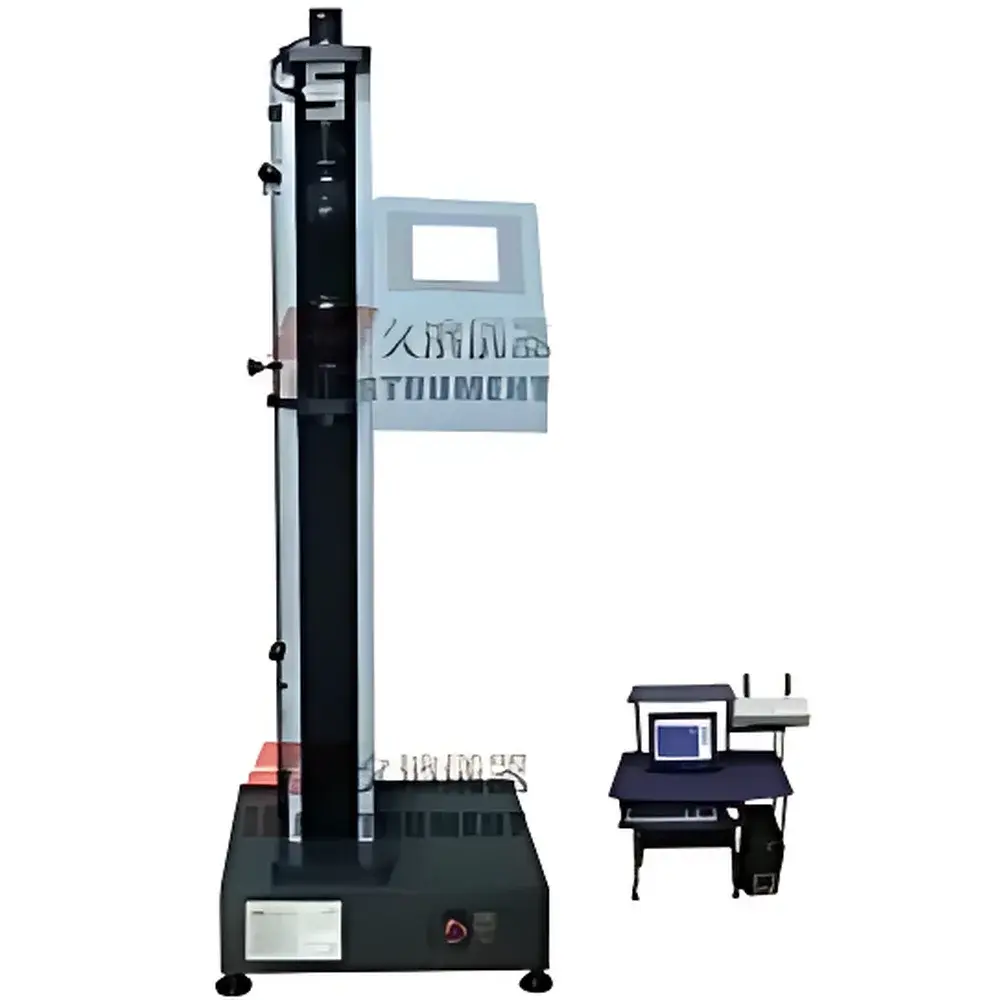
Jiubin Instruments JB-126S Seam Slippage Tester for Textiles and Leather
| Brand | Jiubin Instruments |
|---|---|
| Origin | Shanghai, China |
| Model | JB-126S |
| Max Test Load | 200 kgf (1.96 kN) |
| Load Accuracy | ±0.01% FS |
| Force Resolution | 0.001 N |
| Speed Range | 5–500 mm/min (adjustable, stepless) |
| Effective Travel | ~800 mm |
| Displacement Encoder | 1000 P/R |
| Position Accuracy | ±0.005% (Japan-made) |
| Compliance | ASTM D1683, ISO 13936-1/2, ISO 13935-1/2, GB/T 13772.1–2, GB/T 13773.1–2, JIS L1096, GB/T 3923.1–2, GB/T 3917.2–3 |
Overview
The Jiubin Instruments JB-126S Seam Slippage Tester is a precision electromechanical tensile testing system engineered for standardized evaluation of seam integrity in woven fabrics, knits, nonwovens, and leather materials. It operates on the principle of controlled uniaxial tension applied perpendicular to a stitched seam, quantifying the relative movement (slippage) between yarns at the seam line under defined load or displacement conditions. This measurement is critical for assessing garment durability, seam performance under stress, and compliance with international textile quality benchmarks. The instrument implements dual-mode seam slippage testing—fixed-load (ISO 13936-2 / GB/T 13772.2) and fixed-gape (ISO 13936-1 / GB/T 13772.1)—and extends functionality to full-spectrum mechanical characterization including tensile strength (ISO 13934-1/2), tear resistance (ISO 13937-2, ISO 9073-4), and seam strength (ISO 13935-1/2). Its modular architecture integrates high-fidelity load sensing, real-time displacement tracking, and closed-loop PID control to ensure repeatability across test cycles and laboratories.
Key Features
- Triple-closed-loop digital control system (force, displacement, strain) using adaptive neural-network-based PID algorithms for seamless mode transitions and zero-impact switching between control strategies.
- High-resolution data acquisition: 1/500,000 internal resolution, ±0.01% full-scale load accuracy, and ±0.005% displacement fidelity (Japan-sourced encoder).
- Dual-display operation: Independent control via industrial-grade touchscreen interface and Windows-based PC software—both capable of initiating, monitoring, and terminating tests autonomously.
- Modular fixture design: One pair of application-specific clamps supplied standard; custom fixtures available per material geometry and standard requirements (e.g., grab-test jaws, strip-test grips, seam-slippage combs).
- Comprehensive curve analysis suite: Local zoom, hysteresis loop calculation, yield point detection (upper/lower), modulus derivation, elongation-at-break, and energy absorption metrics (net, return, total).
- Safety-integrated mechanical architecture: Dual-limit switches, emergency stop circuitry, overload cutoff, and automatic return-to-home post-test.
- Configurable reporting: Fully customizable test reports with embedded force–displacement curves; bilingual (English/Chinese) output with user-defined decimal precision (2 or 3 digits) and unit conversion (N, kN, kgf, lbf).
Sample Compatibility & Compliance
The JB-126S accommodates flat, flexible specimens up to 800 mm effective travel and supports standardized specimen widths per ASTM, ISO, and GB protocols—including 50 mm strip specimens (ISO 13934), 100 mm grab specimens (ISO 13934-2), and seam specimens prepared per ISO 13936 Annex A. It is validated for use with cotton, polyester, wool, blends, coated textiles, synthetic leathers, and technical geotextiles. All test methods implemented align with regulatory and quality assurance frameworks: ASTM D1683 (seam slippage), ISO 13936-1/2 (fixed-gape/fixed-load seam testing), ISO 13935-1/2 (seam strength), ISO 13934-1/2 (tensile properties), ISO 13937-2 (trouser tear), and ISO 9073-4 (trapezoidal tear). Data traceability meets GLP audit requirements, with timestamped metadata, operator ID logging, and immutable result storage.
Software & Data Management
The proprietary Windows-based software provides full test lifecycle management—from parameter configuration (predefined method templates for ASTM/ISO/GB standards) to post-test analytics. All raw data (load, displacement, time) are captured at ≥1 kHz sampling rate and stored in encrypted binary format with automatic backup to user-specified drives. Audit-trail functionality records every parameter change, calibration event, and test execution with user login context. Reports export to PDF, Excel, or image formats and include embedded calibration certificates, environmental condition tags (optional), and pass/fail flags against acceptance criteria. Software supports FDA 21 CFR Part 11–compliant electronic signatures when deployed in regulated environments.
Applications
- Quality assurance of ready-to-wear garments: validation of seam slippage resistance in collars, armholes, and side seams under simulated wear loads.
- R&D of high-performance textiles: comparative evaluation of seam stability across stitch types (lockstitch vs. overlock), thread counts, and fabric weaves.
- Leather goods manufacturing: assessment of seam integrity in handbags, footwear, and upholstery where dimensional stability under cyclic loading is critical.
- Technical textile certification: verification of geotextile seam strength per ISO 10319 or filtration media joint performance under hydraulic pressure simulation.
- Academic and contract testing labs: reproducible generation of mechanical property datasets compliant with ISO/IEC 17025 documentation requirements.
FAQ
What standards does the JB-126S support for seam slippage testing?
It fully complies with ISO 13936-1 (fixed-gape method), ISO 13936-2 (fixed-load method), ASTM D1683, GB/T 13772.1–2, and JIS L1096 Annex E.
Can the system perform tensile and tear tests in addition to seam slippage?
Yes—it executes ISO 13934-1/2 (strip/grab tensile), ISO 13937-2 (trouser tear), ISO 9073-4 (trapezoidal tear), and ISO 13935-1/2 (seam strength) without hardware modification.
Is the software validated for use in regulated industries?
The software includes audit-trail logging, electronic signature support, and data immutability features aligned with FDA 21 CFR Part 11 and ISO/IEC 17025 requirements.
What is the maximum specimen thickness the standard clamps can accommodate?
Standard pneumatic or mechanical clamps accept specimens up to 15 mm thick; custom jaw inserts are available for thicker laminates or composite textiles.
Does the system require external calibration services?
No—built-in self-calibration routines and NIST-traceable load cell certification enable in-house verification; annual third-party calibration is recommended for ISO 17025 accreditation.



