
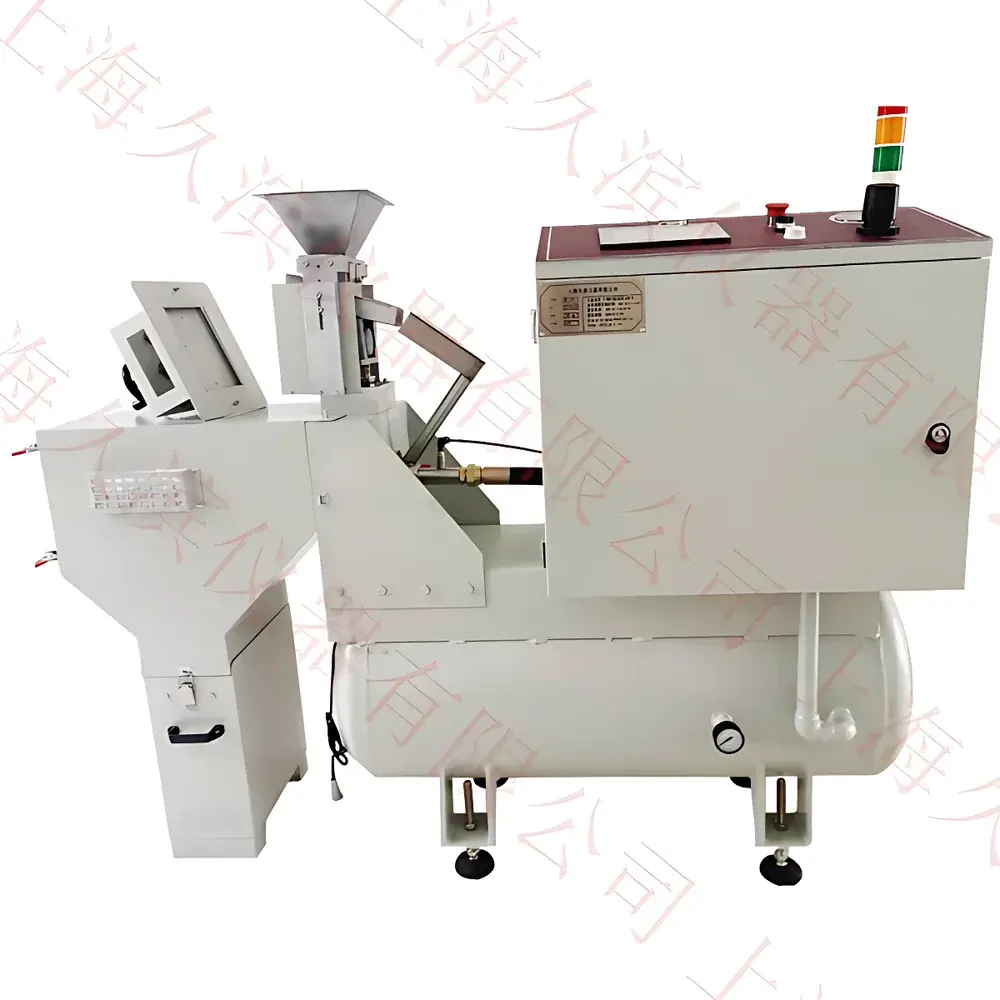
Jiubin Instruments JB-JM5 Multi-Function Gravel Impact Resistance Tester
| Brand | Jiubin Instruments |
|---|---|
| Origin | Shanghai, China |
| Manufacturer Type | Authorized Distributor |
| Country of Origin | China |
| Model | JB-JM5 |
| Price Range | USD 7,000–17,000 |
| Pressure Range | 0–0.8 MPa (adjustable) |
| Test Temperature | Ambient (optional low-/high-temperature chamber available) |
| Air Hose Internal Diameter | 20 mm / 15 mm |
| Air Reservoir Volume | 136 L |
| Nozzle Tube Internal Diameter | 30 mm / 53 mm |
| Specimen Orientation | 45°, 54°, or 90° for flat samples |
| Sound Pressure Level | ≤120 dB(A) |
| Operation Mode | Continuous duty cycle |
| Impact Media | Calibrated gravel, angular sand, or standardized stone particles |
| Feed Rate Control | Electromagnetic vibratory feeder |
| Airflow Pressure Control | Manual needle valve |
| Required Compressed Air Supply | User-provided |
Overview
The Jiubin Instruments JB-JM5 Multi-Function Gravel Impact Resistance Tester is an engineered solution for simulating and quantifying mechanical degradation caused by high-velocity particulate impact—primarily replicating road debris strike conditions encountered by automotive coatings, aerospace composites, and protective surface systems. Based on the principle of controlled pneumatic acceleration, the tester propels standardized gravel or angular sand particles through a calibrated nozzle at regulated pressure and velocity, inducing localized stress, delamination, chipping, or fracture in test specimens. Unlike single-angle or fixed-geometry impact testers, the JB-JM5 integrates modular orientation capability (45°, 54°, and 90° incidence angles for planar substrates) and a fully enclosed 3D test chamber for non-planar components—enabling realistic simulation of real-world exposure profiles across curved body panels, sensor housings, or composite airframe sections. Its design adheres to foundational methodologies referenced in ASTM D3170 (Chipping Resistance of Coatings), ISO 20567-1 (Paints and varnishes — Determination of stone-chip resistance), and SAE J400 (Surface Finish Evaluation – Gravelometer Test), providing traceable, repeatable data for R&D validation and production QC.
Key Features
- Triple-angle specimen mounting system (45°, 54°, 90°) with precision-machined fixtures ensuring consistent impact geometry and reproducible incidence conditions.
- Dual-nozzle configuration (30 mm and 53 mm internal diameter) supporting both high-velocity focused impact and broad-area dispersion testing per application requirements.
- 136-liter pressurized air reservoir with integrated pressure regulation and digital monitoring, enabling stable airflow delivery over extended test durations.
- Electromagnetically driven vibratory feeder with stepless amplitude control, allowing precise tuning of particle feed rate (typically 10–60 g/s) without mechanical wear or clogging.
- Acoustically damped 3D test chamber constructed from reinforced steel and polycarbonate viewing panels, compliant with OSHA 1910.95 noise exposure limits when used with mandatory hearing protection (≤120 dB(A)).
- Modular air supply interface compatible with user-supplied compressors meeting ISO 8573-1 Class 3/4 air quality standards—ensuring contaminant-free operation critical for coating adhesion integrity.
Sample Compatibility & Compliance
The JB-JM5 accommodates rigid and semi-rigid substrates up to 300 × 300 mm (flat mode) or irregular 3D parts within a 400 × 400 × 300 mm chamber volume. Compatible materials include electrophoretic and powder-coated steel, aluminum alloy panels, laminated safety glass, thermoplastic polyolefins (TPO), polyurethane elastomers, and fiber-reinforced polymer (FRP) composites. All test procedures support compliance documentation for IATF 16949 clause 8.5.1.2 (process validation), ISO/IEC 17025 accredited laboratories (when operated with certified gravels and calibrated pressure transducers), and OEM-specific protocols such as Ford CETP 00.00-L-467, GMW14872, and VW TL 226. Optional environmental integration (e.g., thermal conditioning stages) enables combined stress testing aligned with ISO 4892-2 (UV + impact) or ASTM D4329 (cyclic corrosion + impact).
Software & Data Management
While the JB-JM5 operates via hardware-integrated manual controls (pressure valves, feed rate dials, timer relays), it supports external data capture via analog 4–20 mA outputs for pressure, feed rate, and cycle count—compatible with SCADA systems, LabVIEW DAQ modules, or PLC-based MES integration. Test logs—including pressure setpoint, duration, media batch ID, specimen ID, and operator code—can be recorded manually in accordance with GLP principles or imported into LIMS platforms using CSV templates. For full digital auditability, optional add-ons include a USB-connected pressure logger with ±0.01 MPa accuracy and timestamped event recording compliant with FDA 21 CFR Part 11 requirements (electronic signatures, audit trail, data integrity controls).
Applications
- Quantitative assessment of intercoat adhesion loss in multi-layer automotive topcoats under simulated roadway gravel impact.
- Evaluation of brittle fracture thresholds in tempered automotive glazing and laminated windshields.
- Optimization of anti-chip primer formulations for EV battery enclosures exposed to underbody debris.
- Validation of UV-stabilized polymer coatings for agricultural machinery subjected to abrasive soil impact.
- Comparative benchmarking of coating thickness vs. spallation resistance across OEM-specified film builds (e.g., 25–45 µm e-coat + 20–35 µm basecoat + 35–55 µm clearcoat).
- Supporting failure analysis in root cause investigations following field-reported stone-chip damage incidents.
FAQ
Is compressed air supply included with the JB-JM5?
No. A user-supplied oil-free air compressor delivering ≥2 m³/min at 0–0.8 MPa is required. Air must meet ISO 8573-1 Class 3 particulate and Class 4 moisture specifications.
Can the JB-JM5 perform tests at sub-zero or elevated temperatures?
Yes—via optional environmental chambers (–40 °C to +80 °C) mounted externally to the main test enclosure. Temperature-controlled testing requires separate calibration of pressure decay rates and feed dynamics.
What gravel specifications are recommended for ISO 20567-1 compliance?
Calibrated granite or basalt particles conforming to ISO 20567-1 Annex A: 3–6 mm nominal size, angularity index ≥3.5, density 2.6–2.8 g/cm³, and Mohs hardness ≥6.5.
Does the system include calibration certification?
Standard delivery includes factory verification reports for pressure transducers and feed rate linearity. NIST-traceable calibration certificates are available upon request at additional cost.
How is operator safety ensured during operation?
The unit features interlocked access doors, emergency stop circuitry, acoustic shielding, and mandatory PPE integration (hearing protection, face shield, and cut-resistant gloves per ANSI Z87.1 and EN 352-2).



