
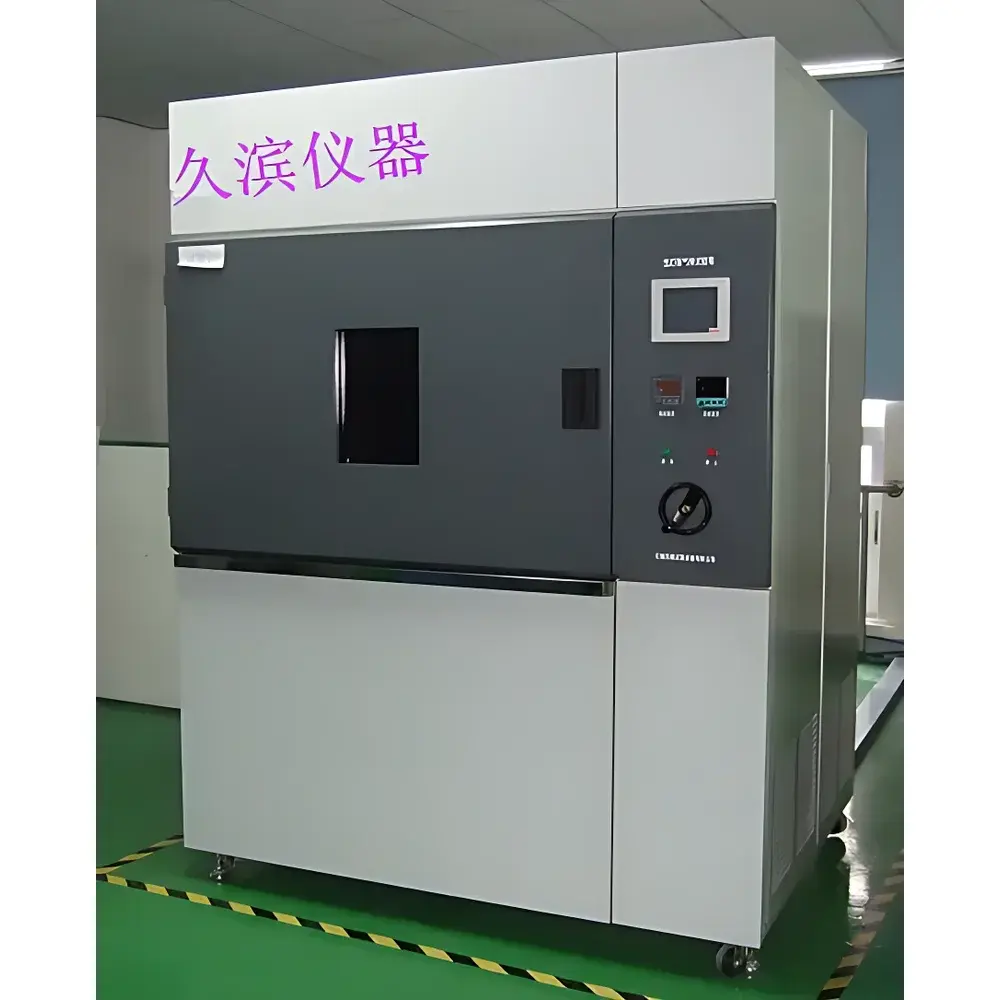
Jiubin Instruments JB-R162 Xenon Arc Weathering Test Chamber
| Brand | Jiubin Instruments |
|---|---|
| Origin | Shanghai, China |
| Model | JB-R162 |
| Internal Chamber Dimensions | 400 × 400 × 500 mm (D×W×H) |
| External Dimensions | 870 × 950 × 1750 mm (D×W×H) |
| Temperature Range | +10°C to +90°C |
| Temp. Uniformity | ±2°C |
| Temp. Stability | ±0.5°C |
| Black Panel Temperature Range | 50°C to 90°C |
| Humidity Range | 45–98% RH |
| Humidity Uniformity | ±5% RH |
| Humidity Stability | ±2% RH |
| Irradiance Spectrum | 290–800 nm |
| Irradiance Setpoint | 550 W/m² |
| Xenon Lamp Configuration | 3 × 2.5 kW (adjustable, total 7.5 kW) |
| Lamp Life | ~1600 h |
| Sample-to-Lamp Distance | 350–375 mm |
| Sample Tray Size | 400 × 700 mm |
| Rain Cycle | 0–240 min adjustable |
| Continuous Rain Duration | 0–9999 min |
| Water Spray Pattern | 18 min on / 102 min off |
| Water Pressure | 1.0–1.5 bar |
| Acoustic Noise Level | ≤80 dB(A) at 1 m |
| Timer Range | 0–999 h (setpoint), 0–99 h (programmable cycling) |
| Heating Power | 1 kW |
| Humidification Power | 1 kW |
| Safety Protections | Leakage current protection, overcurrent cutoff, overtemperature cutoff, audible alarm, low-water & ground-fault detection, power-loss memory function |
Overview
The Jiubin Instruments JB-R162 Xenon Arc Weathering Test Chamber is an engineered environmental simulation system designed to replicate the photodegradative and thermo-hygrometric stresses induced by natural solar radiation, temperature fluctuations, humidity cycling, and periodic water exposure. It employs a high-intensity, filtered xenon arc lamp array to generate a continuous spectrum closely matching terrestrial sunlight (290–800 nm), enabling accelerated aging assessments under controlled, repeatable conditions. Unlike UV-only or fluorescent lamp-based testers, the JB-R162 delivers full-spectrum irradiance—including critical UVA, UVB, visible, and near-infrared bands—making it suitable for evaluating photochemical degradation mechanisms such as polymer chain scission, pigment fading, surface oxidation, and hydrolytic embrittlement. Its architecture supports both static and dynamic exposure protocols, aligning with internationally recognized accelerated weathering methodologies used in materials science, quality assurance, and regulatory compliance workflows.
Key Features
- Triple 2.5 kW air-cooled xenon lamps with electronic power regulation, enabling precise irradiance control up to 550 W/m² across the 290–800 nm band
- Integrated black panel temperature sensor with range of 50–90°C, ensuring accurate surface thermal loading representative of real-world service conditions
- Programmable climate sequencing: independent control of temperature (+10°C to +90°C), relative humidity (45–98% RH), and water spray cycles (duration, frequency, and pattern)
- Robust stainless-steel chamber construction with double-wall insulation and forced-air convection for uniform thermal distribution (±2°C uniformity)
- Dual-stage humidity control via steam humidification and precision condensate drainage, maintaining stability within ±2% RH
- Adjustable sample-to-lamp distance (350–375 mm) and standardized 400 × 700 mm sample tray accommodating ASTM D7869, ISO 4892-2, and GB/T 16422.2-compliant specimen configurations
- Comprehensive safety architecture including leakage current protection, overtemperature cutoff, low-water interlock, ground-fault monitoring, and controller EEPROM-based power-loss memory
Sample Compatibility & Compliance
The JB-R162 accommodates flat-panel specimens up to 400 × 700 mm and is routinely deployed for testing polymeric films, elastomers, coatings, textiles, automotive trim, architectural glazing, packaging laminates, and electronic enclosures. Its operational envelope satisfies the physical and spectral requirements of multiple international standards, including GB/T 16422.2–1999 (plastics), GB/T 8430–1998 (textile colorfastness), GB/T 1865–1997 (paints and varnishes), GB/T 5137.3–1996 (automotive safety glass), GB/T 16259–1996 (colored building materials), and GB/T 2423.24–1995 (electrotechnical products). While not certified to IEC 60068-2-5 or ISO 4892-2 out-of-the-box, its optical, thermal, and hygric performance parameters are fully traceable to those standards’ test condition definitions, supporting internal validation and method transfer in GLP-compliant laboratories.
Software & Data Management
The chamber integrates a programmable logic controller (PLC) with an intuitive touchscreen HMI interface supporting multi-step exposure profiles, real-time parameter logging (temperature, RH, irradiance, spray status), and data export via USB or RS-485. All operational events—including alarm triggers, setpoint changes, and cycle completions—are timestamped and stored with audit-trail capability. While native software does not implement FDA 21 CFR Part 11 electronic signature controls, the system’s deterministic behavior, non-volatile event logging, and configuration lockout modes enable integration into validated environments when paired with third-party LIMS or ELN platforms compliant with GxP documentation requirements.
Applications
- Evaluation of pigment stability and color shift in automotive clearcoats under simulated desert/sunbelt exposure
- Assessment of UV stabilizer efficacy in polyolefin geomembranes for landfill liner qualification
- Accelerated aging of silicone encapsulants in photovoltaic module backsheet systems per IEC 61215 sequence requirements
- Correlation studies between xenon arc exposure hours and outdoor field performance of architectural sealants (ASTM C1135)
- Pre-screening of biodegradable packaging films for photolytic fragmentation kinetics under variable humidity regimes
- Validation of anti-fog coating durability on polycarbonate visors subjected to cyclic condensation and solar loading
FAQ
What spectral irradiance standard does the JB-R162 follow?
It replicates the global solar spectrum (290–800 nm) per ISO 4892-2:2013 and GB/T 16422.2–1999, with optional filter configurations available to match Daylight, Window Glass, or Extended UV filters.
Can the chamber operate without water spray?
Yes — rain and condensation cycles are independently programmable; dry-heat or dry-UV-only exposure modes are fully supported.
Is calibration traceable to national standards?
Irradiance sensors are factory-calibrated against NIST-traceable reference cells; users are advised to perform annual verification using calibrated handheld radiometers.
What maintenance intervals are recommended for the xenon lamps?
Lamps require replacement after ~1600 hours of operation or upon observed spectral drift exceeding ±5% in the 340 nm band, as verified by spectroradiometric measurement.
Does the system support remote monitoring?
Standard configuration includes RS-485 Modbus RTU output for integration with building management systems (BMS) or SCADA networks; Ethernet or Wi-Fi modules are available as optional upgrades.



