
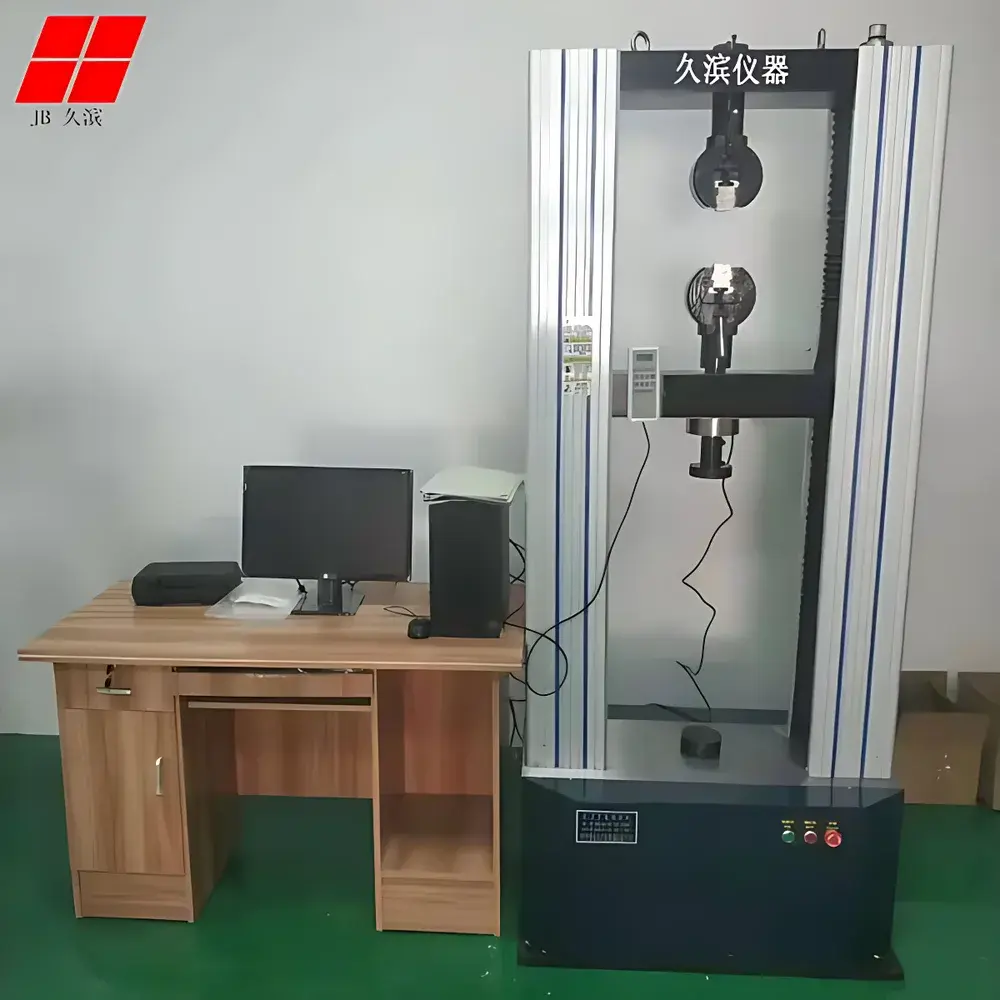
Jiubin JB-117 Metal Bone Pin Tensile Strength Testing Machine
| Brand | Jiubin |
|---|---|
| Origin | Shanghai, China |
| Manufacturer Type | Authorized Distributor |
| Country of Origin | China |
| Model | JB-117 |
| Instrument Type | Electromechanical Universal Testing Machine |
| Maximum Load Capacity | 200 kN |
| Force Measurement Range | 0.4–100% of full scale |
| Force Resolution | 1/500,000 FS |
| Accuracy Class | Class 1 (Force: ±0.5% of reading |
| Displacement | ±0.5% of reading) |
| Crosshead Speed Range | 5–50 mm/min (stepless, programmable) |
| Test Width | ≈370 mm |
| Effective Stroke | ≈800 mm |
| Control Interface | LCD touchscreen + English-language PC software |
| Safety Systems | Overload emergency stop, mechanical travel limits, leakage protection, automatic test termination at break |
| Return Mode | Manual high-speed return or automatic post-test return |
| Power Supply | 220 V, 50 Hz |
| Ambient Operating Conditions | 15–35 °C, 20–80% RH |
| Dimensions (W×D×H) | 800 × 400 × 1800 mm |
| Weight | ≈350 kg |
| Unit Options | g, kg, N, kN, lbf, MPa |
| Fixture Configuration | Customizable per user-specified bone pin geometry and ASTM/ISO test requirements |
Overview
The Jiubin JB-117 Metal Bone Pin Tensile Strength Testing Machine is an electromechanical universal testing system engineered for precise mechanical characterization of orthopedic metallic implants—specifically surgical bone pins—under uniaxial tensile loading. Designed in strict alignment with biomechanical testing protocols for orthopedic devices, it implements servo-controlled load application and high-fidelity displacement feedback to quantify ultimate tensile strength (UTS), yield strength, elongation at break, modulus of elasticity, and load–displacement hysteresis. Its rigid four-column frame, precision-ground ball screws, and closed-loop digital control architecture ensure high reproducibility and minimal compliance error—critical for regulatory-grade validation of Ti-6Al-7Nb, Co-Cr-Mo, and stainless steel 316L bone pins used in internal fixation systems.
Key Features
- Class 1 accuracy certified force measurement (±0.5% of reading) over a 200 kN capacity range, compliant with ISO 7500-1 and ASTM E4 calibration standards
- High-resolution data acquisition: 1/500,000 full-scale resolution enables detection of micro-yield events and subtle plastic deformation onset
- Dual-mode operation: Intuitive LCD touchscreen interface for routine QC checks; full-featured English-language PC software (Windows-based) supporting real-time curve overlay, multi-channel synchronization, and customizable report templates
- Programmable crosshead speed (5–50 mm/min, stepless) with ramp-hold-step profiles optimized for slow-rate quasi-static testing per ISO 5832-12 and YY/T 0345.1
- Integrated safety suite: Dual-limit mechanical stops, overload-triggered emergency halt, ground-fault circuit interruption (GFCI), and automatic break-point detection with immediate load release
- Modular fixture design accommodating ASTM F2193-compliant bone pin grips—including self-aligning wedge-type and hydraulic clamping configurations—for consistent stress distribution and minimized slippage artifacts
Sample Compatibility & Compliance
The JB-117 is validated for testing metallic bone pins conforming to YY/T 0345.1–2011 (Chinese national standard for surgical implants), ISO 5832-12 (forged Co-Cr-Mo alloys), ISO 5832-3 (Ti-6Al-7Nb), and GB/T 228.1–2010 (metal tensile testing at ambient temperature). It supports both straight and bent pin geometries (diameters 0.8–3.2 mm, lengths up to 150 mm) with standardized gauge lengths defined per ISO 6892-1 Annex A. All test methods adhere to GLP principles: audit trails, user-access controls, electronic signatures (21 CFR Part 11-ready configuration available), and raw data export in CSV and XML formats for traceability across QA/QC, R&D, and regulatory submission workflows.
Software & Data Management
The bundled English-language testing software provides ISO 17025-aligned data handling: automatic calculation of UTS, yield point (0.2% offset method), reduction in area, and proof strength; real-time stress–strain curve generation with selectable units (MPa, kN, lbf); and batch-mode statistical analysis (mean, SD, CV%, min/max) across multiple specimens. Raw force–displacement time-series data are timestamped and stored with metadata (operator ID, sample ID, environmental conditions, calibration certificate ID). Export options include PDF test reports with embedded digital signatures, Excel-compatible datasets, and image-captured load–extension curves for inclusion in ISO 14155 clinical investigation dossiers.
Applications
- Tensile evaluation of metallic bone pins per YY/T 0345.1–2011 Clause 6.3 (mechanical performance requirements)
- Comparative fatigue pre-screening via static overload tests prior to cyclic loading per ISO 14801
- Material lot qualification for Ti-6Al-7Nb rods supplied to OEM implant manufacturers
- Post-processing verification of cold-drawn or heat-treated surface integrity in stainless steel pins
- Failure mode analysis—including necking localization, brittle fracture assessment, and grip-induced artifact identification—using synchronized video capture (optional add-on)
- Supporting ISO 13485 quality system audits through documented calibration history, preventive maintenance logs, and uncertainty budgets
FAQ
Does the JB-117 comply with FDA 21 CFR Part 11 requirements for electronic records?
Yes—when configured with password-protected user roles, electronic signature capability, and immutable audit trail logging, the system meets predicate rule requirements for regulated medical device testing environments.
Can the machine test non-metallic orthopedic pins (e.g., PEEK or carbon fiber composites)?
It can accommodate such materials within its force range; however, dedicated low-force load cells (<5 kN) and specialized grips are recommended to avoid measurement saturation and ensure compliance with ISO 5832-11 (polymeric implants) test parameters.
What calibration standards are supported for third-party verification?
The system accepts traceable calibration using Class E1 or F1 deadweight standards per ISO/IEC 17025-accredited laboratories, with force verification performed at 20%, 40%, 60%, 80%, and 100% of full scale.
Is remote diagnostics or firmware update capability available?
Yes—the embedded controller supports secure Ethernet-based remote access for technical support and version-controlled firmware updates, subject to user-configured firewall permissions.
How is specimen alignment ensured to minimize bending moments during tensile testing?
The JB-117 features self-aligning upper and lower grips with spherical seating interfaces, and optional laser alignment aids are available to verify coaxiality within ±0.1° per ASTM E1012 guidelines.



