
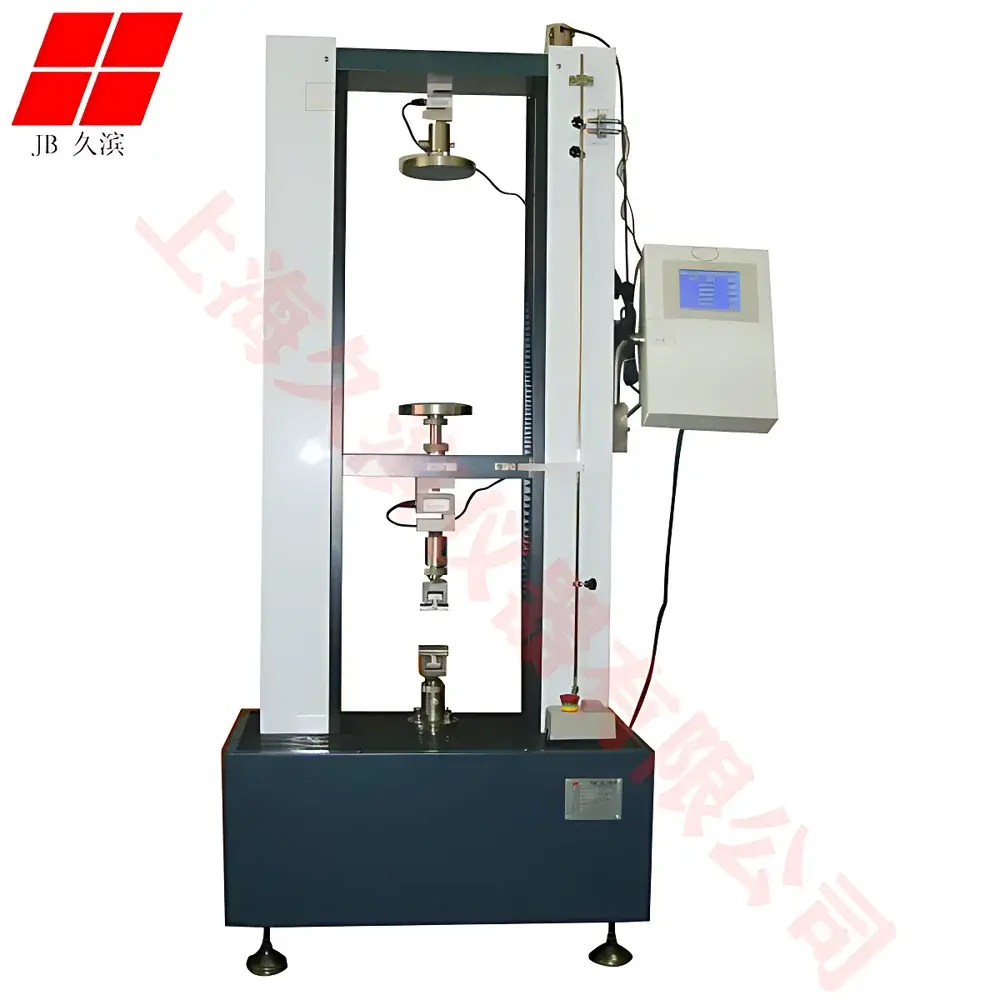
Jiubin JB-117A Honeycomb Aluminum Panel Drum Peel Tester
| Brand | Jiubin |
|---|---|
| Origin | Shanghai, China |
| Model | JB-117A |
| Instrument Type | Electromechanical Universal Testing Machine |
| Force Capacity | 5 kN (configurable up to 50 kN) |
| Drum Peel Mode | Standardized for ASTM D1781 / ISO 8510-2 |
| Force Measurement Accuracy | ±1% of reading (±0.5% optional) |
| Displacement Resolution | 0.001 mm |
| Crosshead Speed Range | 0.001–500 mm/min (adjustable in closed-loop control) |
| Vertical Travel | 600 mm (extendable to 1200 mm) |
| Safety Features | Dual-limit switches, overload cutoff, emergency stop, overcurrent/overvoltage protection |
Overview
The Jiubin JB-117A Honeycomb Aluminum Panel Drum Peel Tester is an electromechanical universal testing machine engineered specifically for standardized peel adhesion evaluation of structural sandwich composites—particularly aluminum honeycomb core panels bonded with face sheets via epoxy, phenolic, or thermoplastic adhesives. It operates on the principle of controlled crosshead displacement and high-fidelity load cell feedback, delivering traceable, repeatable force-displacement data under ISO 8510-2 (peel testing of metal-to-metal adhesive bonds) and ASTM D1781 (drum peel test for adhesives). Unlike general-purpose tensile testers, the JB-117A integrates a precision-machined rotating drum fixture that maintains constant peel angle (typically 180°) and consistent wrap geometry during dynamic separation—critical for eliminating bending moment artifacts and isolating interfacial bond strength. Its rigid C-frame architecture, servo-controlled AC motor drive, and real-time PID-regulated speed control ensure mechanical stability across low-speed peel regimes (<10 mm/min), where viscoelastic dissipation dominates failure mechanics.
Key Features
- Drum peel configuration compliant with ASTM D1781 and ISO 8510-2, including calibrated drum diameter (76.2 mm standard), axial alignment tolerance ≤ ±0.05 mm, and concentricity verification per ISO 17025 calibration protocol
- Modular load cell options: 5 kN base configuration (optional upgrade to 10/20/50 kN) with dual-range transducers enabling high-resolution measurement from 0.4% to 100% FS without range switching
- Crosshead displacement resolution of 0.001 mm, verified via laser interferometer traceability; position accuracy maintained within ±1% over full stroke (600–1200 mm extendable)
- Programmable speed profile capability: linear, ramp-hold, or multi-segment velocity sequences; minimum speed 0.001 mm/min supports quasi-static interfacial debonding analysis
- Integrated safety architecture: hardware-based dual-end limit switches, software-enforced force ceiling, automatic emergency stop activation upon overtravel or current surge
- Universal grip interface accommodating custom peel fixtures—including 90° and 180° fixed-angle jaws, pneumatic clamps for thin-gauge skins (≤0.5 mm), and low-inertia drum mounts for high-frequency cyclic peel studies
Sample Compatibility & Compliance
The JB-117A accommodates honeycomb panel specimens conforming to ASTM C273/C273M (shear properties) and MIL-STD-401 (aerospace sandwich structures), with maximum specimen width 150 mm and thickness up to 50 mm. It supports peel testing of both cured and post-cured adhesive systems—including film adhesives (e.g., FM73, Redux 312), paste adhesives (e.g., EA9394), and thermoplastic interlayers (e.g., PEI, PEEK). All mechanical measurements adhere to ISO/IEC 17025:2017 requirements for testing laboratories. Force and displacement channels are validated annually against NIST-traceable standards; system-level uncertainty budgets comply with GUM (Guide to the Expression of Uncertainty in Measurement) methodology. The instrument meets CE Machinery Directive 2006/42/EC and is designed for GLP-compliant environments requiring audit-ready calibration records and maintenance logs.
Software & Data Management
Control and analysis are executed via Jiubin TestSuite v4.2—a Windows-based platform supporting IEC 62591 (WirelessHART) and Modbus TCP interfaces for lab-wide integration. Real-time data acquisition occurs at 1 kHz sampling rate, with synchronized force, displacement, and time stamps stored in .tdms (NI Technical Data Management Streaming) format. Software modules include: (1) ASTM D1781 peel curve annotation (peak load, average peel force, energy to peel per unit width); (2) statistical batch reporting per ISO 5725; (3) 21 CFR Part 11-compliant user access control, electronic signatures, and immutable audit trails; (4) export to CSV, Excel, and PDF with embedded metadata (operator ID, calibration due date, environmental conditions). Raw data files retain full bit-depth fidelity for third-party reanalysis in MATLAB or Python-based fracture mechanics toolkits.
Applications
- Quantifying adhesive bond integrity in aircraft wing skins, radomes, and floor panels manufactured with aluminum honeycomb cores
- Evaluating thermal aging effects on peel resistance after exposure to 120°C/1000 h per RTCA DO-160 Section 25
- Comparative screening of surface pretreatment methods (e.g., chromic acid anodizing vs. plasma etching) on peel strength retention
- Validating repair bond durability per FAA AC 20-107B for field-adhesive repairs on composite-honeycomb structures
- Supporting DOE (Design of Experiments) studies on adhesive formulation variables—resin/hardener ratio, filler loading, cure cycle ramp rates
- Generating input parameters for cohesive zone modeling (CZM) in finite element simulations of delamination propagation
FAQ
What peel standards does the JB-117A natively support?
ASTM D1781 (drum peel), ISO 8510-2 (metal-to-metal peel), and ASTM D903 (180° peel) — all implemented via certified fixture geometries and software test templates.
Can the system perform cyclic peel testing?
Yes — TestSuite v4.2 enables programmable load/displacement waveforms (sine, triangle, trapezoidal) with frequency up to 5 Hz and peak-to-peak amplitude control for fatigue peel assessment.
Is third-party calibration documentation included?
Each unit ships with a factory calibration certificate traceable to CNAS-accredited metrology labs; optional UKAS or DAkkS certification available upon request.
How is specimen alignment verified prior to testing?
Integrated digital inclinometer and optical alignment guide ensure ±0.2° angular tolerance between peel direction and drum axis; alignment check procedure is embedded in pre-test workflow.
Does the system meet FDA or aerospace quality requirements?
Fully compliant with 21 CFR Part 11 for electronic records/signatures; qualified per AS9100D Annex B for aerospace testing equipment validation protocols.



