
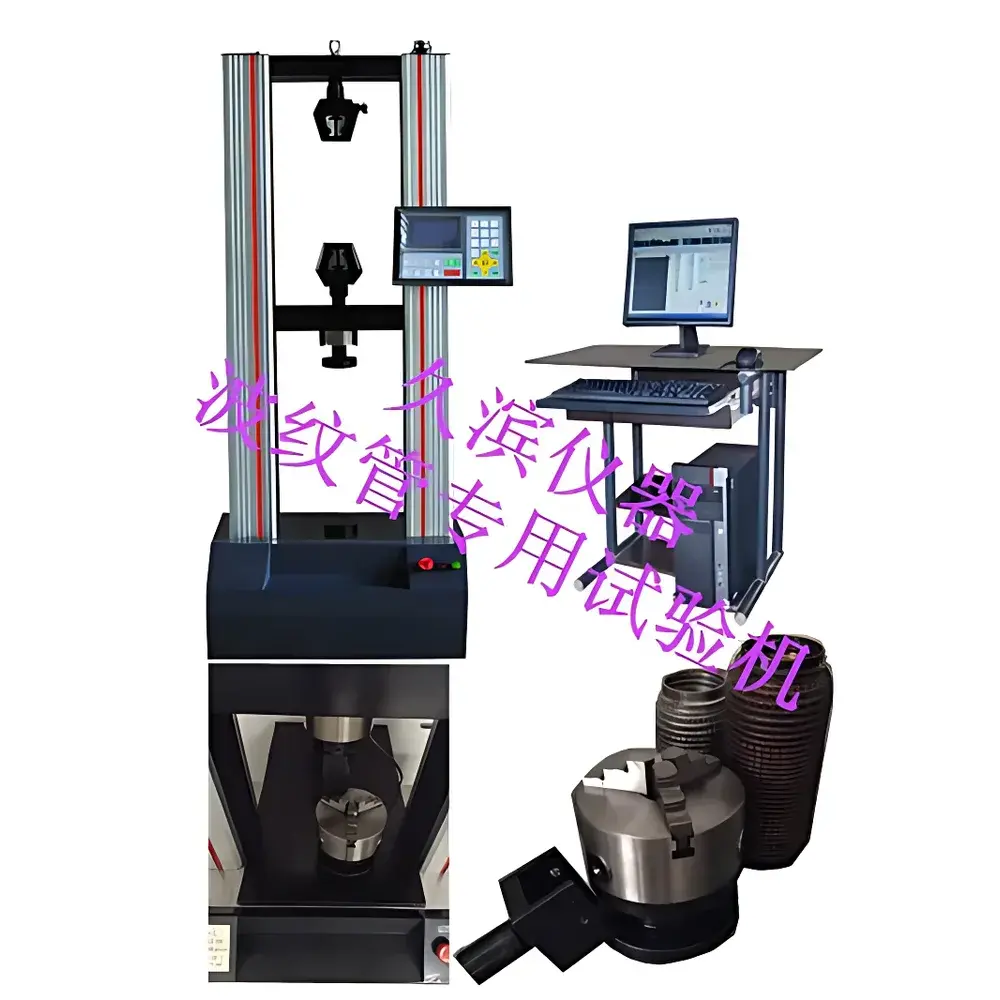
Jiubin JB-117BG Corrugated Pipe Ring Stiffness Testing Machine
| Brand | Jiubin |
|---|---|
| Origin | Shanghai, China |
| Model | JB-117BG |
| Maximum Test Load | 50 kN (customizable) |
| Accuracy Class | 0.5 |
| Load Resolution | 0.001 N |
| Speed Range | 1–500 mm/min (adjustable) |
| Effective Stroke | ~800 mm |
| Displacement Resolution | ±0.005% (Japanese encoder, 1000 P/R) |
| Load Accuracy | ±0.1% |
| Control System | Full-digital triple-closed-loop (force, deformation, displacement) |
| Power Supply | 220 V, 50 Hz |
| Dimensions (W×D×H) | 600 × 800 × 1800 mm |
| Weight | 350 kg |
Overview
The Jiubin JB-117BG Corrugated Pipe Ring Stiffness Testing Machine is a precision electromechanical testing system engineered for the standardized evaluation of ring stiffness in thermoplastic and composite corrugated pipes—primarily per ISO 9969, ASTM D2412, EN 13476-2, and GB/T 9647. It operates on the principle of controlled radial compression applied to a pipe segment mounted on two parallel steel rollers, with real-time measurement of compressive force and diametral deformation to calculate ring stiffness (kN/m²) as defined by the standard slope of the load–deformation curve within specified deformation limits (e.g., 3% or 5% of nominal diameter). The machine integrates high-fidelity load cells, optical rotary encoders for displacement feedback, and a rigid C-frame structural architecture designed to minimize frame compliance and ensure mechanical stability during long-duration creep or cyclic loading protocols. Its modular hardware architecture supports seamless integration into GLP-compliant laboratory environments and aligns with requirements for audit-ready test documentation under ISO/IEC 17025.
Key Features
- Triple-closed-loop digital control system (force, displacement, strain) based on adaptive neural PID algorithms—enabling smooth mode transitions without mechanical shock or data discontinuity.
- Full-range load capacity up to 50 kN with 0.5-class accuracy and ±0.1% load linearity; resolution of 0.001 N ensures detection of micro-yield events in thin-wall polymer pipes.
- Adjustable crosshead speed from 1 to 500 mm/min, programmable in discrete steps or continuous ramp profiles—critical for simulating installation-induced ground settlement or long-term soil loading conditions.
- Dual-display operation: synchronized real-time control via industrial-grade touchscreen panel and Windows-based PC software—both capable of independent test initiation, parameter adjustment, and emergency stop activation.
- Auto-ranging load cell with 1/500,000 internal resolution and automatic zero-point compensation before each test cycle.
- Standard USB 2.0 interface for all peripheral modules (encoder, I/O safety logic, printer), ensuring electromagnetic compatibility and plug-and-play interoperability with third-party DAQ systems.
- Integrated safety architecture including dual mechanical stroke limit switches, overload cutoff relay, earth-leakage circuit breaker, and automatic return-to-home upon test completion.
Sample Compatibility & Compliance
The JB-117BG accommodates pipe specimens with outer diameters ranging from 110 mm to 1200 mm (custom roller sets available), wall thicknesses up to 45 mm, and material classes including HDPE, PP, PVC-U, GRP, and multi-layer structured wall pipes. All test fixtures—including support rollers, loading platens, and alignment guides—are manufactured to dimensional tolerances compliant with ISO 9969 Annex A and ASTM D2412 Figure 1. The system supports pre-test calibration verification per ISO 7500-1 (static calibration) and ISO 376 (transducer verification), with traceable certificates available upon request. Software-generated reports include full metadata: operator ID, environmental conditions (optional sensor input), calibration date, test standard reference, and digital signature fields—meeting FDA 21 CFR Part 11 requirements when configured with user authentication and audit trail logging.
Software & Data Management
The proprietary Windows-based testing software provides bilingual (English/Chinese) GUI with configurable report templates aligned to ISO, ASTM, and GB standards. It delivers automated calculation of ring stiffness (SN), deformation at 3% and 5% deflection, load at specified deformation thresholds, and secant modulus. Raw data files (.csv, .txt) are stored with embedded timestamps and version-controlled metadata; all test curves support zoom, overlay comparison, derivative analysis, and export to MATLAB or Excel. The system enables batch testing with parameter inheritance across sequences, automatic archiving to network drives or local SSD partitions, and password-protected access levels (operator, supervisor, administrator). Audit trail logs record every parameter change, test start/stop event, calibration action, and user login—exportable in PDF/A format for regulatory submissions.
Applications
- Quality assurance of buried corrugated drainage and sewer pipes prior to field installation.
- Development and validation of new pipe formulations under simulated backfill loading conditions.
- Third-party certification testing for CE marking (EN 13476-2), CCC (China Compulsory Certification), and UL listing.
- Research on time-dependent behavior: creep compliance, stress relaxation, and fatigue resistance over 1000+ cycles.
- Comparative evaluation of pipe performance under combined axial compression and radial loading (with optional auxiliary fixtures).
- Verification of manufacturing consistency across production batches per ISO 2859-1 sampling plans.
FAQ
What standards does the JB-117BG comply with for ring stiffness testing?
It fully supports ISO 9969, ASTM D2412, EN 13476-2, GB/T 9647, and JIS A 5740—with built-in calculation routines matching the exact formulas and acceptance criteria defined in each document.
Can the system perform tests beyond ring stiffness—such as tensile or compression testing of pipe materials?
Yes. With interchangeable grips and platens, it functions as a general-purpose universal testing machine (UTM) for metals, polymers, composites, and geotextiles per ASTM E4, ISO 6892-1, and ISO 7438.
Is the software validated for regulated environments (e.g., pharmaceutical or aerospace QA labs)?
When deployed with optional 21 CFR Part 11 compliance package—including electronic signatures, role-based permissions, and immutable audit logs—the software meets GxP and ISO/IEC 17025 requirements.
What maintenance is required to sustain measurement accuracy?
Annual verification of load cell and encoder against NIST-traceable standards is recommended; daily zeroing and monthly mechanical inspection of roller alignment and frame rigidity are documented in the included maintenance logbook.



