
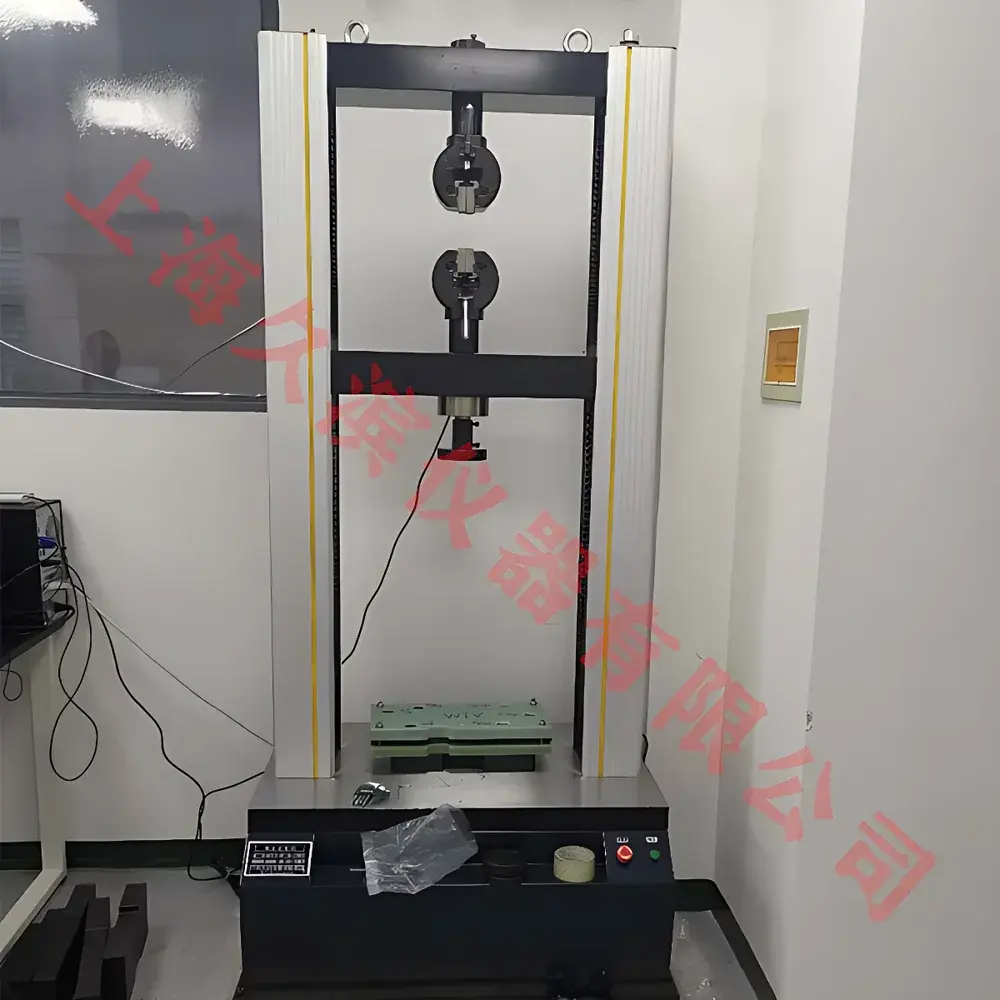
Jiubin JB-119 Dual-Column Universal Testing Machine
| Brand | Jiubin |
|---|---|
| Origin | Shanghai, China |
| Model | JB-119 |
| Instrument Type | Electromechanical Universal Testing Machine |
| Load Capacity | 0–5 kN (user-selectable) |
| Test Width | 380 mm (effective), 1000 mm (tensile span) |
| Speed Range | 0.001–500 mm/min (infinitely variable) |
| Load Accuracy | ±0.5% of full scale |
| Displacement Resolution | 1/200,000 |
| Displacement Accuracy | ±0.005% |
| Force Sensor | High-precision load cell (U.S.-sourced) |
| Drive System | Servo motor (Japan-sourced) + AC motor (Taiwan-sourced) |
| Mechanical Transmission | Precision ball screw (Taiwan-sourced) + high-strength zero-backlash screw (Korea-sourced) |
| Safety Features | Upper/lower mechanical limits, emergency stop button |
| Power Supply | 220 V / 380 V, 50 Hz |
| Net Weight | 1080–1180 kg |
| Dimensions (W×D×H) | 1280 × 950 × 1800 mm |
| Control & Display | Dual-mode — PC-based software interface + embedded microcomputer display |
| Units Supported | g, kg, N, kN, lbf, lb |
Overview
The Jiubin JB-119 Dual-Column Universal Testing Machine is an electromechanical static materials tester engineered for precision tensile, compression, flexural, peel, tear, and shear testing across industrial and R&D laboratories. Based on the fundamental principles of Hooke’s law and controlled displacement-rate loading, the system applies calibrated axial force via a servo-driven crosshead while continuously measuring load and displacement in real time. Its dual-column rigid frame ensures minimal deflection under load—critical for maintaining ASTM E4 and ISO 7500-1 Class 1 compliance during high-force testing up to 5 kN. Designed for repeatable mechanical property characterization, the JB-119 supports standardized test methods including ASTM D638 (tensile properties of plastics), ASTM D790 (flexural properties), ISO 179 (Charpy impact), and GB/T 228.1 (metal tensile testing). The machine operates within ambient laboratory conditions (10–35 °C, ≤80% RH) and meets electromagnetic compatibility requirements per IEC 61326-1.
Key Features
- Rigid dual-column structural architecture with reinforced steel base and vertical uprights, minimizing frame compliance and enhancing test reproducibility.
- High-resolution force measurement using a U.S.-manufactured precision load cell, delivering ±0.5% full-scale accuracy traceable to NIST standards.
- Infinitely variable speed control from 0.001 to 500 mm/min, enabled by a Japan-sourced servo motor and matched with dual transmission options: Taiwan-sourced precision ball screw and Korea-sourced zero-backlash lead screw.
- Dual-display operation mode: Embedded microcomputer panel for standalone setup and real-time monitoring, plus Windows-compatible PC software for advanced data acquisition and analysis.
- Comprehensive safety system including upper/lower mechanical limit switches, hardware-triggered emergency stop circuitry, and automatic load cutoff upon specimen failure.
- Modular fixture interface supporting interchangeable grips—flat-faced, wedge-action, pneumatic, or custom-designed—compatible with ISO 26203-compliant mounting standards.
- Displacement resolution of 1 part in 200,000 and positional accuracy of ±0.005%, ensuring reliable strain quantification for modulus and elongation-at-break calculations.
Sample Compatibility & Compliance
The JB-119 accommodates specimens ranging from thin polymer films (≥0.05 mm thickness) to metallic rods (≤25 mm diameter) and composite laminates (up to 380 mm wide). Its 1000 mm maximum tensile span enables ASTM D3039-compliant testing of fiber-reinforced composites, while the 380 mm effective test width supports multi-specimen arrays for QA batch verification. All firmware and software modules are designed to support audit-ready documentation workflows aligned with GLP and GMP environments. Data integrity safeguards include user-access levels, electronic signatures, and optional 21 CFR Part 11–compliant software packages for regulated pharmaceutical and medical device manufacturing.
Software & Data Management
The integrated testing software provides real-time graphical display of stress–strain, load–displacement, and time-based curves. Users can define multi-step test profiles—including preload, ramp-to-load, dwell, and cyclic protocols—with programmable trigger conditions (e.g., yield point detection, % elongation halt). Raw data exports to CSV, Excel, or XML formats; curve overlays enable comparative analysis across material lots or process variations. Reporting templates comply with ISO 14289-1 (PDF/A) archival standards, and all test logs retain metadata such as operator ID, calibration timestamp, environmental readings, and instrument configuration parameters. Optional extensions support automated report generation with company branding, digital signature embedding, and database synchronization via ODBC or SQL Server connectors.
Applications
- Mechanical validation of thermoplastics, elastomers, and biopolymers per ISO 527 and ASTM D882.
- Tensile strength and Young’s modulus determination for aluminum alloys, stainless steels, and copper foils per ASTM E8/E8M.
- Peel adhesion testing of pressure-sensitive tapes and laminated packaging per ASTM D903 and ISO 8510-2.
- Three-point bending evaluation of ceramic substrates and printed circuit boards per IPC-TM-650 2.4.1.
- Quality conformance checks for automotive fasteners, textile seams, and footwear components under ISO 13934-1 and EN ISO 12947.
- Process development support for extrusion, molding, and coating operations through correlation of mechanical performance with rheological and thermal history data.
FAQ
What load capacities does the JB-119 support, and how is capacity selected?
The JB-119 is configured for a maximum nominal capacity of 5 kN. Users select the operational range (e.g., 500 N, 2 kN, or 5 kN) via software scaling—no hardware changes required. Each range maintains ±0.5% linearity and repeatability per ISO 7500-1.
Is the system compliant with international calibration and traceability standards?
Yes. The load cell is factory-calibrated against NIST-traceable deadweight standards, and the system supports periodic verification per ISO/IEC 17025-accredited procedures. Calibration certificates include uncertainty budgets and environmental correction factors.
Can the JB-119 be integrated into an existing LIMS or MES environment?
Absolutely. The software SDK supports RESTful API integration, OPC UA connectivity, and direct database writes. Prebuilt adapters are available for LabWare LIMS, Thermo Fisher SampleManager, and Siemens Opcenter Execution.
What maintenance intervals are recommended for long-term accuracy?
Biannual verification of load cell linearity and crosshead alignment is advised. Annual recalibration—including displacement encoder verification and screw preload assessment—is recommended for GLP/GMP-regulated use. Preventive maintenance kits and OEM-certified service contracts are available.
Does the system support high-speed dynamic testing or fatigue cycles?
No. The JB-119 is optimized for quasi-static mechanical testing only. For cyclic or high-frequency fatigue applications, we recommend the Jiubin JB-FS series servo-hydraulic testers, which operate up to 100 Hz with closed-loop strain control.



