
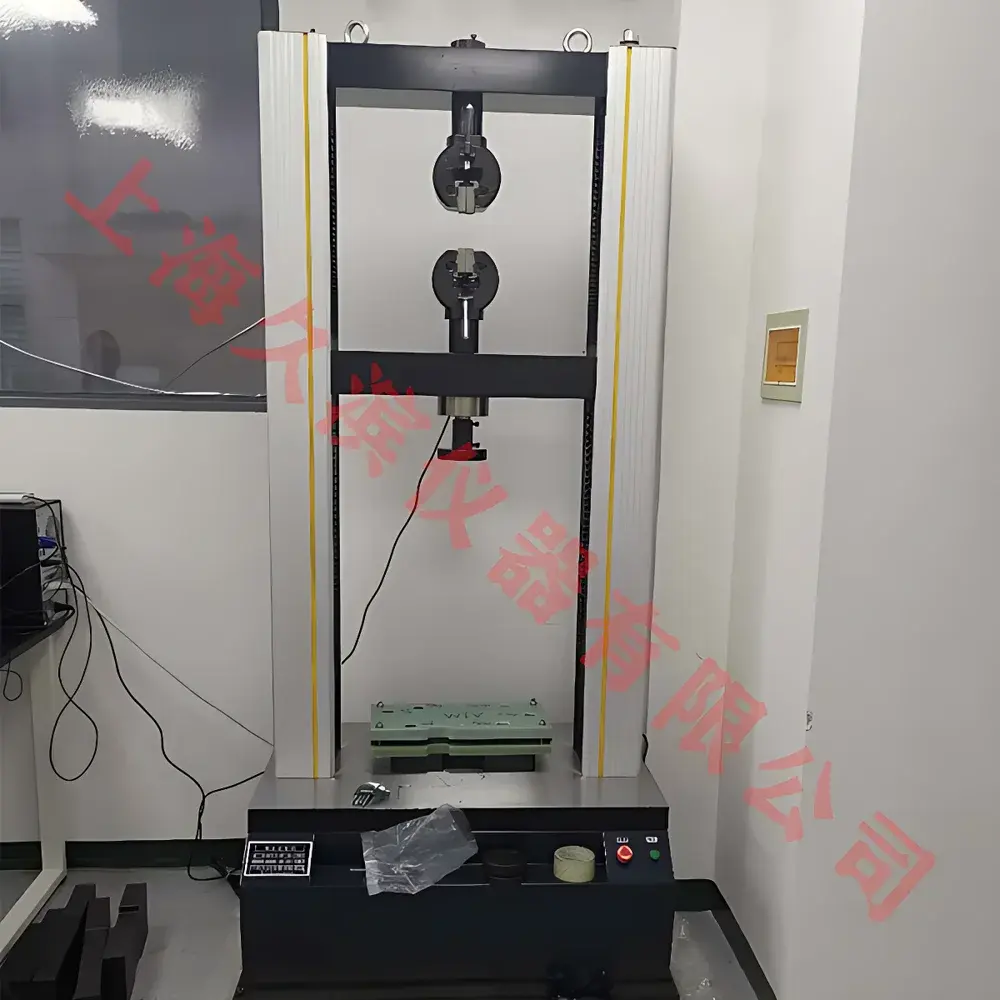
Jiubin JB-119A Servo-Controlled Universal Testing Machine
| Brand | Jiubin Instruments |
|---|---|
| Origin | Shanghai, China |
| Manufacturer Type | Authorized Distributor |
| Country of Origin | China |
| Model | JB-119A |
| Instrument Type | Electromechanical Universal Testing Machine |
| Maximum Test Load | 200 kN |
| Accuracy Class | Class 1 (ISO 7500-1 / ASTM E4 compliant) |
| Speed Range | 0.001–500 mm/min |
| Load Cell Accuracy | ±0.01% FS |
| Displacement Resolution | 0.005% (encoder-based, 1000 P/R) |
| Effective Stroke | ~1000 mm |
| Position Resolution | 0.001 N (force), 0.001 mm (displacement) |
| Drive System | Panasonic AC servo motor |
| Mechanical Transmission | Precision preloaded ball screw (Korean origin) |
| Control Architecture | Dual-mode — PC-based full digital control + standalone microprocessor touchscreen interface |
| Software | Bilingual (English/Chinese) GUI with audit trail, data export (CSV, PDF, XML), and GLP-compliant reporting |
| Power Supply | 380 V AC, 3-phase |
| Dimensions (W×D×H) | 1280 × 950 × 1800 mm |
| Weight | 1180 kg |
| Standard Compliance | ISO 7500-1, ASTM E4, ASTM D638, ASTM D790, ASTM D3410, ISO 527, ISO 178, ISO 6892-1 |
Overview
The Jiubin JB-119A Servo-Controlled Universal Testing Machine is a high-precision electromechanical system engineered for static mechanical characterization of metallic and non-metallic materials under tension, compression, bending, peel, shear, and flexural loading conditions. Built upon a rigid落地-frame architecture with preloaded Korean-sourced ball screws and a Panasonic AC servo drive, the JB-119A delivers stable force application across its full 200 kN capacity range. Its measurement core integrates a Class 1 load cell (per ISO 7500-1 and ASTM E4), optical encoder-based displacement feedback (1000 pulses/revolution), and real-time digital signal processing to ensure traceable, reproducible results. Designed for routine QC laboratories and R&D environments, the system supports standardized test methods including ISO 6892-1 (tensile testing of metals), ISO 527 (plastics), ASTM D638 (tensile properties of plastics), and ASTM D790 (flexural properties). The dual-control architecture—comprising both a Windows-based software suite and an embedded touchscreen HMI—enables operational flexibility without dependency on external computing infrastructure.
Key Features
- 200 kN maximum load capacity with ±0.01% full-scale force accuracy and 0.001 N resolution
- Wide speed range: 0.001–500 mm/min, continuously adjustable via closed-loop servo control
- High-rigidity frame with precision-ground ball screw transmission (Korean origin) and zero-backlash coupling
- Dual independent control modes: full-featured PC software interface + standalone microprocessor-driven touchscreen panel
- Bilingual (English/Chinese) software with configurable report templates, user-level access controls, and electronic signature support
- Audit-trail-enabled data acquisition compliant with GLP and FDA 21 CFR Part 11 requirements (when configured with user authentication and event logging)
- Auto-ranging load measurement system with 1/300,000 internal resolution and dynamic calibration verification
- Integrated thermal-stable load cell amplifier and shielded analog signal path to minimize noise and drift
- Modular fixture interface supporting ASTM-standard grips, wedge-action clamps, bend fixtures, peel jigs, and custom adapters
Sample Compatibility & Compliance
The JB-119A accommodates specimens ranging from thin polymer films (<0.05 mm) to structural steel coupons (up to 50 mm thick), provided within the machine’s effective stroke (~1000 mm) and jaw opening constraints. It is routinely deployed for testing metallic alloys (stainless steels, bearing steels, spring steels), composites (CFRP, GFRP), elastomers (rubber, TPE), textiles, packaging materials (adhesive tapes, laminates), and biomedical polymers. All mechanical and electrical subsystems conform to CE marking requirements (2014/30/EU EMC Directive and 2006/42/EC Machinery Directive). Force and displacement measurements are validated per ISO 7500-1:2018 (static calibration) and ISO 9513:2012 (extensometer verification). Software functionality aligns with ALCOA+ principles for data integrity when operated under documented SOPs and enabled audit-trail settings.
Software & Data Management
Jiubin’s proprietary UTM Control Suite v4.x provides real-time graphical display of stress–strain, load–displacement, and time-based curves, with synchronized multi-channel data logging (load, position, strain if extensometer-equipped, temperature if optional sensor integrated). Raw datasets are stored in encrypted binary format with metadata tagging (operator ID, timestamp, test standard, environmental conditions). Export options include CSV (for Excel/Python analysis), PDF (formatted reports with logo, signature fields, and pass/fail flags), and XML (LIMS-compatible structured output). The software supports method templates aligned with ASTM, ISO, and GB standards; automatic calculation of yield strength (0.2% offset), ultimate tensile strength, modulus, elongation at break, and Poisson’s ratio. Role-based user accounts enforce separation of duties (e.g., operator vs. administrator), while change logs record all parameter modifications and test result overrides.
Applications
- Mechanical validation of aerospace-grade aluminum and titanium alloys per AMS and MIL-STD specifications
- Quality control of automotive gaskets, brake pads, and composite body panels under ISO 14125
- Characterization of biodegradable packaging films (PLA, PHA) for tensile strength and tear resistance (ASTM D882)
- Compression testing of pharmaceutical tablets (USP ) and hydrogel wound dressings
- Peel adhesion assessment of medical device laminates (ISO 8510-2) and EV battery module thermal interface materials
- Flexural modulus determination of fiber-reinforced polymer (FRP) bridge decks (ASTM D7264)
- Routine certification of fasteners, springs, and structural welds per EN 10002-1 and ISO 6892-1
FAQ
What international standards does the JB-119A comply with for force calibration?
The system meets ISO 7500-1:2018 Class 1 requirements and ASTM E4-23 for static force verification, with annual recalibration traceable to NIM (China) or NIST-equivalent national metrology institutes.
Can the JB-119A be integrated into a laboratory LIMS environment?
Yes—via TCP/IP or RS-232 serial communication using ASCII or XML protocol profiles; custom API integration is supported under extended service agreement.
Is an extensometer available as an option?
Yes—contact-type and non-contact video extensometers (with sub-pixel resolution) are available as factory-installed accessories, calibrated per ISO 9513.
Does the software support 21 CFR Part 11 compliance?
When deployed with network authentication, electronic signatures, and audit-trail logging enabled, the software satisfies core Part 11 requirements for closed systems; full validation documentation (IQ/OQ/PQ) is available upon request.
What is the recommended maintenance schedule?
Preventive maintenance every 12 months includes ball screw lubrication, load cell zero-drift verification, encoder alignment check, and safety interlock functional testing—per Jiubin’s PM-UTM-01 procedure.



