
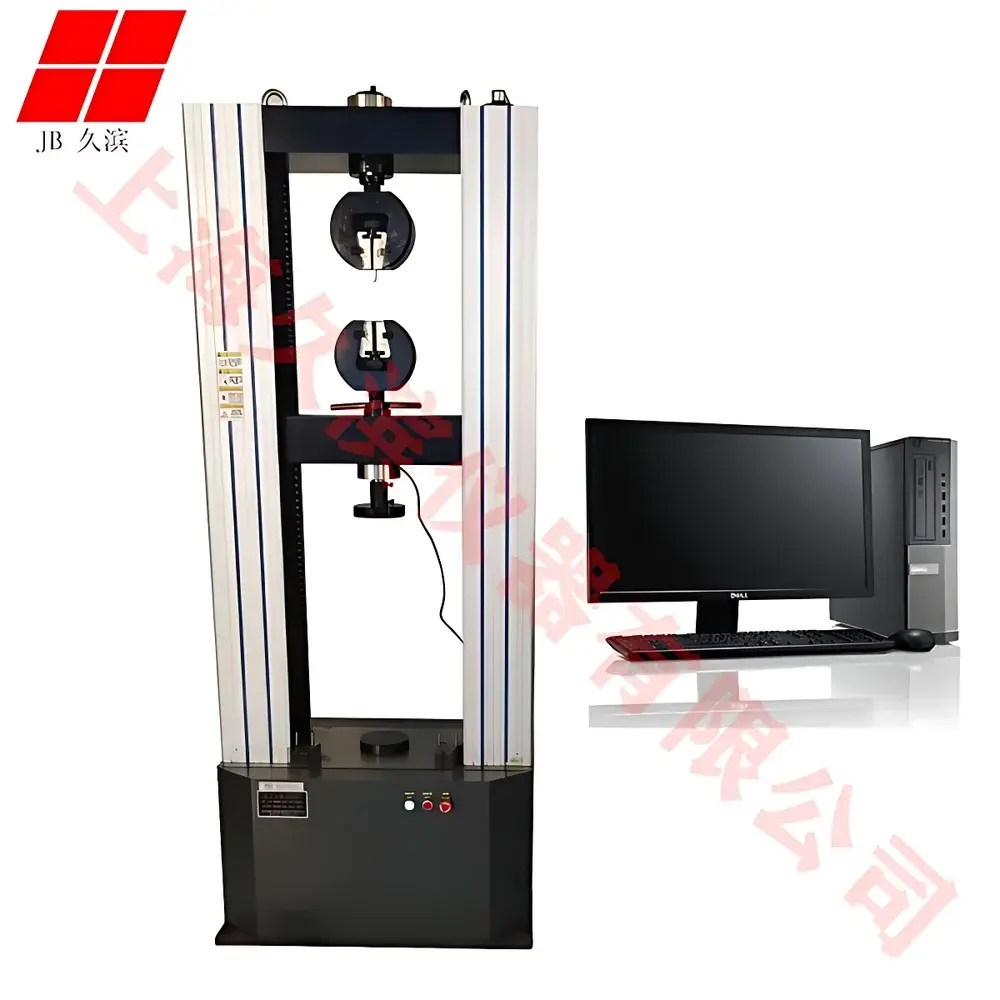
Jiubin JB-119A Single-Column Digital Tensile Testing Machine
| Brand | Jiubin |
|---|---|
| Origin | Shanghai, China |
| Model | JB-119A |
| Instrument Type | Electronic Universal Testing Machine |
| Category | Physical Property Testing Instrument |
Overview
The Jiubin JB-119A Single-Column Digital Tensile Testing Machine is an entry-level electronic universal testing system engineered for precision mechanical property evaluation of elastomeric and polymeric materials—particularly vulcanized rubber compounds, thermoplastic elastomers, rubber sheets, and molded rubber components. It operates on the fundamental principle of controlled uniaxial force application via a servo-controlled DC motor-driven lead screw mechanism, with real-time load measurement using high-stability strain-gauge-based load cells and displacement tracking via optical encoder feedback. Designed to ASTM D412, ISO 37, GB/T 528, and GB/T 1040.2 standards, the JB-119A delivers repeatable tensile strength, elongation at break, modulus (e.g., M100, M300), and stress–strain curve generation under quasi-static loading conditions (typically 0.1–500 mm/min crosshead speed range). Its single-column architecture ensures compact footprint and rigidity suitable for laboratory benchtop deployment in QC labs, R&D centers, and academic teaching environments.
Key Features
- Single-column rigid aluminum alloy frame with precision-ground vertical guide rails and preloaded ball screws for minimal deflection and high axial alignment accuracy
- Digital load cell with dual-range capability (e.g., 50 N / 500 N or 100 N / 1 kN configurations) offering ±0.5% full-scale accuracy per ASTM E4 calibration traceability
- Microprocessor-based digital controller with integrated 32-bit ARM core, enabling real-time closed-loop control of crosshead position, load, or strain
- Backlit LCD display with intuitive menu navigation, direct parameter input (test speed, preload, break detection threshold), and on-screen curve preview
- Standard extensometer interface (optional clip-on or non-contact video extensometer compatible) for accurate strain measurement independent of grip slippage
- Modular grip system supporting pneumatic, wedge, or manual screw-type grips—configurable for dumbbell, ring, or strip specimens per ISO 37 Type 1/2 or ASTM D412 Die C geometries
Sample Compatibility & Compliance
The JB-119A accommodates standard rubber test specimens conforming to ISO 37 (dumbbell-shaped, thickness 2.0 ± 0.2 mm), ASTM D412 (Die C, width 6.0 ± 0.1 mm), and GB/T 528 (Type I, gauge length 25 mm). It supports tensile testing of cured rubber sheets, extruded profiles, O-rings, hose sections, and adhesive-bonded lap joints. The system complies with essential regulatory and quality framework requirements for routine material verification: it meets mechanical safety provisions of ISO 12100, incorporates emergency stop circuitry per IEC 60204-1, and supports documentation practices aligned with GLP (Good Laboratory Practice) and internal QA procedures. While not FDA 21 CFR Part 11–validated out-of-the-box, audit-ready test reports—including operator ID, timestamp, environmental conditions (ambient temperature/humidity logged manually), and raw data export—can be generated for GMP-relevant rubber component qualification in pharmaceutical packaging or medical device manufacturing.
Software & Data Management
The JB-119A includes PC-based data acquisition software (Windows-compatible, USB or RS232 interface) that captures load vs. displacement at ≥100 Hz sampling rate. Software features include automatic yield point detection (0.2% offset method), tangent modulus calculation, hysteresis loop analysis for cyclic loading (with optional return-to-zero function), and customizable report templates compliant with ISO 5893 formatting conventions. Raw ASCII .txt and Excel (.xlsx) exports support third-party statistical process control (SPC) integration. All test records retain immutable metadata (test date/time, operator, machine ID, calibration certificate number), enabling traceability for internal audits or supplier qualification reviews. Firmware updates are delivered via secure USB flash drive—no cloud dependency or internet connectivity required.
Applications
- Quality control of raw rubber compounds and masterbatches across tire, automotive sealing, and industrial rubber goods production
- Evaluation of aging effects (heat, ozone, UV exposure) on vulcanizate mechanical integrity per ASTM D573 and ISO 188
- Comparative assessment of filler dispersion efficiency (e.g., carbon black vs. silica) via stress–strain profile shifts
- Teaching tensile mechanics principles in polymer science and materials engineering curricula at universities including Tsinghua, SJTU, and Fudan
- Supplier qualification testing for rubber gaskets, vibration dampers, and medical tubing per USP extractables compatibility screening protocols
- Supporting failure analysis workflows in automotive Tier-1 suppliers (e.g., BYD, Geely, Chery) for rubber bushing and suspension component validation
FAQ
What is the maximum test speed supported by the JB-119A?
The standard configuration offers a crosshead speed range of 0.05–500 mm/min, adjustable in 0.01 mm/min increments.
Does the system include calibration certification?
Yes—a factory-issued calibration certificate traceable to CNAS-accredited national standards is provided with each unit.
Can the JB-119A perform compression or flexural tests?
Compression testing is possible with optional platens and load cell reorientation; however, flexural testing (e.g., ASTM D790) is not recommended due to structural limitations of the single-column design.
Is the software compatible with LIMS integration?
Raw data export in CSV and Excel formats enables manual import into most LIMS platforms; API-based automation requires custom middleware development.
What maintenance is required for long-term accuracy?
Annual recalibration of the load cell and encoder system is recommended; periodic cleaning of guide rails and lubrication of the lead screw per manufacturer’s maintenance schedule ensures repeatability.



