
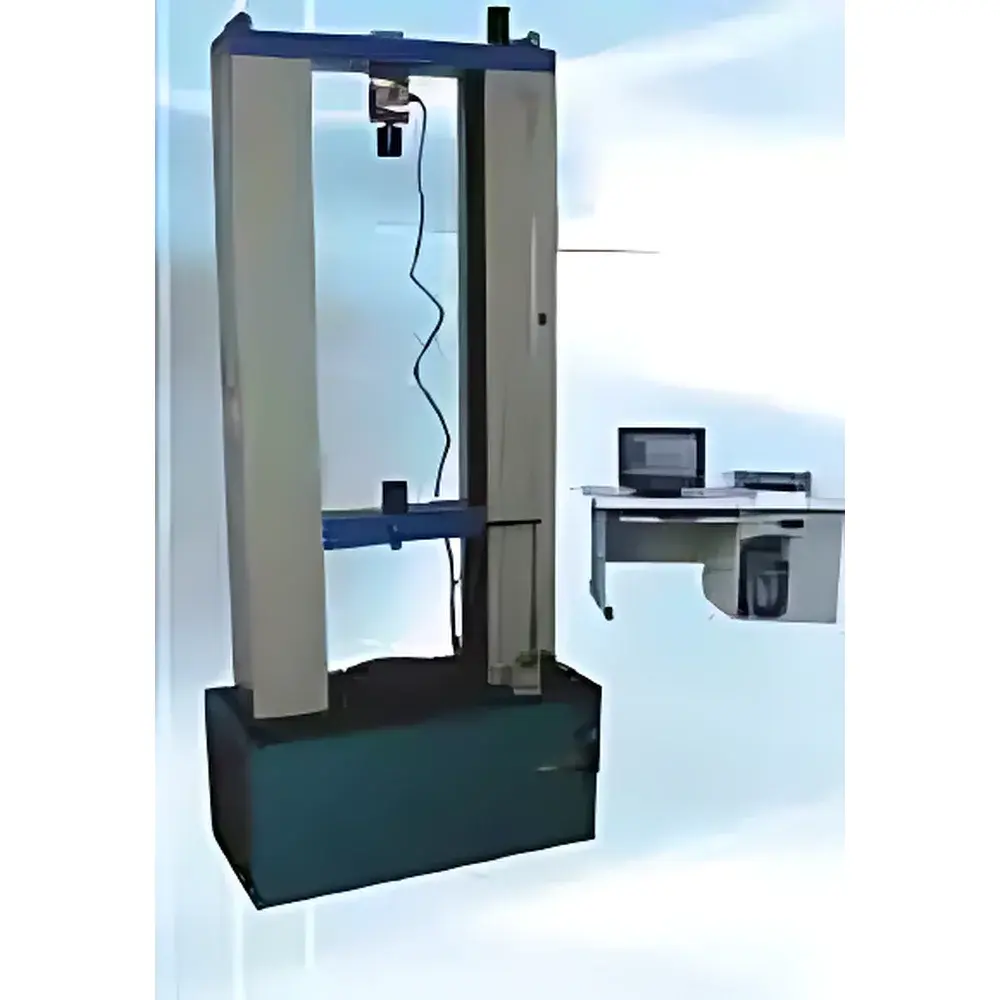
Jiubin JB-119A Universal Tensile Testing Machine for Metals and Alloys
| Brand | Jiubin (JByq) |
|---|---|
| Origin | Taiwan |
| Model | JB-119A |
| Load Capacity | 0–20 kN (user-selectable) |
| Force Accuracy | ±0.5% of full scale |
| Effective Test Width | 380 mm |
| Max. Traverse Travel | 1000 mm |
| Test Speed Range | 0.001–500 mm/min (infinitely variable) |
| Displacement Resolution | 1/200,000 |
| Displacement Accuracy | ±0.005% of reading |
| Drive System | Servo motor (Japan) + AC motor (Taiwan) |
| Mechanical Transmission | Precision preloaded ball screw (Taiwan) + high-strength zero-backlash lead screw (Korea) |
| Load Cell | High-accuracy strain-gauge transducer (USA-made) |
| Safety Features | Upper/lower mechanical limits, emergency stop button |
| Display Interface | Dual-mode — PC-based software + embedded microcomputer display |
| Power Supply | 220 V / 380 V, 50 Hz |
| Net Weight | 1180 kg |
| Dimensions (W×D×H) | 1280 × 950 × 1800 mm |
| Unit Options | g, kg, N, kN, lbf, ozf |
Overview
The Jiubin JB-119A Universal Tensile Testing Machine is an electromechanical static testing system engineered for precision mechanical property evaluation of metallic materials, alloy specimens, fasteners (e.g., screws, bolts, rivets), and structural components. It operates on the fundamental principle of uniaxial force application under controlled displacement or load rate, conforming to standardized test methodologies defined in ASTM E4, ASTM E8/E8M, ISO 6892-1, and GB/T 228.1. The machine integrates a rigid dual-column frame architecture with high-stiffness kinematic transmission—featuring preloaded ball screws and zero-backlash lead screws—to ensure minimal deflection, repeatable load train alignment, and long-term metrological stability. Designed for laboratory and quality control environments, it supports both manual and fully automated test execution, delivering traceable force-displacement data essential for material certification, process validation, and failure analysis.
Key Features
- High-fidelity force measurement using a calibrated, USA-manufactured strain-gauge load cell with ±0.5% full-scale accuracy and 1/200,000 internal resolution.
- Infinitely variable speed control from 0.001 to 500 mm/min, enabling compliance with low-strain-rate creep protocols and high-speed rupture testing per ISO 15630-1.
- Dual-display operation: real-time synchronized readouts via embedded microcomputer interface and Windows-based PC software—supporting multi-channel data logging at ≥100 Hz sampling rate.
- Robust mechanical design incorporating Japanese servo motors, Taiwanese AC drive units, and Korean high-strength lead screws—optimized for durability under cyclic loading and extended service life.
- Comprehensive safety architecture including dual mechanical end-limit switches, redundant emergency stop circuitry, and programmable overload cutoff thresholds.
- Modular fixture compatibility: standard wedge-action grips for metallic rods/wires, plus optional pneumatic, hydraulic, or custom-designed fixtures for threaded fasteners, sheet metal, and composite laminates.
Sample Compatibility & Compliance
The JB-119A accommodates specimens ranging from M2–M24 metric screws and ASTM F606-compliant fasteners to flat tensile bars (up to 380 mm wide), round rods (≤25 mm diameter), and sheet metal coupons (0.1–6 mm thickness). Its 20 kN capacity aligns with ISO 898-1 mechanical property requirements for property class 8.8 through 12.9 steel fasteners. All hardware and firmware comply with CE Machinery Directive 2006/42/EC, and software architecture supports audit-ready data integrity per FDA 21 CFR Part 11 when configured with electronic signature modules and time-stamped event logs. Calibration certificates are traceable to NIST or national metrology institutes (e.g., ITRI in Taiwan).
Software & Data Management
The included Windows-native testing software provides ISO/IEC 17025-aligned test sequence definition, real-time curve overlay (up to 16 concurrent tests), and automated calculation of yield strength (Rp0.2), ultimate tensile strength (Rm), elongation at break (A50mm), reduction of area (Z), and modulus of elasticity (E). Raw data exports to CSV, Excel, and XML formats; PDF reports include configurable headers, specimen metadata, environmental conditions, and statistical summaries (mean, SD, CV%). Optional GLP/GMP add-ons enable user role-based access control, electronic signatures, and immutable audit trails for regulated manufacturing environments.
Applications
- Tensile characterization of stainless steel, aluminum alloys, titanium grades, and nickel-based superalloys per ASTM B557 and ISO 6892-2.
- Mechanical verification of cold-formed and heat-treated screws, bolts, and anchor fasteners against ISO 898-1, DIN 267-4, and SAE J429 specifications.
- Compression testing of sintered metal parts, bearing cages, and powder metallurgy components.
- Three-point bending evaluation of thin-walled tubing, extruded profiles, and brazed joints per ASTM D790.
- Shear strength assessment of riveted assemblies, spot welds, and adhesive-bonded lap joints using custom shear fixtures.
- Quality conformance testing in automotive Tier-1 supplier QC labs, aerospace component manufacturers, and metal fabrication facilities.
FAQ
What standards does the JB-119A support for metallic fastener testing?
It complies with ISO 898-1 (mechanical properties of bolts/screws), ASTM F606 (testing of fasteners), and DIN EN ISO 898-2 (nuts), with configurable test sequences for proof load, tensile strength, and hardness correlation.
Can the system perform automatic yield point detection?
Yes—the software implements ASTM E8-defined offset methods (Rp0.2), automatic upper/lower yield identification per ISO 6892-1 Annex C, and tangent modulus analysis for non-yielding alloys.
Is calibration documentation provided with shipment?
Each unit ships with a factory calibration certificate traceable to ITRI (Taiwan) or NIST (USA), including as-tested force accuracy, displacement linearity, and speed verification data across five points in the operating range.
What maintenance intervals are recommended for long-term accuracy?
Load cell recalibration every 12 months or after 10,000 test cycles; ball screw lubrication every 6 months; annual verification of encoder resolution and mechanical alignment per ISO 7500-1 Class 1 requirements.
Does the software support multi-user environments with permission levels?
Yes—administrator, operator, and reviewer roles can be assigned; password policies, session timeouts, and change logs meet ISO/IEC 17025 clause 7.7 and FDA 21 CFR Part 11 Subpart B requirements.



