
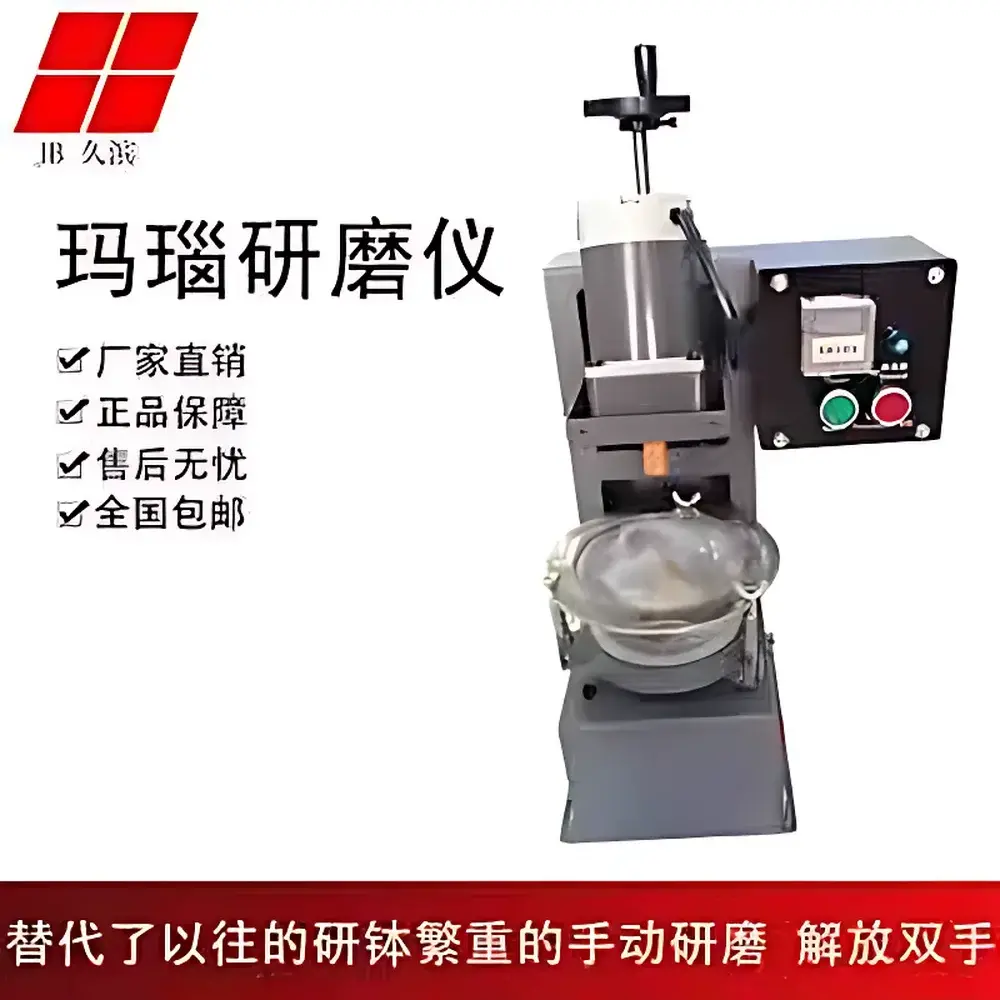
Jiubin JB-120 Automatic Agate Mortar Grinder
| Brand | Jiubin |
|---|---|
| Model | JB-120 |
| Type | Laboratory Mortar Grinder |
| Sample Compatibility | Hard, brittle solids |
| Output Particle Size | 0.01–0.5 mm |
| Mortar Diameter | 120 mm |
| Mortar Depth | 34 mm |
| Pestle Rotation Speed | 20–90 rpm |
| Mortar Rotation Speed | 10 rpm |
| Pestle Motor Power | 25 W |
| Mortar Motor Power | 10 W |
| Grinding Time Range | 1–900 min |
| Dimensions (L×W×H) | 240 × 240 × 500 mm |
| Weight | 12 kg |
| Voltage | 110/220 V, 50/60 Hz |
| Construction Material | Natural Agate (mortar and pestle) |
| Compliance | Designed for GLP-compliant labs |
Overview
The Jiubin JB-120 Automatic Agate Mortar Grinder is an electromechanically controlled, precision grinding instrument engineered for reproducible, contamination-free micronization of hard, brittle solid samples. Unlike conventional manual mortars or high-energy ball mills, the JB-120 employs a dual-axis, geometrically optimized agate-on-agate grinding mechanism based on controlled conical motion—where the agate pestle rotates at variable speed (20–90 rpm) along a fixed tilt angle while the agate mortar rotates slowly (10 rpm) about its vertical axis. This coaxial yet angular kinematic configuration generates uniform compressive shear stress across the entire sample bed, enabling consistent particle size reduction without localized overheating or amorphization. The system operates without lubricants or metallic contact, preserving sample purity—a critical requirement for semiconductor powders, pharmaceutical actives, and ultra-high-purity electronic ceramics. Its design conforms to fundamental principles of mechanical comminution theory, specifically adapted for low-impact, high-uniformity grinding where chemical inertness and surface smoothness are non-negotiable.
Key Features
- Natural agate mortar (Ø120 mm, depth 34 mm) and matching agate pestle—chemically inert, non-porous, and exceptionally wear-resistant for extended service life and zero cross-contamination.
- Independent dual-motor drive system: separate 25 W pestle motor and 10 W mortar motor enable precise decoupling of rotational parameters for process optimization.
- Programmable grinding time (1–900 minutes) with digital timer and automatic shutdown—supports unattended operation during overnight or multi-step protocols.
- Spring-loaded pestle head ensures constant normal force against the mortar’s hemispherical base, maintaining optimal contact pressure regardless of minor wear or thermal expansion.
- Compact footprint (240 × 240 × 500 mm) and low mass (12 kg) facilitate integration into fume hoods, gloveboxes, or cleanroom benchtops without structural reinforcement.
- Universal power input (110/220 V, 50/60 Hz) with internal voltage regulation—certified for use in North America, EU, and APAC laboratory environments.
Sample Compatibility & Compliance
The JB-120 is validated for grinding materials with Mohs hardness up to 7, including silicon carbide, fused alumina, quartz, iodine crystals, crystalline sugars, and pharmaceutical excipients. It is unsuitable for ductile metals, polymers, or hydrated gels. All wetted components are 100% natural agate—free of binders, fillers, or synthetic resins—ensuring compliance with USP , EP 2.9.19, and ISO 8502-3 for particulate testing sample preparation. When used as a pre-analytical step prior to laser diffraction (ISO 13320) or SEM-EDS analysis, the JB-120 delivers statistically representative sub-samples with narrow D10–D90 distributions. Instrument logs (grinding time, motor status) support GLP documentation; though not inherently 21 CFR Part 11 compliant, it integrates seamlessly with LIMS-controlled workflows via external timestamped logging.
Software & Data Management
The JB-120 operates via a dedicated front-panel control interface with LED display—no embedded software, drivers, or cloud connectivity. This architecture eliminates firmware vulnerabilities, OS dependencies, or validation overhead associated with computer-linked systems. All operational parameters (start time, duration, motor engagement status) are manually recorded or captured via external lab notebooks or ELN entries. For regulated environments, users may pair the unit with time-stamped video monitoring or integrate it into automated sample-handling platforms using dry-contact relay outputs (optional accessory). No proprietary file formats or data export functions are implemented—consistent with ICH GCP Annex 11 principles for “simple instruments with minimal data generation.”
Applications
- Preparation of reference standards for XRD phase analysis—especially for nanocrystalline diamond abrasives (0.01–0.1 mm) requiring minimal lattice distortion.
- Size reduction of photovoltaic-grade silicon feedstock prior to trace metal assay (ICP-MS), avoiding stainless-steel contamination from planetary mills.
- Homogenization of herbal extracts and botanical APIs where thermal degradation must be avoided—grinding temperature rise remains below 8 °C under standard 5-min cycles.
- Routine particle size conditioning for tablet formulation studies, supporting QbD-based DOE on dissolution rate variability.
- Production of calibration slurries for dynamic image analysis (ISO 13322-2) and sedimentation field-flow fractionation (SdFFF).
FAQ
Is the JB-120 suitable for cryogenic grinding?
No. The agate components are not rated for thermal shock below –20 °C; condensation or thermal fracture may occur.
Can I replace the agate mortar with a zirconia or tungsten carbide version?
No. The mechanical design, torque profile, and kinematic alignment are calibrated exclusively for natural agate’s density (2.6 g/cm³) and elastic modulus (~70 GPa). Substitution invalidates performance specifications.
What maintenance is required?
Monthly visual inspection of pestle spring tension and mortar surface integrity; cleaning with ethanol or acetone followed by nitrogen purge—no lubrication or recalibration needed.
Does the unit include safety interlocks?
Yes. The lid-mounted microswitch disables both motors when opened mid-cycle, and thermal cutoffs protect both motors at >75 °C winding temperature.
How is particle size distribution verified post-grinding?
Users must employ orthogonal downstream characterization (e.g., laser diffraction per ISO 13320 or static image analysis per ISO 9276-2); the JB-120 itself provides no in situ particle measurement capability.



