
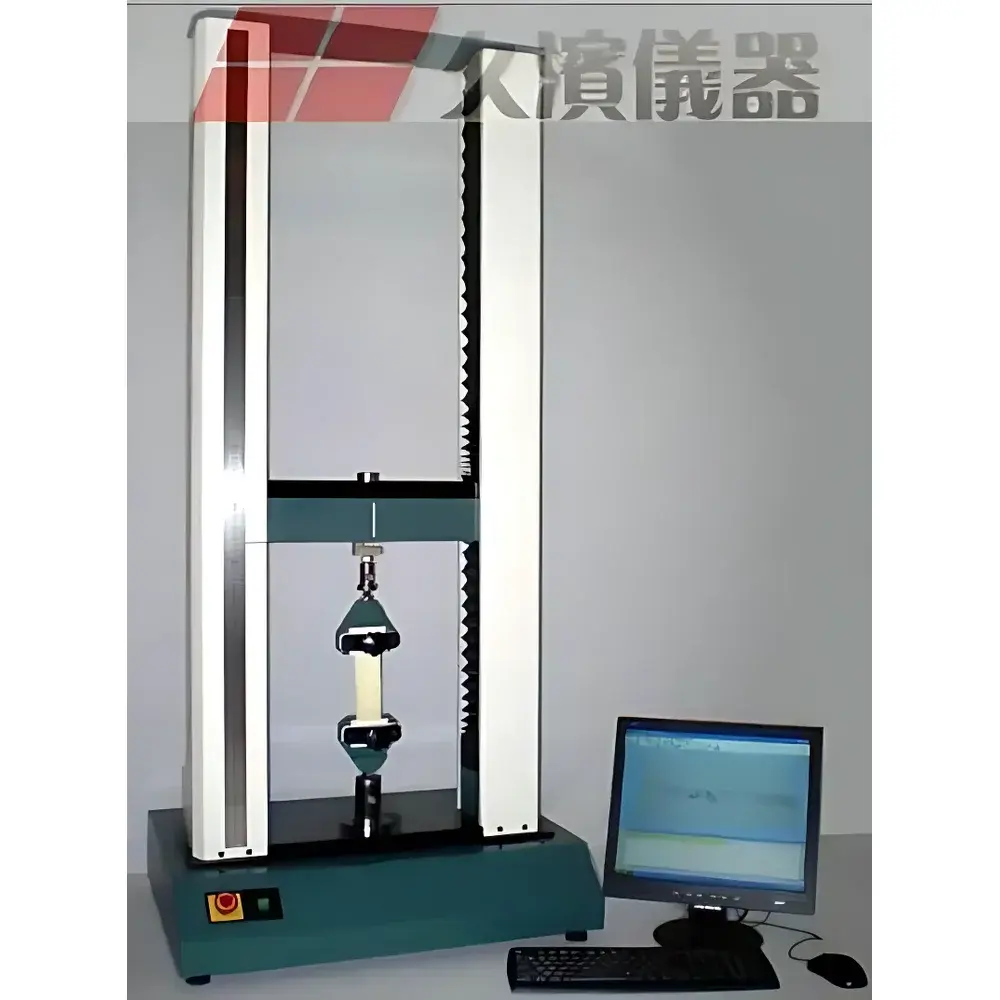
Jiubin JB-124 Series Servo-Controlled Universal Testing Machine
| Brand | Jiubin Instruments |
|---|---|
| Origin | Taiwan |
| Model | JB-124A / JB-124B |
| Load Capacity | 0–5 kN (user-selectable) |
| Force Sensing | High-precision load cell (USA-made) |
| Force Accuracy | ±0.5% of full scale |
| Effective Test Width | 380 mm |
| Max. Tensile Travel | 1000 mm |
| Drive System | Servo motor (Japan-made) + AC motor (Taiwan-made) |
| Mechanical Transmission | Precision ball screw (Taiwan-made) |
| Test Speed Range | 0.001–500 mm/min (infinitely variable) |
| Displacement Resolution | 1/200,000 |
| Displacement Accuracy | ±0.005% of full stroke |
| Safety Features | Upper/lower mechanical limits |
| Display Interface | Dual-mode — PC-based software + embedded microcomputer display |
| Power Supply | 220 V / 380 V, 50 Hz |
| Net Weight | 1080–1180 kg |
| Dimensions (W×D×H) | 1280 × 950 × 1800 mm |
| Compliance | ASTM E4, ASTM E8, ISO 6892-1, GB/T 228.1 |
Overview
The Jiubin JB-124 Series Servo-Controlled Universal Testing Machine is an electromechanically integrated static materials testing system engineered for precision mechanical property evaluation under controlled uniaxial loading conditions. Based on the fundamental principles of Hooke’s Law and stress–strain constitutive modeling, it delivers repeatable force–displacement data across tension, compression, flexure (3-point bending), and shear test modes. Designed to meet the functional requirements of QC laboratories, R&D centers, and third-party certification facilities, the JB-124 platform conforms to core international standards including ASTM E4 (load verification), ASTM E8/E21 (tensile testing of metallic materials), ISO 6892-1 (metallic materials – tensile testing at ambient temperature), and GB/T 228.1 (Chinese national standard for metallic tensile testing). Its modular architecture supports rapid reconfiguration for diverse specimen geometries and material classes — from elastomers and textiles to high-strength alloys and composite laminates.
Key Features
- High-fidelity force measurement via NIST-traceable, USA-manufactured load cells with ±0.5% full-scale accuracy and 1/200,000 internal resolution.
- Infinitely variable speed control from 0.001 to 500 mm/min, enabled by a Japan-sourced servo motor coupled with a dual-stage transmission system featuring Taiwan-made precision ball screws and Korea-sourced zero-backlash lead screws.
- Dual-display operation: real-time synchronized visualization via both embedded microcomputer interface and Windows-based PC software — enabling offline analysis without interrupting live tests.
- Robust structural frame with reinforced base and vertical columns, rated for maximum static loads up to 5 kN and designed to minimize deflection-induced measurement error during high-force compression or bending.
- Comprehensive safety architecture including hardware-based upper/lower travel limits, redundant emergency stop circuitry, and automatic load cutoff upon specimen failure detection.
- Modular fixture compatibility: standardized T-slot crosshead and base plate allow quick interchange of pneumatic, wedge-grip, peel, bend, and shear fixtures per ASTM D638, D790, D1876, and ISO 178 specifications.
Sample Compatibility & Compliance
The JB-124 accommodates specimens ranging from thin polymer films (≥0.05 mm thickness) to structural metal bars (up to Ø25 mm diameter), with effective test width of 380 mm and vertical clearance of 1000 mm. It supports standardized test methods for metals (ASTM E8, ISO 6892-1), plastics (ASTM D638, ISO 527), elastomers (ASTM D412), composites (ASTM D3039), adhesives (ASTM D1002), and textiles (ISO 13934-1). All firmware and software modules are structured to support audit-ready documentation per GLP and GMP requirements, including electronic signature capability, user access levels, and time-stamped test log archiving compliant with FDA 21 CFR Part 11 principles where validated configurations are deployed.
Software & Data Management
The bundled Jiubin TestSuite™ v4.x software provides ISO/IEC 17025-aligned data acquisition, curve overlay, statistical reporting, and customizable report templates exportable in PDF, Excel, and XML formats. It supports automated parameter derivation — including yield strength (Rp0.2), ultimate tensile strength (UTS), elongation at break (%EL), modulus of elasticity (E), and secant modulus — with configurable interpolation algorithms and noise-filtering thresholds. Raw data files are stored in encrypted binary format with embedded metadata (operator ID, calibration timestamp, environmental conditions). The system logs all user actions (test initiation, parameter edits, report generation) in an immutable audit trail, facilitating traceability during regulatory inspections.
Applications
Typical use cases include: mechanical qualification of incoming raw materials (e.g., stainless steel strips, PVC extrusions); process validation of heat-treated components; comparative analysis of weld joint integrity; fatigue pre-screening via monotonic ramp tests; quality conformance testing of medical device components (catheter shafts, suture anchors); and specification verification of automotive gaskets and sealing compounds. In academic settings, the JB-124 serves as a teaching platform for solid mechanics labs, supporting hands-on instruction in stress transformation, plasticity onset, and fracture mechanics fundamentals.
FAQ
What standards does the JB-124 comply with for calibration and verification?
It meets ASTM E4 for force verification, ISO 7500-1 for static calibration, and GB/T 16825.1 for verification of universal testing machines.
Can the system perform closed-loop strain-controlled testing?
Yes — when equipped with optional extensometers (e.g., clip-on or video-based), the controller supports displacement-, load-, or strain-controlled test profiles per ISO 6892-1 Annex A.
Is the software compatible with LIMS integration?
TestSuite™ supports ODBC-compliant database exports and REST API endpoints for bidirectional data exchange with laboratory information management systems.
What maintenance intervals are recommended for long-term accuracy?
Annual force calibration using certified deadweight standards is advised; mechanical inspection (lubrication, screw alignment, limit switch function) every 6 months under continuous operation.
Does the system support multi-specimen batch testing?
Yes — the software enables sequential test programming with auto-reset, specimen ID tagging, and pass/fail logic based on user-defined acceptance criteria.



