
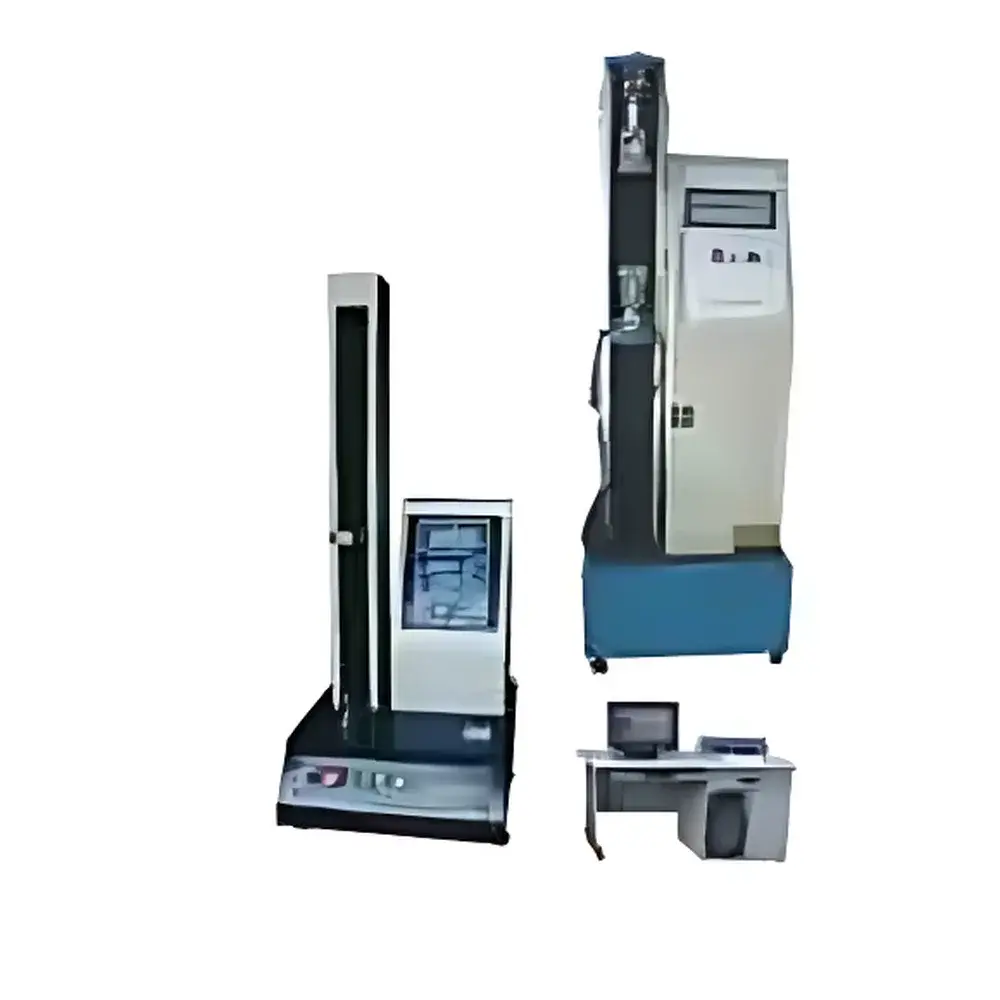
Jiubin JB-125A Universal Tensile Testing Machine for Rubber and Plastics
| Brand | Jiubin |
|---|---|
| Model | JB-125A |
| Capacity | 0–200 kg (user-selectable) |
| Load Cell | High-precision U.S.-made load cell |
| Load Accuracy | ±0.5% |
| Effective Test Width | 380 mm |
| Max. Travel Distance | 900 mm |
| Drive System | Servo motor (Japan-made) + AC motor (Taiwan-made) |
| Mechanical Transmission | High-accuracy ball screw (Taiwan-made) + High-strength backlash-free screw (Korea-made) |
| Test Speed Range | 0.001–500 mm/min (infinitely variable) |
| Displacement Accuracy | ±0.005% |
| Resolution | 1/200,000 |
| Safety Features | Upper/lower mechanical limits, emergency stop button |
| Display | Dual-mode — PC-based GUI + embedded microcomputer display |
| Power Supply | 220 V, 50 Hz |
| Net Weight | 180 kg |
| Dimensions (W×D×H) | 450 × 450 × 1200 mm |
| Unit Options | g, kg, N, kN, lb |
Overview
The Jiubin JB-125A Universal Tensile Testing Machine is an electromechanical static testing system engineered for precision mechanical property characterization of polymeric, elastomeric, metallic, and composite materials. Based on the fundamental principles of uniaxial force–displacement measurement under controlled strain rate or load rate, the JB-125A complies with core international test standards including ASTM D412 (rubber tensile properties), ASTM D638 (plastics tensile properties), ISO 37, ISO 527-1/-2, and GB/T 1040. Its modular architecture supports standardized test modes—tensile, compression, flexural (three-point bending), peel, tear, and shear—making it suitable for R&D laboratories, QC/QA departments, and contract testing facilities operating under GLP or ISO/IEC 17025 frameworks.
Key Features
- High-fidelity load measurement via a certified U.S.-sourced load cell with ±0.5% full-scale accuracy, traceable to NIST-equivalent calibration protocols.
- Dual-drive configuration: A high-response Japanese servo motor enables precise low-speed control (down to 0.001 mm/min), while a robust Taiwan-made AC motor ensures stable operation across mid-to-high speed ranges (5–500 mm/min).
- Mechanically optimized transmission system combining a Taiwan-manufactured precision ball screw and a Korea-sourced high-rigidity, zero-backlash lead screw—minimizing axial play and ensuring long-term repeatability in displacement tracking.
- Embedded microcomputer interface co-integrated with Windows-based PC software, enabling synchronized real-time data acquisition, dual-display redundancy, and hardware-level safety interlocks.
- Comprehensive safety architecture: dual mechanical end-limit switches, fail-safe emergency stop circuitry compliant with IEC 60204-1, and automatic load cutoff upon over-range detection.
- Resolution of 1/200,000 full scale ensures sub-micron displacement resolution at maximum stroke, critical for evaluating modulus transitions and yield onset in viscoelastic polymers.
Sample Compatibility & Compliance
The JB-125A accommodates specimens ranging from thin elastomer strips (e.g., vulcanized rubber sheets per ASTM D412 Type C) to rigid thermoplastic bars (ASTM D638 Type I), textile yarns, coated cables, and laminated composites. Standard clamping options include pneumatic wedge grips, roller grips for film testing, and custom-designed fixtures for footwear sole adhesion or wire insulation peel. All test procedures align with regulatory expectations for audit readiness: raw data logs retain timestamps, operator IDs, and instrument metadata; test method parameters are locked via password-protected profiles; and electronic records meet minimum ALCOA+ criteria (Attributable, Legible, Contemporaneous, Original, Accurate, Complete, Consistent, Enduring, Available) as referenced in FDA 21 CFR Part 11 Annex 11 guidance.
Software & Data Management
The proprietary Jiubin TestSuite v3.2 software provides ISO/IEC 17025-aligned data handling: automatic curve overlay for batch comparison, modulus calculation at user-defined strain intervals (e.g., secant modulus at 100% elongation), and automated report generation in PDF/Excel formats compliant with internal SOPs. Audit trail functionality logs all parameter modifications, test starts/stops, and calibration events with digital signatures. Optional modules support GMP-compliant electronic signatures, multi-user role-based access control, and direct integration with LIMS platforms via ASTM E1384-compliant XML export.
Applications
- Tensile strength and elongation-at-break evaluation of natural/synthetic rubbers used in automotive seals and medical tubing.
- Compression set analysis of silicone elastomers per ASTM D395 Method B.
- Three-point flexural testing of ABS, PC, and PP injection-molded parts to determine flexural modulus and stress–strain behavior.
- Peel strength quantification of pressure-sensitive adhesives on flexible packaging substrates (ASTM D903).
- Shear strength validation of structural bonding interfaces in composite assemblies.
- Quality conformance verification for cable jacketing materials under UL 1581 Section 1060.
FAQ
What international standards does the JB-125A support out-of-the-box?
Preconfigured test methods include ASTM D412, D638, D790, D903, ISO 37, ISO 527, and GB/T 1040 series. Custom method templates can be built using the scriptable test sequence editor.
Is the system compatible with 21 CFR Part 11 requirements?
Yes—when deployed with optional Electronic Signature and Audit Trail modules, the system satisfies Part 11’s technical controls for electronic records and signatures, including role-based permissions, immutable audit logs, and biometric or PKI-based signing.
Can third-party夹具 (fixtures) be integrated?
All mechanical interfaces conform to ISO 2041 standard mounting dimensions; custom fixtures may be validated for traceable force transmission using NIST-traceable calibration adapters.
What maintenance intervals are recommended for long-term accuracy?
Load cell recalibration every 12 months (or after 10,000 cycles), ball screw lubrication every 6 months, and annual mechanical alignment verification per manufacturer’s service manual.
Does the system support real-time data streaming to SCADA or MES platforms?
Via OPC UA server add-on (optional), enabling bidirectional communication with industrial automation systems for production-line SPC integration.



