
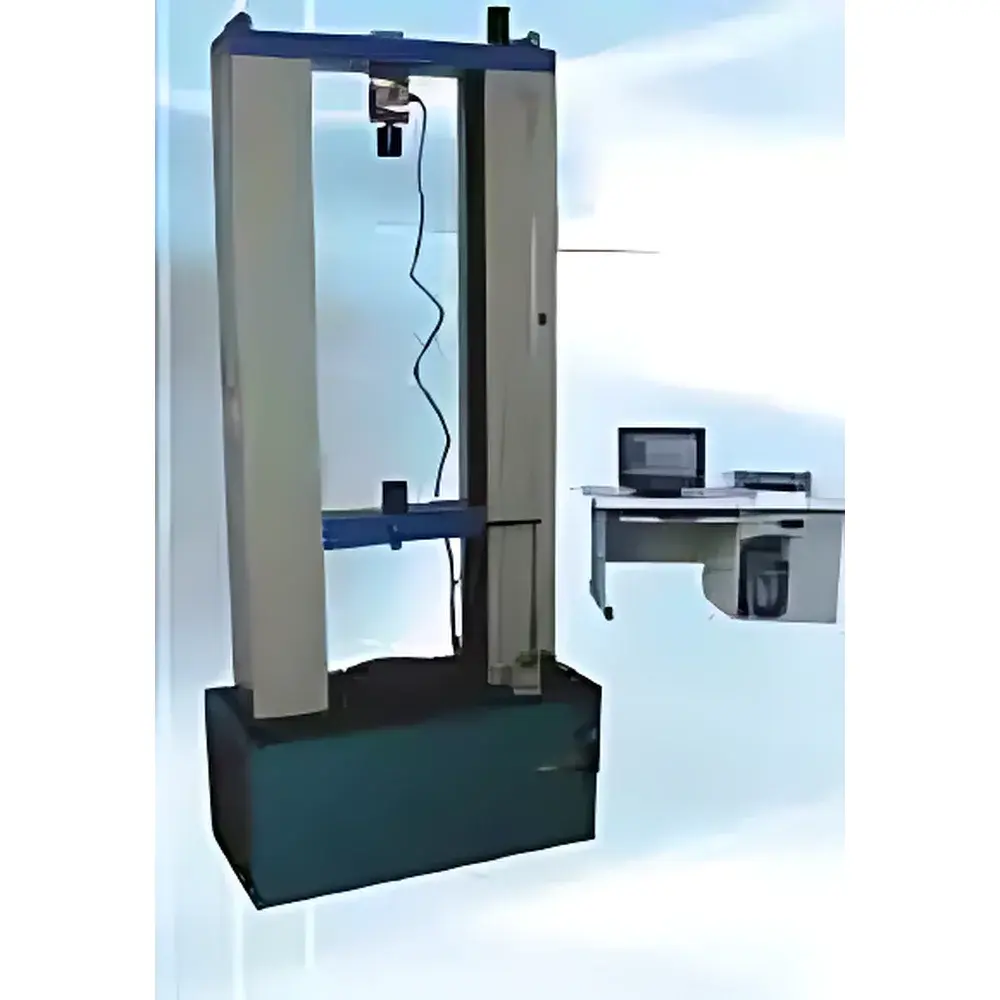
Jiubin JB-126 Advanced Universal Testing Machine (UTM) for Tensile, Compression, and Three-Point Bending Tests
| Brand | Jiubin |
|---|---|
| Model | JB-126 |
| Type | Electromechanical Universal Testing Machine |
| Load Capacity | 0–200 kg (user-selectable) |
| Load Cell Accuracy | ≤0.5% FS |
| Effective Test Width | 380 mm |
| Max. Stroke | 1000 mm |
| Test Speed Range | 0.001–500 mm/min (infinitely variable) |
| Displacement Resolution | 0.005% |
| Force Resolution | 1/200,000 |
| Control System | Japanese Servo Motor + Taiwan-Made Precision Ball Screw |
| Load Sensor | U.S.-Made High-Accuracy Load Cell |
| Safety Features | Upper/Lower Mechanical Limits + Emergency Stop |
| Display | Dual-mode (PC-based GUI + Embedded Microcomputer Interface) |
| Power Supply | 220 V, 50 Hz |
| Net Weight | 160 kg |
| Dimensions (W×D×H) | 450 × 450 × 900 mm |
| Unit Options | g, kg, N, kN, lb, lbf |
Overview
The Jiubin JB-126 is an electromechanical universal testing machine engineered for precision mechanical property evaluation of solid materials across research laboratories, quality control departments, and manufacturing R&D facilities. It operates on the fundamental principles of static axial loading—applying controlled uniaxial tensile, compressive, flexural (three-point bending), and shear forces to standardized or custom specimens. The system integrates a high-fidelity load measurement chain (U.S.-sourced strain-gauge load cell), closed-loop servo motion control (Japan-manufactured motor), and a rigid mechanical frame with Taiwan-sourced ground ball screws to ensure minimal deflection and high positional repeatability. Designed for compliance with foundational mechanical test standards—including ASTM E4 (force verification), ASTM E8/E8M (tensile testing of metals), ASTM D790 (flexural properties of plastics), and ISO 6892-1—the JB-126 delivers traceable, reproducible results essential for material qualification, process validation, and regulatory documentation.
Key Features
- Electromechanical architecture with zero hydraulic fluid dependency—ensuring clean operation, low maintenance, and long-term calibration stability.
- User-selectable load capacity up to 200 kg, optimized for small-to-medium cross-section specimens in polymers, elastomers, composites, thin metals, textiles, and packaging materials.
- Infinitely variable speed control from 0.001 to 500 mm/min, supporting both quasi-static and moderate-rate mechanical characterization per ISO 527-1 and ASTM D638 protocols.
- Dual-display interface: embedded microcomputer panel for standalone operation + full-featured PC software for advanced data acquisition, real-time curve overlay, and automated report generation.
- High-resolution force transduction (1/200,000 internal resolution) and displacement feedback (0.005% linearity), enabling detection of subtle yield transitions, plastic deformation onset, and fracture initiation points.
- Modular fixture compatibility—standardized grips for tensile bars, compression platens, three-point bend fixtures (with adjustable span), and optional shear adapters—all mechanically aligned to ISO 204 and ASTM E1012 requirements.
- Integrated safety architecture: dual mechanical end-limit switches, hardware-triggered emergency stop circuitry, and software-enforced overload protection to prevent actuator stall or specimen overloading.
Sample Compatibility & Compliance
The JB-126 accommodates specimens ranging from thin films (<0.1 mm thick) to structural rods (≤25 mm diameter) and flat laminates (max. 380 mm wide × 1000 mm stroke). Common applications include tensile testing of wire terminals, peel strength assessment of adhesive bonds in flexible electronics, flexural stiffness evaluation of PCB substrates, compression resistance of foam packaging, and bending fatigue pre-screening of medical device components. The system supports standard specimen geometries defined in ASTM D638 Type I–V, ISO 527-2, ISO 178 (three-point bending), and EN 13119 (geotextiles). All force and displacement calibrations are traceable to national metrology institutes via third-party certificate options (NIST-traceable load cell calibration available upon request). The machine’s firmware and software architecture support audit-ready data integrity—meeting GLP documentation requirements and aligning with FDA 21 CFR Part 11 principles for electronic records when paired with validated PC configurations.
Software & Data Management
The proprietary Jiubin TestSuite v3.x software provides ISO/IEC 17025-aligned test method configuration, including pre-defined templates for tensile modulus calculation (secant/tangent), yield point identification (0.2% offset), ultimate tensile strength (UTS), elongation at break, flexural modulus, and load-deflection slope analysis. Real-time stress–strain and load–displacement curves are rendered with auto-scaling axes and exportable vector graphics (SVG/PDF). Data files are saved in encrypted binary format (.jtd) with embedded metadata: operator ID, timestamp, environmental conditions (optional sensor input), calibration status flags, and raw ADC counts. Batch analysis tools enable statistical comparison across up to 99 test runs—generating mean ± SD tables, Weibull distribution plots, and CPK capability indices. Audit trail functionality logs all parameter changes, report edits, and user login/logout events—supporting internal quality audits and external inspections under ISO 9001 and IATF 16949 frameworks.
Applications
- Quality assurance of metal stampings and spring clips in automotive harness assemblies.
- Mechanical validation of biodegradable polymer sutures per ISO 10993-12.
- Peel adhesion testing of pressure-sensitive tapes per ASTM D3330.
- Bending rigidity assessment of corrugated cardboard per TAPPI T811.
- Tensile strength and elongation profiling of nonwoven fabrics used in filtration media.
- Compression set evaluation of silicone gaskets under sustained load (ASTM D395).
- Three-point flexural testing of ceramic dental restorations per ISO 6872.
FAQ
What standards does the JB-126 comply with for tensile testing?
It meets the mechanical and procedural requirements of ASTM E4, ASTM E8/E8M, ISO 6892-1, and GB/T 228.1—subject to proper calibration, fixture alignment, and operator training.
Can the system perform cyclic or fatigue testing?
No—the JB-126 is designed exclusively for static and quasi-static monotonic loading. For dynamic or high-cycle fatigue, a dedicated servo-hydraulic or electrodynamic fatigue tester is required.
Is third-party calibration certification included?
Factory calibration is provided; NIST-traceable certificates with uncertainty budgets are available as an optional add-on service.
What operating systems are supported by the PC software?
TestSuite v3.x supports Windows 10/11 (64-bit) with .NET Framework 4.8 and administrator privileges for driver installation.
How is data integrity ensured during long-duration creep tests?
The embedded microcontroller maintains independent data logging at 100 Hz sampling rate—even if the PC connection is interrupted—ensuring no loss of time-series displacement or load history.



