
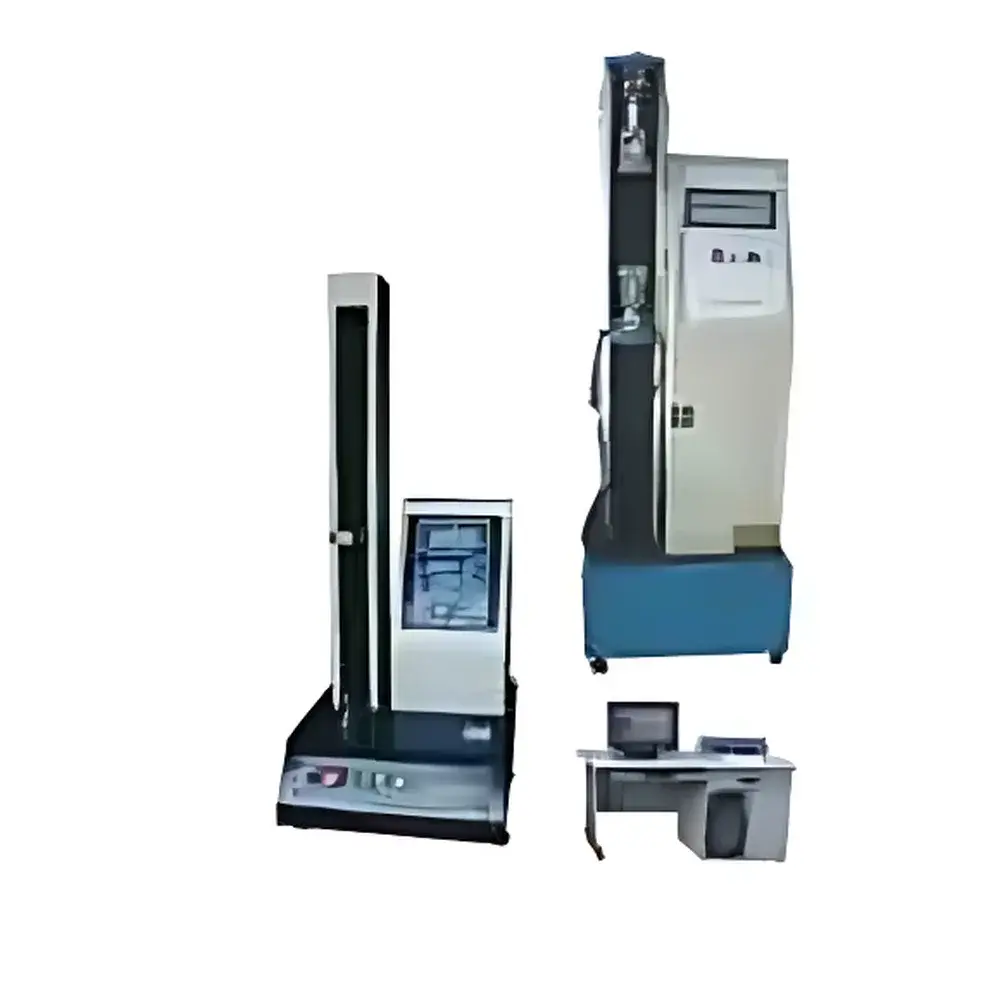
Jiubin JB-126A Universal Testing Machine for Wire & Cable Mechanical Property Evaluation
| Brand | Jiubin |
|---|---|
| Origin | Taiwan |
| Model | JB-126A |
| Load Capacity | 0–200 kg (user-selectable) |
| Load Cell Accuracy | ±0.5% FS |
| Effective Test Width | 380 mm |
| Max. Stroke | 1000 mm |
| Test Speed Range | 0.001–500 mm/min (infinitely variable, servo-controlled) |
| Displacement Accuracy | ±0.005% |
| Resolution | 1/200,000 |
| Power Supply | 220 V, 50 Hz |
| Net Weight | 160 kg |
| Dimensions (W×D×H) | 450 × 450 × 900 mm |
| Safety Features | Upper/lower mechanical limits, emergency stop switch |
| Control System | Dual-mode — PC-based software + embedded microcomputer display |
| Actuation | Japanese servo motor |
| Mechanical Drive | Taiwanese precision ball screw |
| Load Sensing | High-accuracy U.S.-made load cell |
| Unit Options | g, kg, N, kN, lb, lbf |
Overview
The Jiubin JB-126A Universal Testing Machine is an electromechanically integrated materials testing system engineered for precision mechanical characterization of wire and cable assemblies, as well as a broad range of metallic, polymeric, elastomeric, textile, and composite specimens. It operates on the principle of controlled uniaxial force application—measuring tensile strength, yield point, elongation at break, compressive modulus, three-point bending stiffness, peel resistance, and shear performance under standardized loading conditions. Designed to meet routine QC/QA requirements in cable manufacturing, wire harness production, and component qualification labs, the JB-126A conforms to fundamental test method frameworks including ASTM D412 (rubber tensile), ASTM D882 (thin plastic films), IEC 60811-501 (cable insulation tensile), and ISO 527-2 (plastics tensile testing). Its rigid frame architecture, high-resolution displacement feedback, and low-drift load measurement ensure repeatable results across batch-to-batch verification cycles.
Key Features
- High-fidelity dual-control interface: Synchronized operation via embedded microcomputer display and Windows-based PC software—enabling real-time curve plotting, parameter presetting, and multi-step test sequencing.
- Precision actuation system: Japanese servo motor coupled with Taiwanese ground ball screw delivers smooth, backlash-free motion across the full speed range (0.001–500 mm/min), supporting both quasi-static and dynamic ramp protocols.
- Traceable force measurement: U.S.-sourced load cell with ±0.5% full-scale accuracy and 1/200,000 internal resolution ensures compliance with ISO 7500-1 Class 1 calibration standards.
- Modular fixture compatibility: Standardized T-slot base accommodates interchangeable grips—including pneumatic wedge clamps, compression platens, three-point bend fixtures, and peel test adapters—custom-configurable per specimen geometry and industry standard.
- Robust mechanical safety architecture: Dual mechanical limit switches, hardware-triggered emergency stop circuitry, and automatic load cutoff upon specimen rupture prevent overtravel or overload damage.
- Comprehensive data traceability: Software supports audit-ready test logs with timestamped metadata, operator ID tagging, and export to CSV/PDF formats compatible with laboratory information management systems (LIMS).
Sample Compatibility & Compliance
The JB-126A accommodates specimens up to 380 mm wide and 1000 mm in active travel length—suitable for insulated conductor strands, armored cables, PVC-sheathed wires, fiber-reinforced jacketing, and termination assemblies. Its mechanical design satisfies structural stability requirements per ASTM E4 (load frames) and ISO 7500-1 (static calibration). When operated with validated fixtures and calibrated load cells, test outputs support regulatory submissions under IEC 60502 (power cables), UL 1581 (wire reference standard), and EN 50363 (insulation material specifications). All firmware and software modules are designed to support GLP-compliant documentation workflows, including electronic signature capability and change-controlled version history.
Software & Data Management
The bundled Windows application provides full test configuration, real-time stress–strain visualization, automatic peak detection, and customizable report generation. Users may define multi-stage test profiles (e.g., preload → ramp → hold → return), apply polynomial curve fitting for modulus calculation, and overlay comparative datasets from historical batches. Raw data files retain native resolution and metadata—including environmental timestamps, calibration certificate IDs, and sensor serial numbers—to satisfy FDA 21 CFR Part 11 requirements for electronic records and signatures. Optional integration with SQL databases enables centralized query access for quality engineers performing SPC analysis or CAPA investigations.
Applications
- Tensile evaluation of copper/aluminum conductors and polymer insulation layers under ambient and elevated temperature conditions.
- Peel strength assessment of laminated cable jackets and adhesive-backed shielding tapes per ASTM D903.
- Three-point flexural testing of rigid cable trays, conduit housings, and connector bodies per ISO 178.
- Compression resistance of foam-filled cable fillers and fire-retardant wraps.
- Shear strength validation of crimped terminal joints and soldered splice points.
- Quality gate testing during incoming raw material inspection, in-process WIP verification, and final product release.
FAQ
What standards does the JB-126A support out-of-the-box?
The system includes preconfigured test templates for ASTM D412, ASTM D882, IEC 60811-501, ISO 527-2, and UL 1581 Annex D—each with default parameters aligned with method-defined speed, gauge length, and sampling rate requirements.
Can the machine be calibrated to national metrology institute (NMI) traceable standards?
Yes—the load cell and displacement encoder are supplied with NIST-traceable calibration certificates; users may perform periodic verification using certified deadweight sets or third-party accredited calibration services.
Is the software compliant with FDA 21 CFR Part 11 for regulated environments?
The optional software package includes role-based access control, electronic audit trails, and digital signature functionality—fully configurable to meet Part 11 technical and procedural requirements for electronic records.
What maintenance intervals are recommended for long-term accuracy?
Biannual verification of load cell linearity and displacement encoder drift is advised; annual lubrication of ball screw assembly and inspection of grip jaw surfaces are included in the manufacturer’s preventive maintenance schedule.



