
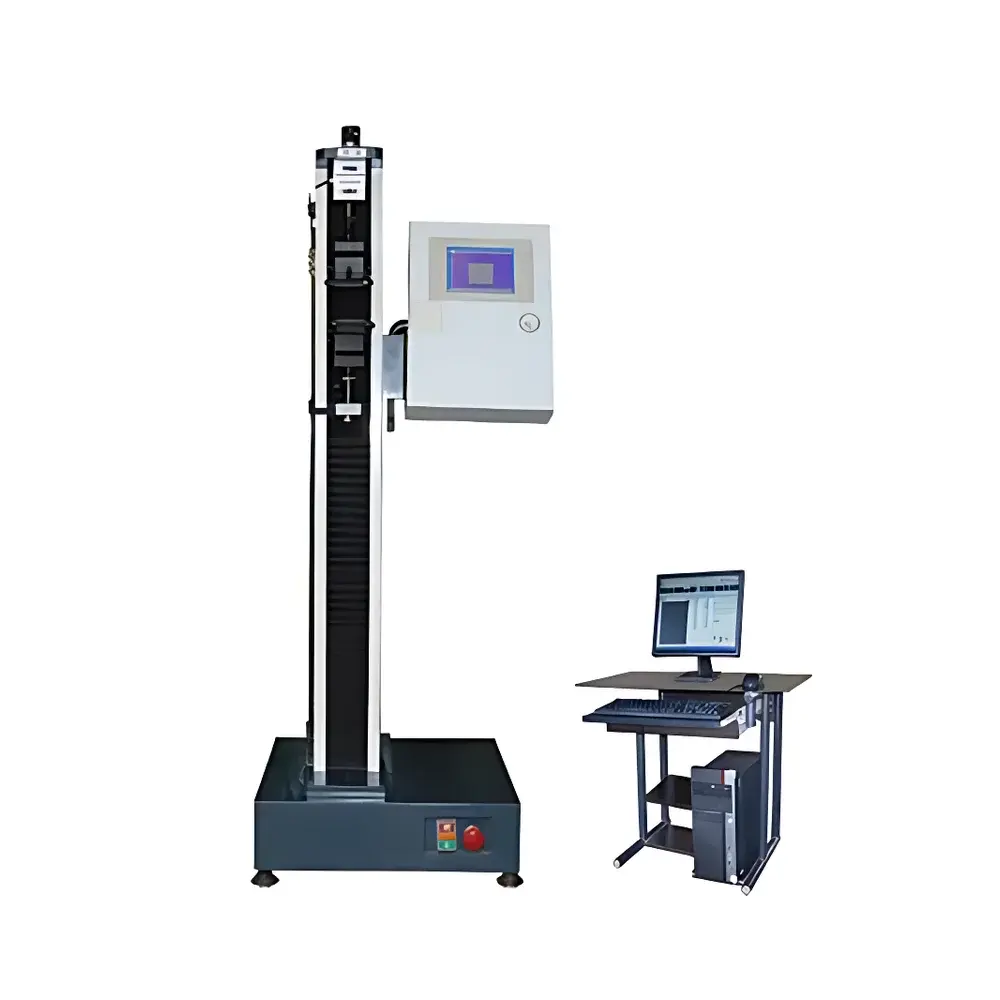
Jiubin JB-126B Electronic Universal Testing Machine
| Brand | Jiubin |
|---|---|
| Origin | Shanghai, China |
| Manufacturer Type | Authorized Distributor |
| Country of Origin | China |
| Model | JB-126B |
| Test Capacity Options | 5 kN, 2 kN, 1 kN, 50 kgf, 20 kgf, 10 kgf, 5 kgf |
| Accuracy Class | Class 1 (per ISO 7500-1 / ASTM E4) |
| Load Resolution | 0.001 N |
| Load Accuracy | ±0.05% of full scale |
| Displacement Resolution | ±0.005% (Japanese encoder, 1000 P/R) |
| Speed Range | 0.01–500 mm/min (infinitely variable, AC servo motor, Taiwan-made) |
| Effective Stroke | 900 mm (standard), 600 mm (compact variant) |
| Control System | Full-digital triple-closed-loop (force, displacement, strain) with adaptive neural PID algorithm |
| Data Acquisition | 300,000-count resolution, USB interface standard |
| Software | Windows-based, bilingual (English/Chinese), GLP-compliant data logging and audit trail |
| Safety Features | Overload emergency stop, mechanical travel limit switches, leakage protection, automatic breakpoint halt |
| Dimensions (L×W×H) | 650×450×1800 mm or 450×450×1200 mm |
| Weight | 180 kg or 56 kg |
| Power Supply | 220 V AC |
Overview
The Jiubin JB-126B Electronic Universal Testing Machine is a precision-engineered electromechanical system designed for static mechanical property characterization of metallic and non-metallic materials under uniaxial loading conditions. It operates on the fundamental principle of controlled force application through a high-rigidity load frame, coupled with real-time measurement of axial load, displacement, and—when equipped with extensometry—strain. The system complies with international standards including ISO 7500-1 (static calibration of testing machines), ASTM E4 (verification of force-measuring instruments), and ASTM E8/E8M (tension testing of metallic materials). Its modular architecture integrates a Taiwan-sourced AC servo drive, high-strength ground lead screw transmission, and a Class 1-certified load cell, enabling reproducible mechanical testing across a broad dynamic range—from low-force polymer film peel tests to high-stiffness metal tensile evaluations up to 5 kN. The machine’s落地式 (floor-standing) structural design ensures vibration isolation and long-term dimensional stability, critical for achieving sub-0.1% repeatability in modulus and yield point determination.
Key Features
- Triple-closed-loop digital control system with adaptive neural PID algorithm, enabling seamless switching between force, displacement, and strain control modes without test interruption or overshoot.
- High-fidelity data acquisition at 300,000 internal counts resolution, supporting precise quantification of mechanical thresholds such as upper/lower yield strength, offset yield (0.2% proof stress), and tensile/compressive modulus.
- Real-time synchronized plotting of multiple curve types: load vs. displacement, stress vs. strain, load vs. time, displacement vs. time, and hysteresis loops—displayed dynamically during test execution.
- Bilingual (English/Chinese) Windows-based software with configurable report templates, password-protected parameter editing, user-defined decimal precision (2 or 3 digits), and unit flexibility (N, kN, kgf, lbf, MPa, psi).
- Comprehensive post-test analysis suite: automatic calculation of ultimate tensile strength (UTS), elongation at break, reduction in area, Young’s modulus, bending modulus, peel strength (90°/180°), shear strength, adhesion pull-off force, and cyclic energy dissipation (net, return, total).
- Hardware-level safety redundancy: dual mechanical stroke limit switches, electronic overload cutoff, earth-leakage circuit interrupter (ELCI), and programmable auto-return-to-initial-position upon test completion.
- Standard USB connectivity for all peripherals (load cell, encoder, controller); no proprietary cabling required. Touchscreen display and PC host operate independently—enabling dual-control redundancy.
Sample Compatibility & Compliance
The JB-126B accommodates specimens ranging from ultra-thin polymer films (≥10 µm thickness) to structural metal coupons (up to 25 mm width × 6 mm thickness). Standard configurations support ASTM D638 (plastics), D882 (thin films), D790 (flexural), D1876 (T-peel), ISO 527, ISO 178, ISO 1133, and GB/T 228.1 testing protocols. Optional extensometers (contact or non-contact), environmental chambers (−70°C to +300°C), and specialized fixtures—including pneumatic vise grips, wedge-action clamps, compression platens, peel arms, and shear adapters—are available to extend compliance into automotive, aerospace, medical device, and packaging QA/QC workflows. All firmware and software modules are structured to support 21 CFR Part 11 readiness (electronic signatures, audit trails, data integrity logs) when deployed in regulated GMP/GLP environments.
Software & Data Management
The embedded control software provides full traceability: every test session records operator ID, timestamp, environmental metadata (if sensor-integrated), calibration history, and raw channel data (1 kHz sampling default, configurable up to 10 kHz). Data files are saved in open-format CSV and proprietary .JBT binary containers—with optional encryption and hierarchical folder-based backup to any local or network-mounted drive. Curve replay functionality allows retrospective re-analysis using updated algorithms or revised pass/fail criteria. Export options include PDF reports with embedded graphs, Excel-compatible datasets, and image exports (PNG/SVG) for technical documentation. Audit logs track all parameter modifications, user logins, and report generation events—meeting ISO/IEC 17025 documentation requirements for accredited laboratories.
Applications
This system serves R&D labs and QC departments performing standardized mechanical validation across diverse sectors: tensile testing of stainless steel fasteners per ASTM F606; compression analysis of pharmaceutical tablets (USP ); peel strength verification of medical adhesive tapes (ISO 2555); flexural modulus assessment of CFRP laminates (ASTM D7264); elongation-at-break evaluation of elastomeric seals; and shear resistance profiling of thermal interface materials. Its adaptability extends to failure mode analysis—capturing brittle fracture onset, ductile necking progression, viscoelastic recovery, and creep compliance under sustained load—making it suitable for both routine compliance verification and advanced material behavior studies.
FAQ
What standards does the JB-126B comply with for calibration and verification?
It meets ISO 7500-1 Class 1 accuracy requirements and supports verification per ASTM E4, ensuring traceable force measurement to national metrology institutes.
Can the system perform cyclic or fatigue testing?
While optimized for static quasi-static tests, it supports programmed multi-step loading sequences (e.g., preload → hold → ramp → unload) with dwell timing; dedicated high-cycle fatigue systems require separate hardware.
Is third-party calibration certification included?
Factory calibration is performed pre-shipment; ISO/IEC 17025-accredited calibration certificates are available upon request at additional cost.
How is data integrity ensured during long-duration tests?
Continuous RAM buffering and periodic auto-save (configurable interval) prevent data loss during power interruption; uninterruptible power supply (UPS) integration is recommended for >2-hour tests.
Are custom fixture designs supported?
Yes—Jiubin offers engineering consultation and CAD-based custom fixture development for non-standard specimen geometries or industry-specific test methods (e.g., wire rope grip, micro-tensile dogbones, orthopedic implant shear jigs).



