
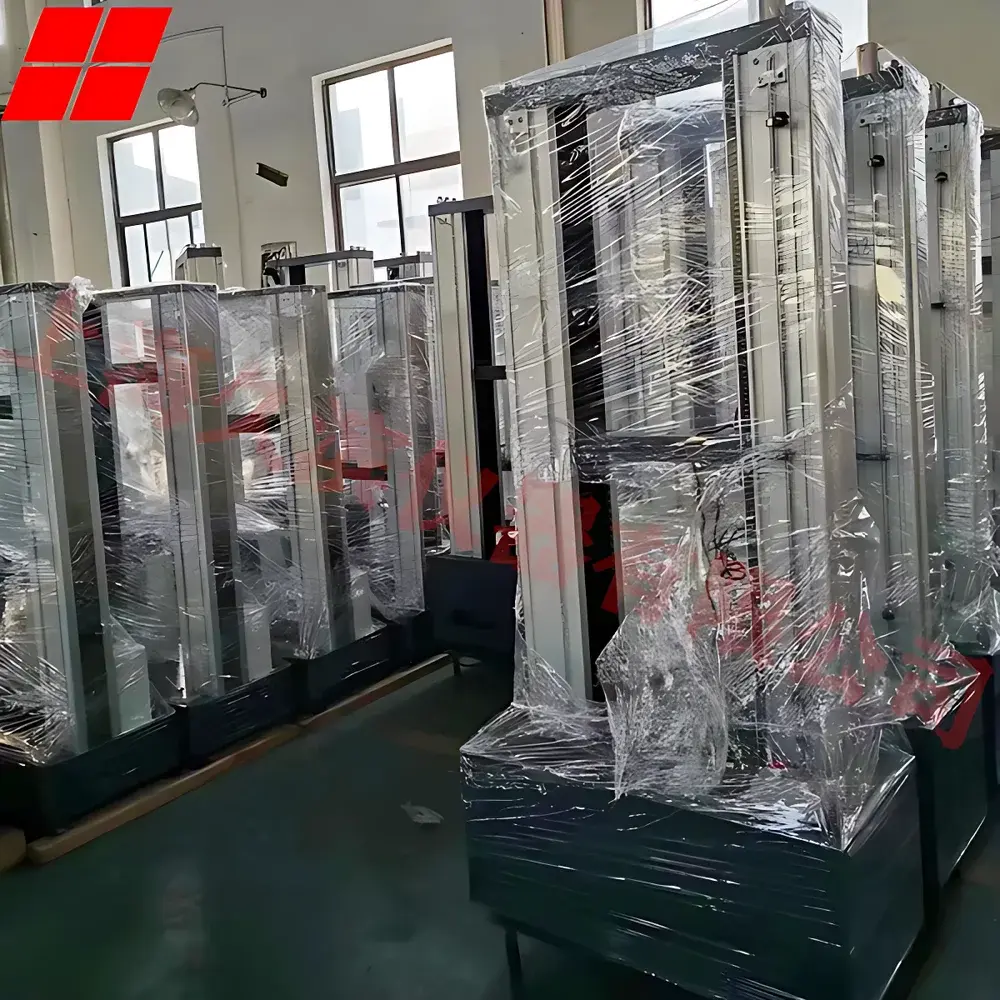
Jiubin JB-128A Solar Cell Tabbing Ribbon Peel Strength Tester
| Brand | Jiubin Instruments |
|---|---|
| Origin | Shanghai, China |
| Manufacturer Type | Authorized Distributor |
| Country of Origin | China |
| Model | JB-128A |
| Price | USD 7,200 (FOB Shanghai) |
| Max Load Capacity | 20 kN |
| Effective Test Height | 800 mm |
| Force Sensor | Transcell (USA), 20 kN |
| Actuation System | Panasonic AC Servo Motor + Dedicated Panasonic Servo Controller |
| Force Resolution | ±1/500,000 FS |
| Force Range | 0.4–100% FS |
| Force Accuracy | ±0.5% of reading |
| Displacement Resolution | 0.05 mm |
| Displacement Accuracy | ±0.5% of reading |
| Strain Resolution | ±1/300,000 FS |
| Strain Range | 0.2–100% FS |
| Strain Accuracy | ±0.5% of reading |
| Speed Range | 0.001–500 mm/min (infinitely variable, segmented control) |
| Speed Accuracy | ±1% (<0.01 mm/min) |
| Force Rate Control Range | 0.5–6% FS/s |
| Force Rate Accuracy | ±1% of set value |
| Strain Rate Control Range | 0.2–6% FS/s |
| Strain Rate Accuracy | ±1% (<0.05% FS/s) |
| Power Supply | AC 220 V, 50 Hz |
| Dimensions (W×D×H) | 800 × 400 × 1800 mm |
| Weight | ~300 kg |
| Software | Dual-language (English/Chinese) proprietary test suite with full GLP-compliant audit trail, real-time curve plotting, and ASTM/ISO/GB report export |
Overview
The Jiubin JB-128A Solar Cell Tabbing Ribbon Peel Strength Tester is a precision electromechanical universal testing system engineered for quantitative mechanical evaluation of interfacial adhesion in photovoltaic module laminates. It operates on the principle of controlled quasi-static tensile separation under standardized 180° peel geometry, as defined in GB/T 2790–1995 (equivalent to ISO 8510-2 and ASTM D903). The instrument applies calibrated axial force to separate a flexible adherend (e.g., EVA encapsulant or POE film) from a rigid substrate (tempered glass or polymer backsheet) at a fixed angle and constant rate, enabling calculation of peel strength in N/15 mm — a critical parameter directly correlated with long-term module reliability, moisture ingress resistance, and thermal cycling endurance. Its architecture integrates high-fidelity load measurement, sub-millimeter displacement tracking, and real-time strain monitoring — all synchronized within a single data acquisition loop to ensure traceable, repeatable, and metrologically defensible results required for IEC 61215 qualification, factory acceptance testing (FAT), and R&D validation.
Key Features
- High-stability 20 kN load frame with rigid C-frame construction and reinforced crosshead guidance for minimal deflection during high-force peel initiation
- Transcell (USA) precision load cell with ±0.5% full-scale accuracy and resolution down to 0.002 N — certified per ISO 376 Class 0.5
- Panasonic AC servo drive system delivering smooth, jitter-free motion across the full speed range (0.001–500 mm/min), with closed-loop position feedback and programmable acceleration/deceleration profiles
- Integrated extensometer-grade strain measurement module (±0.5% FS accuracy, 0.2–100% FS range) supporting concurrent peel force and substrate deformation analysis
- Dual-clamp configuration with pneumatic-assisted alignment and micro-adjustable jaw faces to ensure uniform stress distribution across 15-mm-wide specimens
- Real-time force–displacement–time synchronization with ≥1 kHz sampling rate and onboard digital filtering to suppress mechanical noise
Sample Compatibility & Compliance
The JB-128A accommodates standard PV laminate specimens per GB/T 2790–1995, IEC 61215-2:2016 (MQT 17), and UL 1703 Annex G: 15 mm wide × ≥300 mm long strips cut from laminated assemblies comprising tempered glass (3.2 mm), EVA/POE encapsulant (0.45–0.55 mm), and fluoropolymer-based backsheets (e.g., TPT, TPE). It supports both glass-to-encapsulant and backsheet-to-encapsulant peel configurations, with pre-peel notch fixtures ensuring consistent debond initiation. All test parameters — including peel angle verification, clamping pressure calibration, and environmental preconditioning (per GB/T 2918–1998, 23°C/50% RH, ≥2 h equilibration) — are programmable and logged with timestamped metadata. The system meets mechanical safety requirements per ISO 12100 and electrical safety per IEC 61000-6-2/6-4, and its software architecture complies with ALCOA+ principles for data integrity.
Software & Data Management
The bundled dual-language test software provides full GLP/GMP-aligned operation: user-level access control (admin/operator), electronic signatures, automated audit trails (per FDA 21 CFR Part 11), and immutable raw-data archiving in .csv and .tdms formats. Test methods are stored as reusable templates with embedded standards logic (e.g., automatic exclusion of initial 25 mm of peel data per GB/T 2790), while post-test calculations include mean peel force, standard deviation, coefficient of variation, and pass/fail flagging against configurable limits (e.g., ≥15 N/15 mm for backsheet adhesion). Reports export directly to PDF with embedded test curves, specimen IDs, environmental logs, and calibration certificates — fully compatible with LIMS integration via OPC UA or REST API.
Applications
- Quantitative assessment of EVA/POE encapsulant adhesion to soda-lime glass and polymer backsheets under ambient and post-conditioned states (e.g., damp heat, thermal cycling, boiling water immersion per IEC 61215 MQT 11/17)
- Comparative evaluation of alternative encapsulants (e.g., ionomer, silicone hybrids) and surface-treated substrates (plasma-activated glass, corona-modified backsheets)
- Process validation of lamination parameters (temperature, pressure, dwell time) and curing kinetics in pilot-line and mass-production environments
- Root-cause analysis of delamination failures observed in fielded modules through correlation of peel strength decay with accelerated aging exposure
- Support for technical documentation required for TÜV Rheinland, UL, and CSA certification submissions
FAQ
Does the JB-128A comply with international PV testing standards beyond GB/T 2790?
Yes — its mechanical design, control algorithms, and reporting structure align with ISO 8510-2, ASTM D903, and IEC 61215-2 Clause 10.17 (peel adhesion verification), with method templates preconfigured for each.
Can the system perform other mechanical tests besides peel?
Yes — it supports tensile, compression, flexural, and shear testing per ISO 527, ASTM D638, and EN 14410 using optional fixtures; however, peel-specific calibration and validation are performed separately.
Is third-party calibration documentation included?
Each unit ships with an ISO/IEC 17025-accredited calibration certificate covering load, displacement, and speed channels, valid for 12 months from shipment.
What environmental conditions are required for installation?
A temperature-controlled lab (20–25°C, ±2°C), low-vibration floor, and grounded 220 V / 50 Hz supply with ≥30 A circuit protection are mandatory for metrological stability.
How is software updated, and is legacy data preserved?
Updates are delivered via secure FTP with version-controlled release notes; all historical test databases remain fully accessible and backward-compatible across major releases.



