
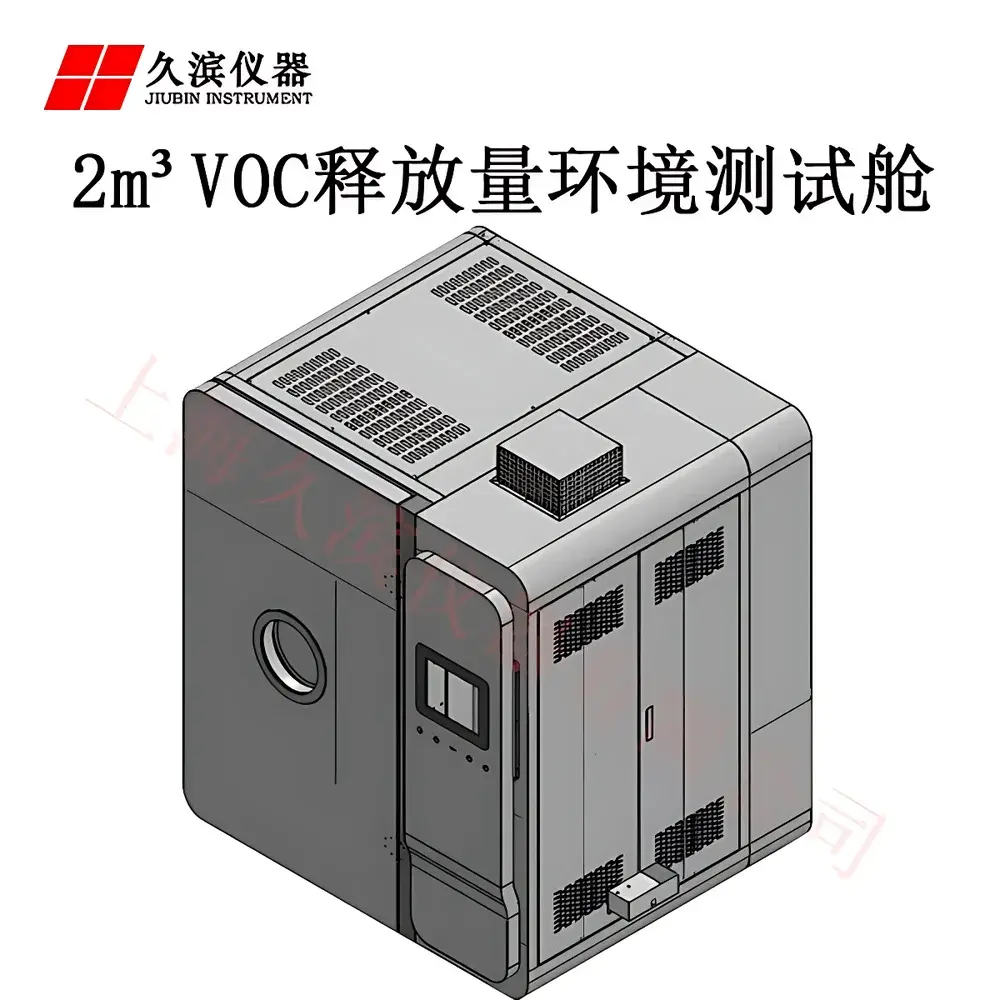
Jiubin JB-160-1m³ VOC Emission Test Chamber for Automotive Interior Components, Compliant with GB/T 39897–2021
| Key | Brand: Jiubin Instruments |
|---|---|
| Origin | Shanghai, China |
| Model | JB-160-1m³ |
| Chamber Volume | 1 m³ |
| Standard Compliance | GB/T 39897–2021 (Determination of Odor and VOC Emission from Building Materials and Automotive Interior Parts) |
| Configuration | Single-chamber, temperature/humidity-controlled, stainless steel interior, inert gas purge system, integrated sampling ports for TO-15/TO-17 canister or thermal desorption tube extraction |
Overview
The Jiubin JB-160-1m³ VOC Emission Test Chamber is a precision-engineered environmental test system designed specifically for standardized evaluation of volatile organic compound (VOC) and odor emissions from automotive interior components—such as dashboards, seat fabrics, trim panels, adhesives, and foams—under controlled climatic conditions. It operates in strict accordance with the Chinese national standard GB/T 39897–2021, “Test Method for Odor and VOC Emissions from Building Materials and Automotive Interior Parts,” which defines chamber-based emission testing protocols aligned with internationally recognized principles of material emission kinetics, including ISO 16000-9, ASTM D5116, and VDA 278. The chamber employs a dynamic flow-through configuration with conditioned air supply (temperature range: 23 ± 0.5 °C; relative humidity: 50 ± 5 % RH), calibrated volumetric flow control (typically 0.5–2.0 air changes per hour), and electropolished 316L stainless steel internal surfaces to minimize adsorption and ensure chemical inertness during extended exposure cycles (e.g., 24 h, 72 h, or 168 h). Its design facilitates quantitative collection of emitted compounds via standardized sorbent tubes (e.g., Tenax TA, Carbopack™) or evacuated canisters for subsequent analysis by GC-MS, GC-FID, or PTR-TOF-MS.
Key Features
- 1 m³ internal volume with precisely dimensioned internal geometry (1000 mm × 1000 mm × 1000 mm), optimized for uniform airflow distribution and minimal boundary layer interference per GB/T 39897–2021 Annex A.
- High-stability climate control system: PID-regulated heating/cooling and humidification/dehumidification modules ensuring ≤ ±0.3 °C temperature stability and ≤ ±3 % RH variation over full operational duration.
- Electropolished 316L stainless steel chamber body and sample support rack, passivated to eliminate catalytic surface reactions and reduce background VOC contribution.
- Dual-stage HEPA + activated carbon filtration on inlet air supply, coupled with zero-air generator compatibility for ultra-low blank performance (<0.1 µg/m³ total VOC baseline).
- Integrated sampling manifold with multiple NPT 1/4″ ports (front, top, side), configurable for simultaneous multi-point sampling or sequential time-resolved profiling.
- Real-time monitoring interface displaying chamber temperature, RH, airflow rate, pressure differential, and elapsed test time—data logged at user-defined intervals (1–60 min) to internal SD card or external PC via RS-485/Ethernet.
Sample Compatibility & Compliance
The JB-160-1m³ chamber accommodates flat or three-dimensional automotive interior parts up to 800 mm × 600 mm footprint and 300 mm height, mounted on a non-emitting stainless steel grid platform. Sample loading follows standardized conditioning (e.g., 24 h at 23 °C/50 % RH prior to chamber insertion) and surface-area-to-volume ratio requirements defined in GB/T 39897–2021 (typically 0.4–1.0 m²/m³). The system supports full traceability workflows required under GLP and ISO/IEC 17025 accreditation: all calibration certificates (flow meters, hygrometers, thermistors), maintenance logs, and test reports are structured to meet audit-ready documentation standards. While GB/T 39897–2021 is the primary compliance anchor, chamber performance parameters—including air exchange rate accuracy (±2 %), temperature uniformity (≤ ±0.8 °C across working zone), and wall loss correction factors—are validated against ISO 16000-11 reference procedures.
Software & Data Management
The chamber is operated via Jiubin’s dedicated LabControl™ software (Windows-based, English UI), enabling automated test scheduling, parameter ramping (e.g., stepped T/RH profiles), alarm-triggered event logging (e.g., door open, flow deviation >5 %), and export of time-stamped CSV/Excel datasets compliant with LIMS integration. Audit trail functionality records operator ID, parameter modifications, and report generation events—fully satisfying data integrity requirements of FDA 21 CFR Part 11 when deployed in regulated R&D or QC environments. Raw sensor data and metadata (including chamber serial number, calibration expiry dates, and environmental certification stamps) are embedded in each exported file header.
Applications
- Pre-certification screening of interior materials for OEM Tier-1 suppliers (e.g., BYD, Geely, Chery, FAW-Volkswagen) against corporate VOC limits (e.g., VW TL 52283, BMW GS 97014).
- Comparative emission profiling of alternative bio-based polymers, low-odor adhesives, or recycled content composites in academic research (e.g., Tsinghua University, SJTU, Tongji University).
- Root-cause analysis of odor complaints in production vehicles via correlation of chamber emission fingerprints (e.g., aldehydes, styrene, xylenes) with sensory panel assessments.
- Validation of mitigation strategies—including plasma treatment, thermal aging pre-conditioning, or catalytic scrubber integration—in collaboration with institutes such as BGI Guangzhou or NAST.
- Supporting regulatory submissions to CNCA or MIIT for China Compulsory Certification (CCC) related to vehicle cabin air quality.
FAQ
What is the maximum allowable sample surface area for a 1 m³ chamber per GB/T 39897–2021?
Per Clause 6.2.2, the recommended loading ratio is 0.4–1.0 m² of exposed material surface area per cubic meter of chamber volume. For the JB-160-1m³, this corresponds to ≤1.0 m² for conservative testing or up to 0.4 m² for high-emission materials requiring lower detection thresholds.
Can the chamber be used for formaldehyde-specific emission testing per GB 18580–2017?
Yes—the chamber’s inert construction, stable climate control, and sampling port configuration fully support formaldehyde collection using DNPH-coated cartridges followed by HPLC-UV analysis, as specified in GB 18580–2017 Annex B.
Is third-party calibration and validation documentation provided with delivery?
Each unit ships with a factory calibration report covering airflow verification (traceable to NIM, China), temperature/humidity sensor calibration (NIST-traceable references), and chamber leak rate test results (<0.5% volume/hour at 250 Pa differential), all valid for 12 months.
Does the system support automated sampling robot integration?
The chamber includes standardized mechanical mounting interfaces and Modbus TCP communication protocol support, enabling seamless integration with commercial autosamplers (e.g., Markes UNITY-xr, PerkinElmer TurboMatrix) for unattended multi-sample campaigns.







