
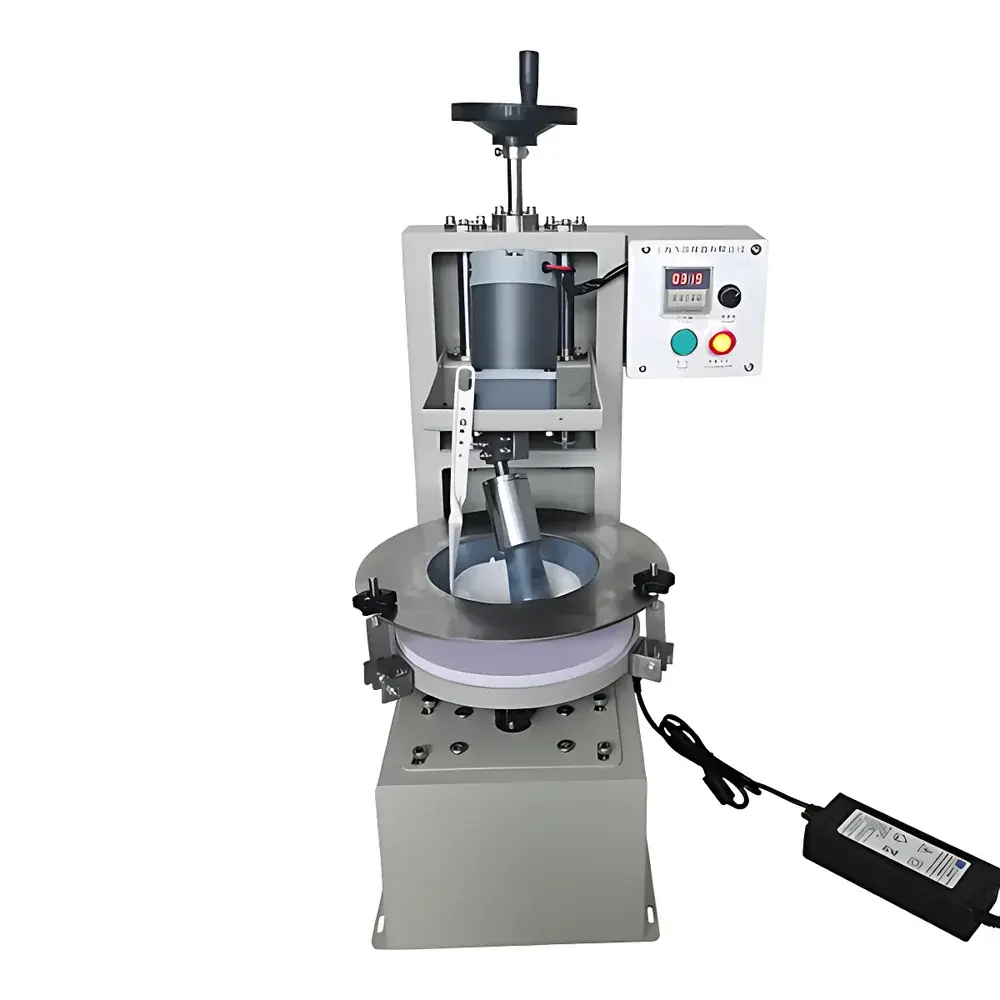
Jiubin JB-200 Automatic Agate Mortar Grinder
| Brand | Jiubin |
|---|---|
| Model | JB-200 |
| Type | Automatic Mortar Grinder |
| Mortar Diameter | 200 mm |
| Pestle Speed | 1–150 rpm |
| Mortar Speed | 10 rpm |
| Pestle Motor Power | 60 W |
| Mortar & Pestle Material | Agate or Alumina Ceramic |
| Dimensions (L×W×H) | 320 × 240 × 630 mm |
| Weight | 15 kg |
| Voltage | AC 220 V, 50 Hz |
| Programmable Grinding Time | Yes |
Overview
The Jiubin JB-200 Automatic Agate Mortar Grinder is an electromechanically driven, precision-controlled laboratory grinding system engineered for reproducible, contamination-free micronization of brittle, hard, and temperature-sensitive materials. It operates on the principle of controlled mechanical attrition—where a rotating agate (or alumina ceramic) pestle applies radial and axial compressive-shear forces against a stationary or slowly rotating agate mortar bowl—enabling progressive particle size reduction without significant heat generation or metallic contamination. Unlike high-energy ball mills or rotor-stator homogenizers, this mortar-based architecture preserves crystal structure integrity and minimizes amorphization risk in pharmaceutical actives, geological standards, semiconductor precursors, and high-purity ceramics. Designed specifically for laboratories requiring batch-to-batch consistency in sub-50 µm particle size distributions, the JB-200 bridges the gap between manual mortar-and-pestle preparation—prone to operator variability—and fully automated planetary milling systems—often over-engineered for routine sample prep.
Key Features
- High-purity grinding chamber: Interchangeable agate or alpha-alumina ceramic mortar and pestle sets ensure zero metal leaching—critical for trace-element analysis (e.g., ICP-MS sample prep) and GMP-compliant pharmaceutical development.
- Independent speed control: Pestle rotation (1–150 rpm) and mortar rotation (10 rpm fixed) are decoupled, allowing optimization of shear-to-compression ratio across material classes—from friable botanicals to ultra-hard silicon carbide powders.
- Programmable time-based operation: Digital timer supports grinding durations from 10 seconds to 99 minutes, with automatic shutdown and audible alert—eliminating subjective endpoint determination.
- Integrated vertical actuation: Precision-guided Z-axis movement ensures consistent pestle immersion depth and contact pressure, minimizing edge chipping and improving wear uniformity on agate components.
- Modular tooling interface: Standardized mounting fixtures accommodate optional accessories—including vacuum-sealed mortar lids for oxygen/moisture-sensitive samples and PTFE-coated scrapers for quantitative recovery of low-yield analytes.
- Compact benchtop footprint: At 320 × 240 × 630 mm and 15 kg, the unit integrates seamlessly into ISO Class 5–7 cleanrooms or QC laboratories with space constraints.
Sample Compatibility & Compliance
The JB-200 accommodates solid samples up to 10 g per batch, including crystalline oxides (Al₂O₃, ZrO₂), pharmaceutical APIs (e.g., ibuprofen, paracetamol), geological reference materials (NIST SRM 278), and electronic-grade powders (LiCoO₂, SiC). Its non-metallic wetted path complies with USP particulate matter testing requirements and ASTM D562 for pigment dispersion assessment. While not certified under FDA 21 CFR Part 11, its deterministic time-based operation supports audit-ready SOP documentation when paired with lab notebook entries or LIMS-integrated logging. The device meets IEC 61000-4 electromagnetic compatibility standards and conforms to GB/T 14710 environmental testing protocols for Chinese domestic laboratory equipment.
Software & Data Management
The JB-200 operates via a dedicated microcontroller-based control panel with LED display and tactile membrane buttons—no external PC or proprietary software required. All operational parameters (start time, duration, speed confirmation) are retained in non-volatile memory across power cycles. For regulated environments, users may document settings manually in electronic lab notebooks (ELNs) or integrate timestamped usage logs via optional RS-232 output (available on JB-200-PRO variant). No firmware updates or cloud connectivity are implemented—ensuring long-term validation stability and eliminating cybersecurity exposure vectors common in IoT-enabled instruments.
Applications
- Pharmaceutical R&D: Pre-formulation studies requiring phase-pure micronized API batches for dissolution profiling per USP .
- Geochemical laboratories: Homogenization of rock powder standards prior to XRF or LA-ICP-MS analysis—preserving elemental stoichiometry.
- Materials science: Preparation of nanocomposite precursors where mechanical alloying must be avoided.
- Food safety testing: Grinding of spice matrices for aflatoxin extraction without thermal degradation.
- Environmental monitoring: Reduction of soil/sediment samples to <75 µm for TCLP leaching tests (EPA Method 1311).
FAQ
What materials are compatible with the agate mortar and pestle?
Agate is suitable for most non-acidic, non-hydrofluoric acid applications—including oxides, carbonates, silicates, and organic solids. For HF-containing or strongly alkaline samples, alumina ceramic tooling is recommended.
Can grinding time be adjusted incrementally during operation?
No—the timer is pre-set before initiation. Interrupting mid-cycle requires manual reset; however, repeatable multi-step protocols (e.g., 2 × 3 min pulses) can be documented in SOPs.
Is the unit suitable for cryogenic grinding?
Not natively—no liquid nitrogen port or insulated housing is provided. Ambient-temperature operation only; for cryo-grinding, consider supplemental dry ice cooling with appropriate safety precautions.
How often should the agate components be inspected for wear?
Visual inspection before each use is advised; replace pestle or mortar if surface pitting exceeds 0.1 mm depth or if dimensional tolerance drift affects reproducibility (typically after ~200–500 hr cumulative use under standard loads).
Does the JB-200 support GLP-compliant calibration records?
Yes—speed verification (tachometer measurement) and timer accuracy (±0.5% deviation at 10–60 min intervals) can be validated using NIST-traceable instruments and documented per internal QA procedures.



