
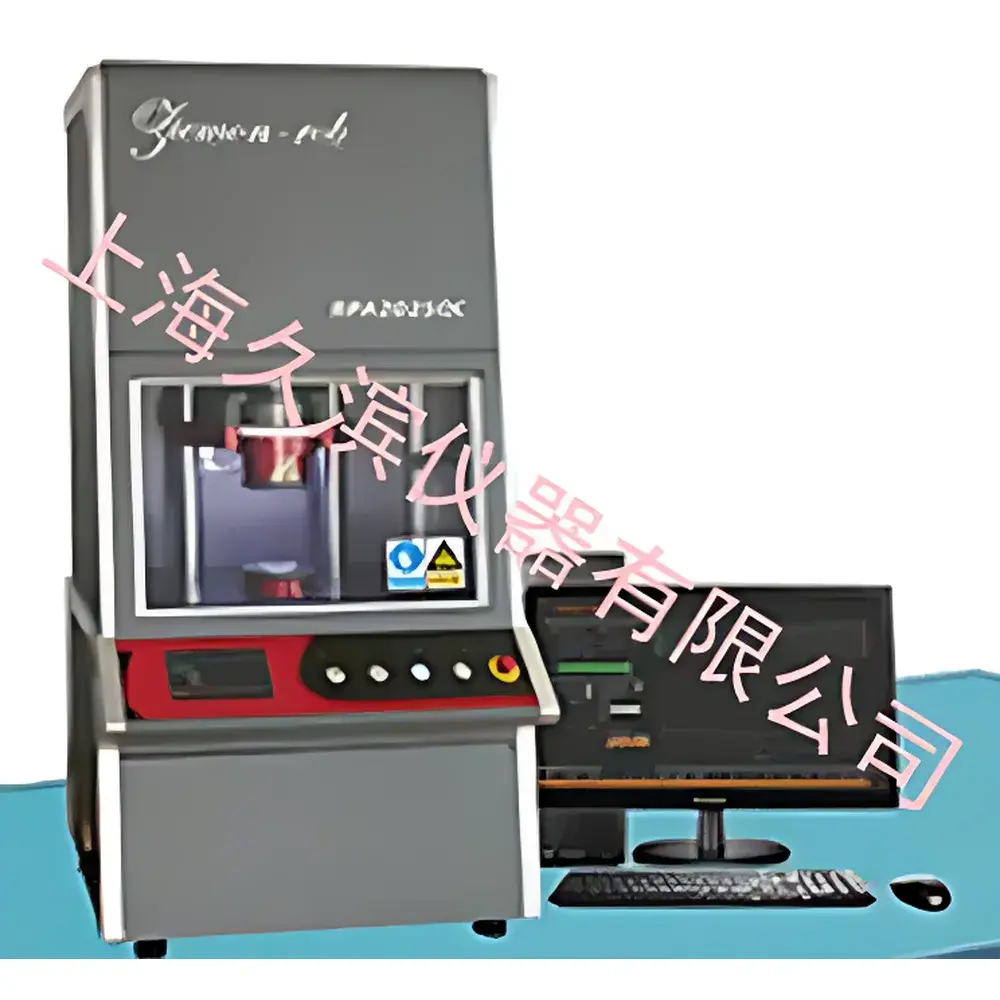
Jiubin JB-2025 Vulcanizometer for Rubber Processing Analysis
| Brand | Jiubin |
|---|---|
| Model | JB-2025 |
| Origin | Shanghai, China |
| Temperature Range | Ambient to 230 °C (±0.3 °C) |
| Temp. Resolution | ±0.01 °C |
| Heating Rate | 30–190 °C in <6 min |
| Cavity Type | Sealed dual-conical oscillating cavity |
| Cavity Gap | 0.45 mm (standard) |
| Drive System | Direct-drive servo motor |
| Oscillation Frequencies | 0.1, 0.5, 1.0, 1.67, 2.0, 20 Hz |
| Oscillation Angles | ±0.2°, ±0.5°, ±1.0°, ±7.143° |
| Strain Amplitudes | ±2.8%, ±7%, ±14%, ±100% |
| Torque Range | 0.01–200 dNm |
| Torque Resolution | 0.01 dNm |
| Torque Accuracy | ±0.5% |
| Closure Force | ≥11.5 kN |
| Sample Volume | ~4.5 cm³ |
| Compliance | ASTM D5289, D6204, D6601 |
Overview
The Jiubin JB-2025 Vulcanizometer is a high-precision, modular rheometric instrument engineered for comprehensive characterization of uncured and curable elastomeric materials under controlled thermal and dynamic mechanical conditions. It operates on the principle of forced oscillatory shear within a sealed, temperature-regulated dual-conical cavity—applying controlled angular displacement or frequency sweeps while measuring the resulting torque response. This enables simultaneous quantification of pre-cure processing behavior (e.g., Mooney viscosity analogs), cure kinetics (scorch time, optimum cure time, cure rate), crosslink density development, and post-cure viscoelastic properties—including storage modulus (G′), loss modulus (G″), and tan δ—across a wide range of strain amplitudes and frequencies. Designed for laboratory-based formulation development and production QC, the JB-2025 delivers traceable, reproducible data aligned with internationally recognized test methodologies.
Key Features
- Microprocessor-controlled thermal system with 4-wire PT100 platinum resistance sensors, ensuring ±0.3 °C accuracy and ±0.01 °C resolution across a 0–230 °C operating range
- Direct-drive servo actuation enabling precise, low-inertia oscillation at six selectable frequencies (0.1–20 Hz) and four discrete angular amplitudes (±0.2° to ±7.143°)
- High-force pneumatic closure system delivering ≥11.5 kN clamping force to maintain cavity integrity and eliminate leakage during high-temperature, high-strain testing
- Dual-conical cavity geometry with standardized 0.45 mm gap, optimized for uniform shear field distribution and minimal wall slip effects in high-viscosity rubber compounds
- Torque transducer mounted directly on the upper cavity plate, offering 0.01 dNm resolution and ±0.5% full-scale accuracy over a 0.01–200 dNm dynamic range
- Programmable thermal ramping profiles: achieves 30–190 °C in under 6 minutes without overshoot, supporting accelerated cure profiling per ASTM D5289 Annex A1
- Integrated safety interlocks, over-temperature cutoff, and real-time cavity pressure monitoring to ensure operator and sample integrity
Sample Compatibility & Compliance
The JB-2025 accommodates raw natural and synthetic rubbers (e.g., NR, SBR, BR, EPDM, FKM), compounded stock (including carbon-black- or silica-filled formulations), thermosetting elastomers, and experimental polymer blends. Its design conforms to the mechanical and procedural requirements of ASTM D5289 (Standard Test Method for Rubber Property—Vulcanization Using Rotorless Cure Meters), ASTM D6204 (Standard Test Method for Rubber Property—Unvulcanized—Mooney Viscosity), and ASTM D6601 (Standard Test Method for Rubber Property—Dynamic Mechanical Properties—Torsional Vibration). All test protocols support GLP-compliant documentation when paired with validated software; instrument firmware and calibration records are maintained per ISO/IEC 17025:2017 guidelines for testing laboratories.
Software & Data Management
The JB-2025 is operated via dedicated Windows-based control and analysis software supporting multi-user role-based access, audit trail logging, and electronic signature capability compliant with FDA 21 CFR Part 11 requirements. Real-time data acquisition includes torque vs. time, G′/G″ vs. temperature, tan δ peaks, and derivative cure rate curves. Export formats include CSV, XML, and PDF reports with embedded metadata (operator ID, calibration certificate ID, environmental conditions). Raw datasets retain full timestamped waveform resolution for retrospective reanalysis. Software supports automated pass/fail evaluation against user-defined specification limits and batch trend charting for SPC implementation in manufacturing environments.
Applications
- Rubber compound formulation optimization: evaluating accelerator systems, filler dispersion effects, and plasticizer efficiency on scorch safety and cure rate
- Production lot release testing: verifying consistency of incoming raw rubber lots and mixed compound batches against master curve databases
- Accelerated aging studies: coupling isothermal cure tests with post-cure thermal cycling to assess reversion resistance in high-temperature service compounds
- Dynamic property mapping: generating master curves via time–temperature superposition (TTS) for finite element modeling of tire tread or sealant performance
- Regulatory submission support: generating ASTM-aligned datasets for FDA 510(k), REACH SVHC screening, or MIL-DTL-25391 qualification packages
- Academic research: investigating structure–property relationships in novel bio-based elastomers and nanocomposite systems
FAQ
What international standards does the JB-2025 fully support?
The instrument meets the mechanical, thermal, and data reporting requirements of ASTM D5289, D6204, and D6601. Calibration procedures follow ISO 17025 traceability chains, and software validation packages are available for Part 11 compliance.
Can the JB-2025 perform both small-strain linear viscoelastic (LVE) and large-strain nonlinear tests?
Yes—by selecting appropriate oscillation angles (±0.2° to ±7.143°) and strain amplitudes (±2.8% to ±100%), users can characterize LVE regions for modulus determination or explore Payne effect, Mullins effect, and fracture onset in filled systems.
Is the cavity design compatible with ASTM D5289’s rotorless configuration requirement?
Yes—the sealed dual-conical cavity eliminates rotating elements and ensures true rotorless operation as defined in ASTM D5289 Section 5.1, minimizing mechanical wear and improving long-term torque stability.
How is temperature uniformity verified across the cavity during rapid heating cycles?
Each unit undergoes cavity mapping using NIST-traceable micro-thermocouples at nine spatial points; thermal gradient remains ≤0.5 °C across the active shear zone during 30–190 °C ramps.
Does the system support integration into a central LIMS or MES platform?
Yes—via OPC UA and RESTful API interfaces, the JB-2025 exports structured test results, instrument status logs, and calibration metadata to enterprise data infrastructure without middleware dependency.







