
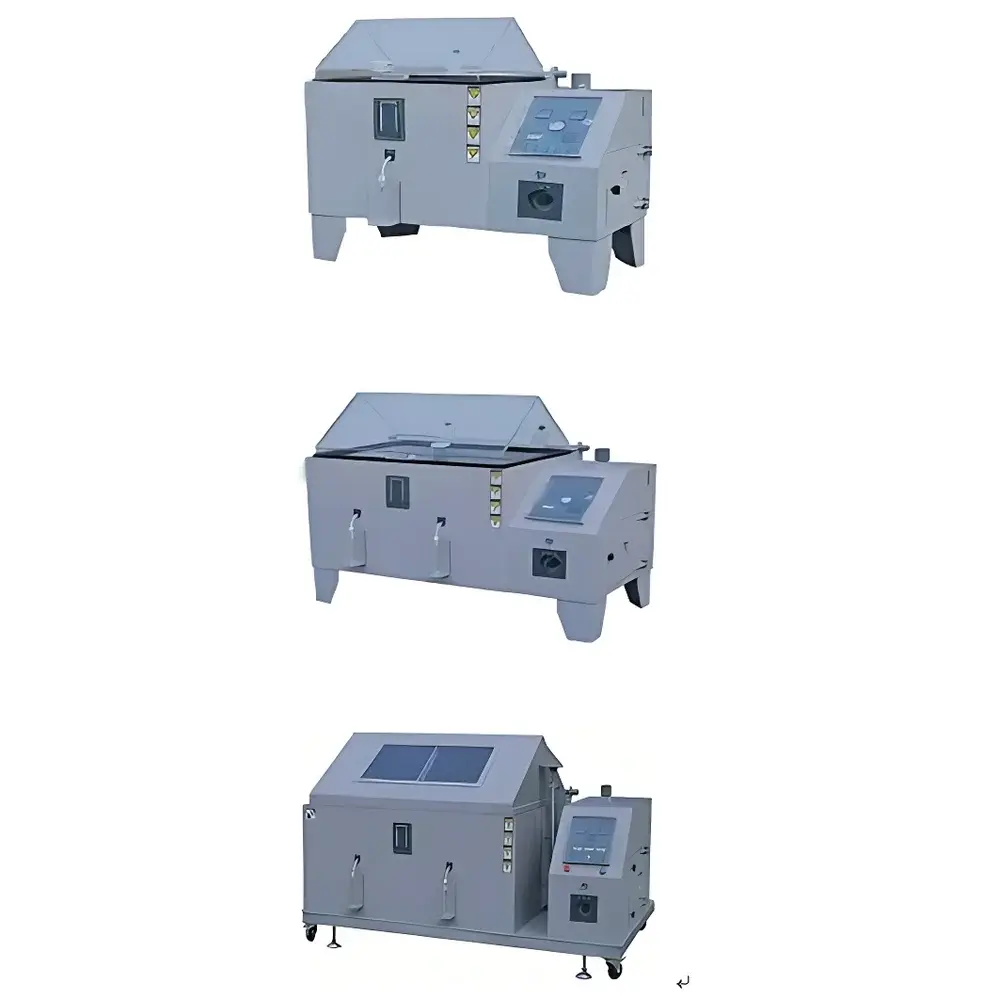
Jiubin JB-210A/B/C/D Salt Spray Test Chamber
| Brand | Jiubin |
|---|---|
| Origin | Taiwan |
| Model | JB-210A, JB-210B, JB-210C, JB-210D |
| Chamber Dimensions (L×W×H) | 60×45×40 cm / 90×60×50 cm / 120×80×50 cm / 160×100×50 cm |
| External Dimensions (L×W×H) | 107×60×118 cm / 141×88×128 cm / 190×130×140 cm / 230×130×140 cm |
| Chamber Volume | 108 L / 270 L / 480 L / 800 L |
| Humidity | ≥85% RH |
| Test Temperature | NSS/ACSS: 35°C ±1°C |
| CASS | 50°C ±1°C |
| Saturated Air Tank Temperature | NSS/ACSS: 47°C ±1°C |
| CASS | 63°C ±1°C |
| Salt Solution Concentration | 5% NaCl (w/v) |
| Spray Rate | 1.0–2.0 mL/80 cm²/h |
| Spray Mode | Continuous or Intermittent |
| Compressed Air Pressure | 1.00 ±0.1 kgf/cm² |
| Power Supply | AC 200 V, 10 A / 20 A / 30 A / 30 A |
| Construction Material | Imported PVC板材 (PVC-U, corrosion-resistant grade) |
| Compliance Standards | ASTM B117, ISO 9227:2006(E), GB/T 10125–1997, CNS 5078-C6053 |
Overview
The Jiubin JB-210 Series Salt Spray Test Chamber is an engineered environmental test system designed to evaluate the corrosion resistance of metallic and coated materials under accelerated saline atmospheric conditions. Based on the principle of controlled fog generation via compressed-air atomization of a standardized sodium chloride solution, this chamber replicates aggressive marine or industrial coastal environments in a reproducible, laboratory-controlled setting. It operates in accordance with internationally recognized accelerated corrosion testing protocols—including neutral salt spray (NSS), acetic acid salt spray (AASS), and copper-accelerated acetic acid salt spray (CASS)—enabling comparative assessment of surface treatments such as electroplating, anodizing, painting, phosphating, and anti-rust oil application. The chamber integrates steam-based heating for uniform thermal distribution and employs Henry’s Law–based saturation of compressed air in a heated humidification tank to ensure stable relative humidity (≥85% RH) and consistent droplet morphology throughout the test duration.
Key Features
- Corrosion-resistant construction using high-purity, imported PVC-U panels—resistant to hydrochloric acid, sodium hydroxide, and salt solutions over extended exposure cycles.
- Precision temperature control via microprocessor-based PID controller (±0.1°C resolution) with dual independent overtemperature protection circuits for operational safety.
- Adjustable glass nozzle assembly with conical disperser design ensures uniform, non-crystallizing salt fog distribution across the test specimen area—eliminating localized dry spots or salt buildup.
- Auto-refill water level management system maintains uninterrupted operation by triggering replenishment when reservoir levels fall below threshold.
- Two spray modes: continuous fog generation for standard NSS/AASS protocols, and programmable intermittent cycling for simulating real-world wet/dry corrosion cycles.
- Saturated air tank heated independently to precise setpoints (47°C ±1°C for NSS/AASS; 63°C ±1°C for CASS), ensuring thermodynamic equilibrium and stable fog density per ISO 9227 requirements.
- Integrated LED digital display interface provides real-time monitoring of chamber temperature, saturated tank temperature, and operational status indicators.
Sample Compatibility & Compliance
The JB-210 Series accommodates flat, cylindrical, or irregularly shaped specimens up to the internal chamber volume limit (108–800 L), with adjustable specimen racks and non-metallic support fixtures to prevent galvanic interference. All models are validated against major international standards including ASTM B117–19 (Standard Practice for Operating Salt Spray (Fog) Apparatus), ISO 9227:2006(E) (Corrosion tests in artificial atmospheres — Salt spray tests), GB/T 10125–1997 (Equivalent to ISO 9227), and CNS 5078-C6053 (Chinese National Standard for salt fog testing). The system supports full traceability documentation required for GLP-compliant laboratories and meets prerequisite conditions for ISO/IEC 17025 accreditation audits when operated within defined procedural controls.
Software & Data Management
While the base JB-210 Series utilizes embedded microcontroller logic without external PC connectivity, optional RS-485 or Ethernet-enabled data logging modules (JB-210-DCM) are available for integration into centralized laboratory information management systems (LIMS). These modules record timestamped temperature, humidity, and operational cycle data at user-defined intervals (1–60 min), generating CSV-compatible audit trails compliant with FDA 21 CFR Part 11 requirements when paired with electronic signature validation protocols. All firmware adheres to IEC 61508 functional safety guidelines for industrial control equipment.
Applications
- Quality assurance of automotive fasteners, chassis components, and trim finishes under OEM-specific corrosion specifications (e.g., GMW 14872, Ford CETP 00.00-L-467).
- Validation of aerospace aluminum alloys and titanium substrates following AMS 2700 and ASTM G85 Annex A5 (modified salt spray).
- R&D evaluation of novel anti-corrosion coatings—including silane-based, graphene-enhanced, and self-healing polymer systems—against industry benchmark materials.
- Supplier qualification testing for electronics enclosures, PCB conformal coatings, and medical device housings requiring IEC 60529 IPX4-level environmental resilience.
- Third-party certification testing for ISO 14001 environmental management system compliance where corrosion performance forms part of product lifecycle impact analysis.
FAQ
What salt concentration is used in standard NSS testing?
A 5.0% (w/v) sodium chloride solution, prepared using reagent-grade NaCl and deionized water (conductivity ≤20 µS/cm), is required per ASTM B117 and ISO 9227.
Can the chamber perform CASS testing without hardware modification?
Yes—the JB-210 series supports CASS testing via software-set temperature profiles (50°C chamber, 63°C saturation tank) and addition of copper chloride catalyst to the salt solution, as specified in ISO 9227 Clause 7.3.
Is PVC construction suitable for long-term exposure to acidic salt mists?
Yes—industrial-grade PVC-U exhibits exceptional resistance to chloride ion penetration and acid degradation, with service life exceeding 15 years under continuous NSS operation when maintained per manufacturer guidelines.
How is fog uniformity verified during calibration?
Per ISO 9227 Annex B, fog collection is measured using at least three 80 cm² funnels placed across the working zone; recorded deposition must remain within 1.0–2.0 mL/h with ≤15% inter-funnel deviation.
Does the system include validation documentation for ISO/IEC 17025 compliance?
Factory calibration certificates (traceable to NIST or NML standards) and IQ/OQ protocol templates are provided; full PQ execution requires user-defined test samples and acceptance criteria aligned with internal quality procedures.
Related Products



