
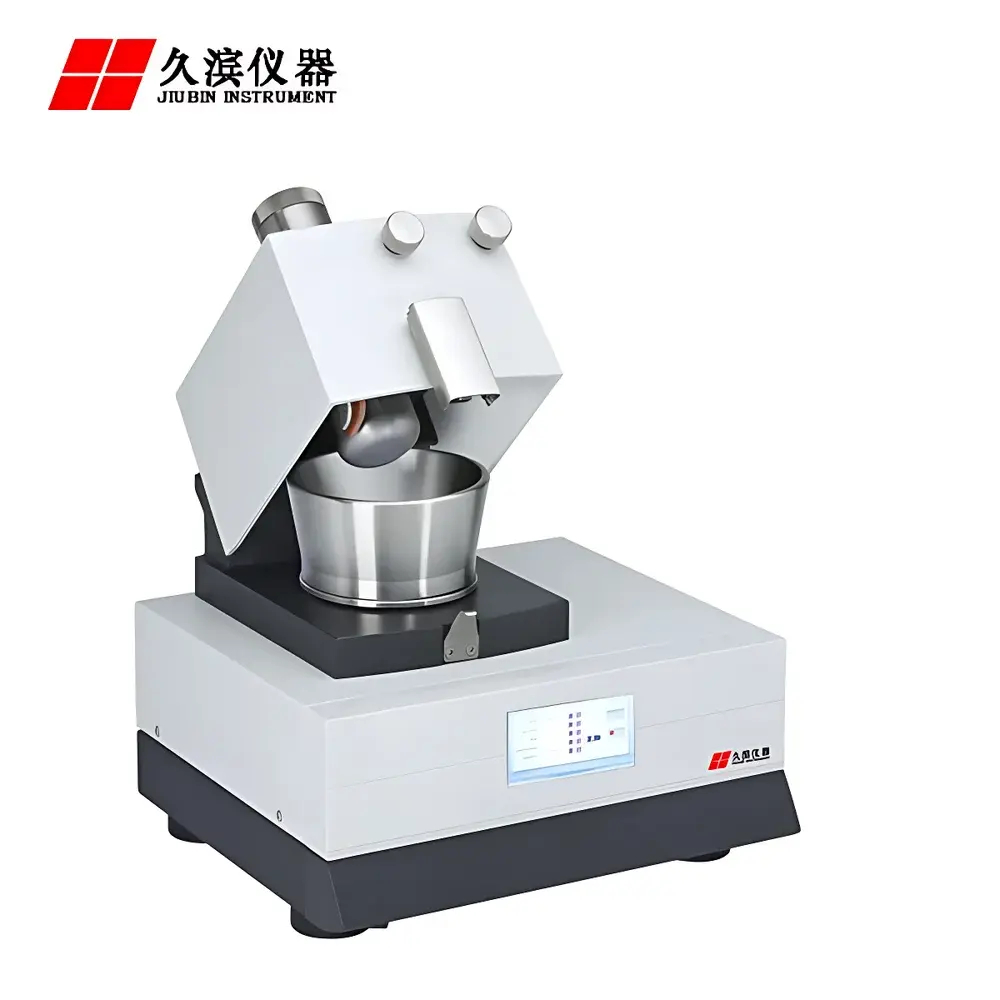
Jiubin JB-220 Mortar Grinder
| Brand | Jiubin |
|---|---|
| Origin | Shanghai, China |
| Model | JB-220 |
| Instrument Type | Mortar Grinder |
| Sample Applicability | Hard, brittle, soft, sticky, moist, or paste-like materials |
| Maximum Feed Size | ≤ 10 mm |
| Final Particle Size | ~10 µm |
| Batch Volume | 10–230 mL |
| Operation Modes | Dry grinding, wet grinding, cryogenic grinding |
| Pressure Adjustment | Graduated scale with real-time load display |
| Grinding Time Resolution | 1-second precision |
| Safety | Interlocked safety guard with automatic shutdown |
| Motor | High-torque, low-noise geared motor |
| Sealing | Dust-tight grinding chamber |
| Illumination | Integrated LED lighting with observation window |
| Grinding Kit Options | 7 material-compatible sets (e.g., agate, stainless steel, tungsten carbide, zirconia, PTFE, ceramic, hardened steel) |
| Mounting | Tool-free plug-in mortar and pestle assembly |
Overview
The Jiubin JB-220 Mortar Grinder is a precision-engineered laboratory grinding instrument based on the classical mortar-and-pestle principle, adapted for reproducible, controllable, and contamination-minimized sample comminution. It operates via controlled mechanical compression and shearing between a vertically actuated pestle and a fixed, concave mortar bowl—generating high localized stress under adjustable pressure to fracture particles through brittle fracture, plastic deformation, and attrition mechanisms. Unlike rotor-based mills, this design delivers low heat generation per unit mass, making it especially suitable for thermolabile, hygroscopic, or oxidation-sensitive samples. Its modular architecture supports method transfer across R&D, QC, and regulatory environments where particle size reduction must comply with documented procedures and traceable parameters.
Key Features
- Intuitive 7-inch capacitive touchscreen interface with real-time load monitoring and programmable grinding profiles (time, pressure, pause intervals)
- Calibrated pestle pressure scale (0–100 units) enables precise force control—critical for preserving crystallinity in pharmaceutical actives or avoiding amorphization in mineralogical analysis
- Tool-free, bayonet-style mortar–pestle coupling ensures rapid changeover between batches and cleaning validation readiness
- Interlocked safety guard halts operation instantly upon lid opening; integrated proximity sensors meet IEC 61000-6-2 EMC immunity requirements
- Dust-tight grinding chamber with silicone gasket seal prevents cross-contamination and operator exposure—aligned with OSHA 1910.1200 hazard communication standards
- LED-lit observation window allows visual verification of pestle alignment, sample distribution, and grinding homogeneity without interrupting operation
- Seven interchangeable grinding kits—including agate (for trace-metal-free geochemical prep), zirconia (for high-hardness ceramics), PTFE (for acidic or fluorinated matrices), and hardened steel (for high-throughput industrial QA)—support ISO/IEC 17025 method validation
- Low-vibration, brushless geared motor delivers consistent torque output across 0.1–5 N·m range, minimizing mechanical drift during extended runs
Sample Compatibility & Compliance
The JB-220 accommodates heterogeneous feed materials up to 10 mm in maximum dimension—including rock fragments, sintered oxides, dried plant tissue, pharmaceutical tablets, metallurgical slags, and hydrated cement clinkers. Final particle distributions typically center around 10 µm (D50) with narrow span (D90/D10 < 3.5) under optimized dry-grinding conditions. The system supports ASTM D2493 (soil particle size analysis), ISO 13320 (laser diffraction sample prep), and USP <429> (pharmaceutical granule size specification). All contact surfaces are certified non-reactive per FDA CFR Title 21 Part 177, and optional documentation packages include IQ/OQ protocols compliant with GLP and GMP Annex 15 requirements.
Software & Data Management
Grinding parameters—including time, pressure setpoint, actual load curve, cycle count, and ambient temperature—are logged internally with timestamp and user ID. Export is supported via USB 2.0 to CSV or XML formats compatible with LIMS integration (e.g., LabWare, Thermo Fisher SampleManager). Audit trails retain all parameter modifications with electronic signature capability meeting FDA 21 CFR Part 11 requirements. Optional firmware upgrade enables remote diagnostics and calibration certificate synchronization with NIST-traceable reference standards.
Applications
- Preparation of homogenized sub-samples for XRF, XRD, and SEM-EDS analysis in geological and metallurgical laboratories
- Reduction of API-excipient blends prior to dissolution testing (USP <711>) and content uniformity assays
- Particle size standardization of reference materials used in inter-laboratory proficiency testing (ILS)
- Cryogenic grinding of polymer composites and biological tissues using liquid nitrogen-cooled mortar inserts
- Homogenization of contaminated soil cores for EPA Method 3050B acid digestion
- Production of ultrafine ceramic precursors for sintering studies requiring <15 µm median size
- Batch-wise processing of food spices and herbal extracts where volatile oil retention is critical
FAQ
What types of materials are incompatible with the JB-220?
Highly fibrous materials (e.g., raw cellulose pulp), elastomers with >400% elongation at break, and bulk metals exceeding HB 350 hardness are not recommended due to pestle slippage or excessive wear.
Can the JB-220 be validated for GMP use?
Yes—full qualification documentation (DQ/IQ/OQ/PQ), including pressure transducer calibration certificates and grinding repeatability data (RSD ≤ 2.3% for n=6 replicate runs), is available upon request.
Is wet grinding supported with solvent recovery?
Wet grinding is fully supported; however, the sealed chamber is not designed for vacuum-assisted solvent extraction. Optional condenser adapters enable reflux-compatible setups for volatile solvents.
How often does the pestle–mortar interface require recalibration?
Load sensor calibration is factory-performed and stable for ≥12 months under normal use; annual verification against dead-weight standards is advised per ISO/IEC 17025 Clause 6.5.2.
Does the instrument meet CE or UKCA marking requirements?
Yes—the JB-220 complies with EU Machinery Directive 2006/42/EC, EMC Directive 2014/30/EU, and RoHS 2011/65/EU, with full technical file available for customs clearance.



