
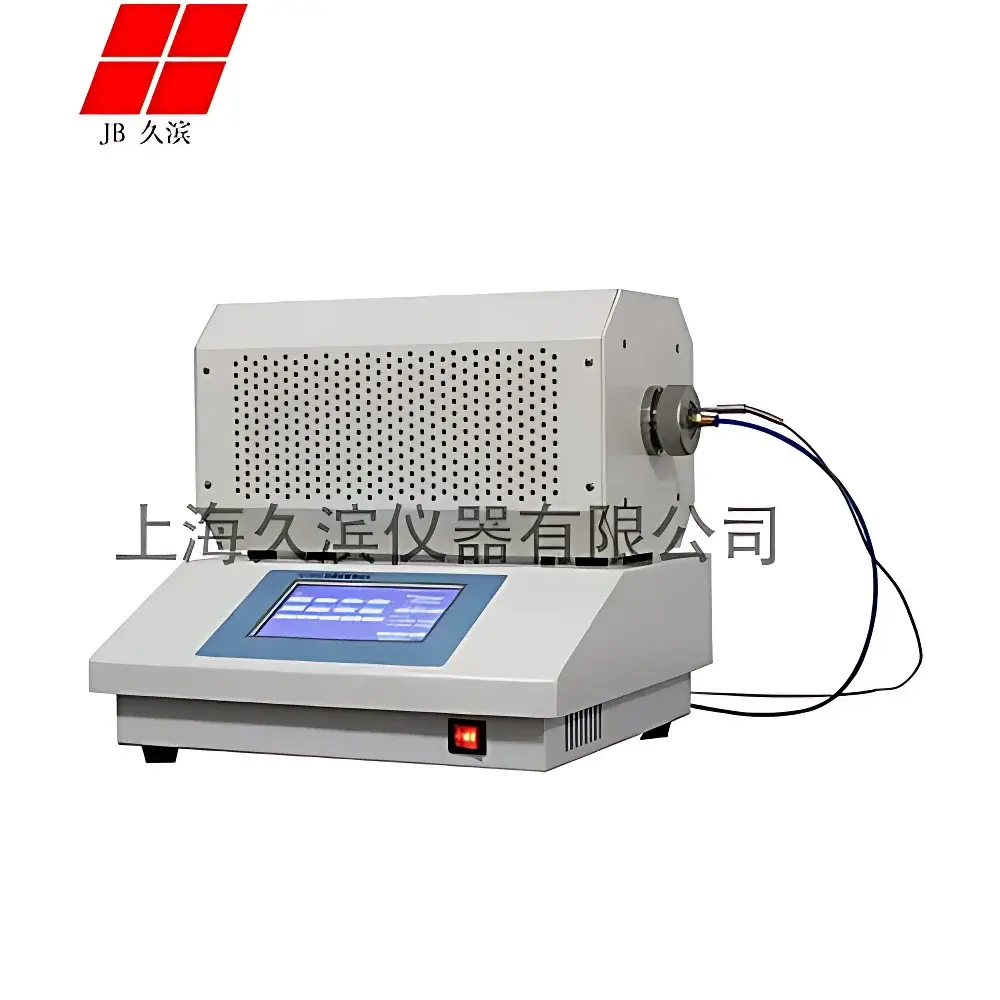
Jiubin JB-3500S Automated Thermogravimetric Carbon Black Content Analyzer for Polymeric Materials
| Brand | Jiubin Instruments |
|---|---|
| Model | JB-3500S |
| Origin | Shanghai, China |
| Temperature Range | Ambient to 1100 °C |
| Heating Zone Length | 220 mm |
| Quartz Tube Dimensions | 440 mm (L) × 32 mm (ID) |
| Quartz Boat Options | 50 mm or 75 mm |
| Temperature Resolution | 0.01 °C |
| Temperature Stability | ±0.2 °C |
| Heating Rate | 0.1–40 °C/min |
| Gas Flow Control | Digital Mass Flow Controller (0–300 mL/min or 0–2000 mL/min) |
| Gas Pressure Rating | 0.2 MPa |
| Display | 7-inch 24-bit color LCD touchscreen |
| Communication Interface | USB |
| Sample Capacity | Up to 3 specimens simultaneously |
| Exhaust Port Diameter | 12 mm |
| Compliance | GB/T 3515–2005, GB/T 13021–1991, GB/T 2951.41–2008, IEC 60811-4-1:2004 |
Overview
The Jiubin JB-3500S Automated Thermogravimetric Carbon Black Content Analyzer is an industrial-grade instrument engineered for precise, reproducible quantification of carbon black concentration in thermoplastic and elastomeric materials—including polyethylene (PE), polypropylene (PP), polybutylene (PB), cable insulation and jacketing compounds, and vulcanized rubber. It operates on the principle of controlled pyrolysis under inert nitrogen atmosphere, followed by gravimetric determination of residual carbonaceous mass. Unlike combustion-based methods, this thermogravimetric approach eliminates oxidative interference and ensures high fidelity in carbon black measurement—critical for quality control in wire & cable manufacturing, polymer compounding, and regulatory compliance testing. The system integrates a dual-temperature-sensing architecture, programmable thermal profiling, and full automation from sample loading to final report generation, minimizing operator dependency and inter-laboratory variability.
Key Features
- Automated nitrogen gas delivery and switching via digital mass flow controller with dual-range capability (0–300 mL/min and 0–2000 mL/min), ensuring optimal purge efficiency across diverse sample matrices.
- Dual high-precision thermocouple array embedded along the heating zone enables real-time temperature gradient monitoring and enhanced thermal uniformity control (±0.2 °C stability).
- 7-inch full-color LCD touchscreen interface with intuitive navigation supports complete program definition—including multi-step ramp-hold-cool cycles, gas flow scheduling, and alarm-triggered event logging.
- 220 mm extended heating zone accommodates up to three standardized quartz boats simultaneously, enabling batch processing without compromising thermal homogeneity.
- Removable fused-quartz tube (440 mm L × 32 mm ID) facilitates rapid cooling and routine maintenance; large-diameter (12 mm) exhaust port prevents soot accumulation and flow restriction during prolonged pyrolysis.
- Integrated acoustic alert signals completion of thermal protocol; USB interface enables direct data export and remote supervision via PC-based terminal software.
Sample Compatibility & Compliance
The JB-3500S is validated for use with granular, pelletized, and powdered polymeric feedstocks conforming to ASTM D1606 (historical reference), ISO 6964 (rubber—determination of carbon black content), and multiple Chinese national standards: GB/T 3515–2005 (rubber—determination of carbon black content by pyrolysis), GB/T 13021–1991 (polyethylene pipes—carbon black content test), and GB/T 2951.41–2008 / IEC 60811-4-1:2004 (electric cables—tests on insulating and sheathing materials). Its design adheres to GLP-aligned operational rigor, supporting audit-ready record retention including timestamped temperature profiles, gas flow logs, and weight-change curves. While not FDA 21 CFR Part 11-certified out-of-the-box, the instrument’s deterministic behavior and traceable calibration path make it suitable for GMP-adjacent QC environments where raw material specification verification is required.
Software & Data Management
Data acquisition and analysis are managed through a vendor-supplied Windows-compatible application accessible via USB connection. The software captures continuous weight loss kinetics synchronized with temperature and gas flow parameters, generating TGA-style derivative (DTG) and residual mass plots. Users may define custom calculation templates aligned with standard reporting formats—for instance, % carbon black = (mass residue after pyrolysis / initial dry mass) × 100. All raw datasets are saved in CSV and proprietary binary formats with embedded metadata (operator ID, sample ID, date/time stamp, method version). Audit trail functionality includes user login tracking and parameter change history, supporting internal QA documentation requirements.
Applications
This analyzer serves critical roles in polymer formulation validation, incoming raw material inspection, and production line release testing. Typical use cases include: verifying carbon black loading consistency in PE black masterbatches used for UV-stabilized geomembranes; assessing dispersion homogeneity in PP-based automotive interior compounds; confirming compliance of halogen-free flame-retardant cable jackets per IEC 60811 specifications; and supporting R&D efforts in conductive polymer development where carbon black acts as both filler and functional additive. Its robust thermal architecture and inert-atmosphere control also support method development for alternative carbonaceous fillers such as carbon nanotubes or graphene derivatives—provided appropriate pyrolysis validation is performed.
FAQ
What standards does the JB-3500S directly support?
It is fully aligned with GB/T 3515–2005, GB/T 13021–1991, GB/T 2951.41–2008, and IEC 60811-4-1:2004 for carbon black quantification in polymers and elastomers.
Can the instrument operate unattended for extended runs?
Yes—fully automated thermal programming, gas switching, and endpoint detection enable overnight operation without manual intervention.
Is quartz tube replacement required after each test?
No—the fused-quartz tube is designed for repeated use; cleaning protocols and visual inspection between batches are sufficient under normal operating conditions.
How is temperature calibration verified?
The system supports external calibration using NIST-traceable reference thermocouples; factory calibration certificates are provided with each unit.
What maintenance intervals are recommended?
Routine checks of gas seals, quartz boat integrity, and flow meter zero-point drift are advised every 200 operational hours; annual preventive maintenance is recommended for sustained metrological reliability.



