
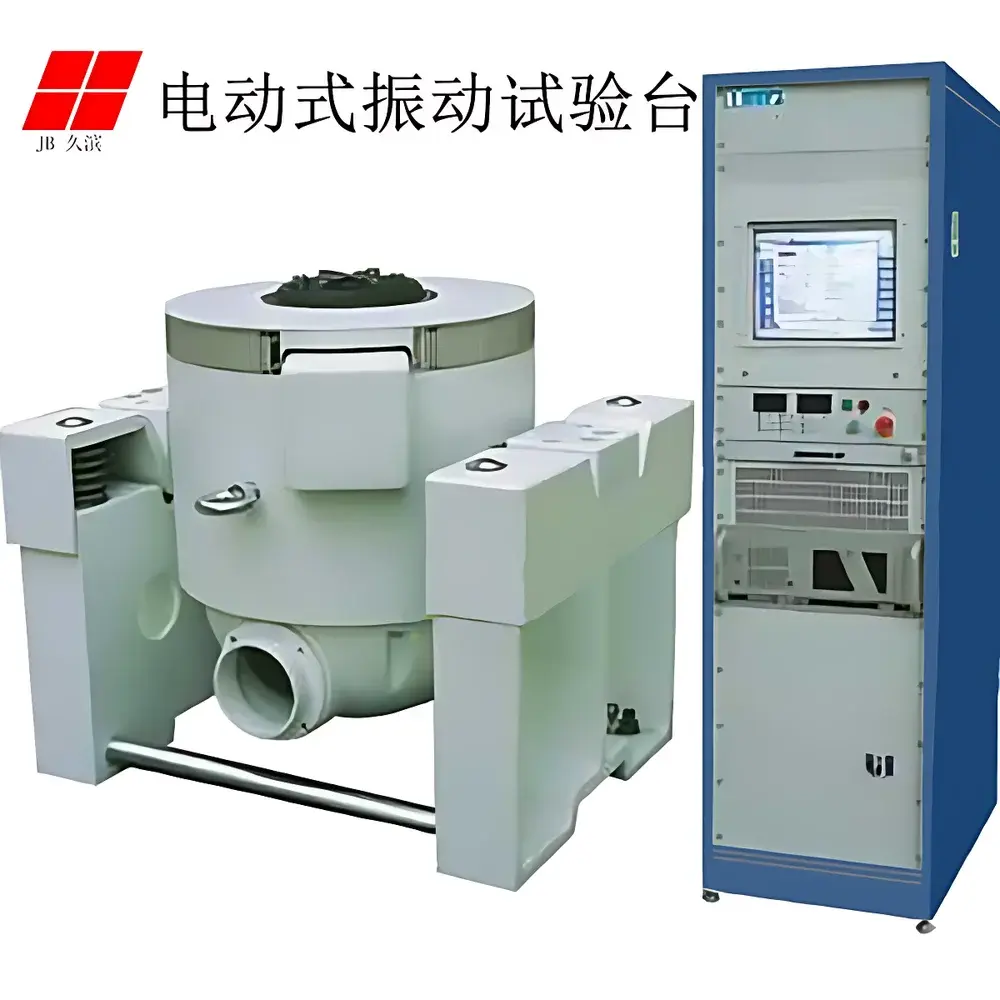
Jiubin JB-600-5 Electrodynamically Driven Vibration Test System
| Brand | Jiubin |
|---|---|
| Origin | Shanghai, China |
| Model | JB-600-5 |
| Sinusoidal Force Range | 9800–49000 N |
| Rated Frequency Range | 5–3000 Hz |
| Peak Velocity | 1020 m/s |
| Zero-Load Acceleration | 1.5 m/s² |
| Peak-to-Peak Displacement | 51 mm |
| Payload Capacity | 140–1000 kg |
| Power Consumption | 22–76 kVA |
| Supply Voltage | AC 380 V ±10%, 50 Hz |
| Moving Coil Mass | 3–50 kg |
| Power Amplifier Weight | 250–800 kg |
| Cooling Method | Forced Air |
| Compliance | GB/T 13310-91, Q/320502SN001-2003 |
Overview
The Jiubin JB-600-5 Electrodynamically Driven Vibration Test System is a high-performance electrodynamic shaker designed for laboratory-based simulation of mechanical vibration environments encountered during transportation, handling, and operational service life. It operates on the principle of Lorentz force generation: a moving coil—suspended within a dual-magnetic-field structure—experiences a time-varying electromagnetic force when energized by a controlled alternating current from a high-efficiency switching amplifier. This fundamental transduction mechanism enables precise, repeatable excitation across broad frequency and amplitude domains. Engineered for structural integrity and thermal stability, the system integrates a coreless moving coil assembly, cantilevered suspension with air-spring isolation, and a digitally regulated forced-air cooling architecture. Its performance envelope meets or exceeds the requirements of GB/T 13310-91 (Technical Specifications for Electrodynamically Driven Vibration Systems) and enterprise standard Q/320502SN001-2003, ensuring traceability and technical validity in regulated test environments.
Key Features
- Dual-magnetic-circuit design enhances magnetic flux density uniformity and improves force linearity across the full operational bandwidth.
- Coreless moving coil construction minimizes inertia and eddy-current losses, supporting high acceleration fidelity and extended high-frequency response up to 3000 Hz.
- Cantilevered suspension with pneumatic (air-spring) support delivers low-resonance mechanical isolation and stable center-of-gravity positioning under variable payload conditions (140–1000 kg).
- High-efficiency switching power amplifier achieves >90% electrical-to-electromechanical power conversion, significantly reducing thermal load and energy consumption relative to linear amplifiers.
- Integrated intelligent protection logic monitors coil temperature, voltage/current limits, displacement saturation, and amplifier status in real time, enabling automatic shutdown without manual intervention.
- Soft-start functionality ensures controlled ramp-up of excitation signals, mitigating mechanical shock during system initialization and safeguarding both test article and shaker hardware.
Sample Compatibility & Compliance
The JB-600-5 accommodates a wide range of test specimens—from printed circuit boards (PCBs), optical modules (e.g., automotive ADAS cameras), and avionics enclosures to full-scale automotive subassemblies and aerospace structural components. Its configurable slip table and auxiliary fixture interfaces support ISO 5344-compliant mounting practices. The system is validated for conformance with national and international standards including GB/T 2423.10 (sinusoidal vibration), GB/T 2423.56 (broadband random vibration), GJB 150.16A, MIL-STD-810H Method 514.8, IEC 60068-2-6, ISO 16750-3, and ASTM D999. All control and measurement functions are structured to support GLP/GMP-aligned documentation workflows, including audit-trail-capable test logging and calibration certificate traceability.
Software & Data Management
The system interfaces with industry-standard vibration control platforms (e.g., Vibration Research VR9500, Crystal Instruments CoCo-90, or m+p VibControl) via IEEE 1394 or Ethernet-based real-time communication protocols. Control software supports closed-loop feedback using accelerometers or laser Doppler vibrometers, enabling precise spectral shaping for sine sweep, resonant dwell, random PSD synthesis, and transient shock replication. Data acquisition resolution is ≥24-bit, with sampling rates configurable up to 102.4 kHz per channel. Export formats include UFF58, HDF5, and CSV; all raw and processed datasets retain embedded metadata (test ID, operator, calibration date, environmental conditions). For regulated environments, optional FDA 21 CFR Part 11 compliance packages provide electronic signature enforcement, role-based access control, and immutable audit trails.
Applications
This vibration test system serves as a foundational tool in product development, qualification, and reliability assurance across multiple sectors. In automotive engineering, it validates ECU housing integrity under road-induced broadband vibration profiles per ISO 16750-3. In aerospace, it performs modal survey excitation and qualification-level random testing per DO-160 Section 8. In electronics manufacturing, it verifies solder joint fatigue resistance in PCBAs subjected to transport vibration spectra defined in ISTA 3A or JEDEC JESD22-B103. Additionally, it supports HALT/HASS protocols where controlled over-stress profiling identifies design weaknesses prior to field deployment. Its capacity to deliver high-force, low-distortion excitation at frequencies up to 3000 Hz makes it suitable for resonance search, fatigue life estimation, and transmissibility analysis of medium-to-large mechanical assemblies.
FAQ
What standards does the JB-600-5 comply with for vibration testing?
It conforms to GB/T 13310-91, GB/T 2423.10, GB/T 2423.56, MIL-STD-810H Method 514.8, and ISO 16750-3, among others.
Can this system perform both sine and random vibration tests?
Yes—it supports closed-loop sinusoidal sweep, resonant dwell, broadband random PSD generation, and classical shock pulse testing.
What is the maximum payload capacity and how is payload distribution managed?
Rated payload ranges from 140 kg to 1000 kg; optimal center-of-gravity alignment is ensured via adjustable slip-table mounting and dynamic balancing procedures.
Is the power amplifier water-cooled or air-cooled?
The system employs forced-air cooling for both the shaker armature and power amplifier, eliminating dependency on external chillers or plumbing infrastructure.
Does the system support third-party control software integration?
Yes—it provides native driver support for Vibration Research, m+p International, Crystal Instruments, and HEAD Acoustics platforms via standard digital I/O and TCP/IP interfaces.



