
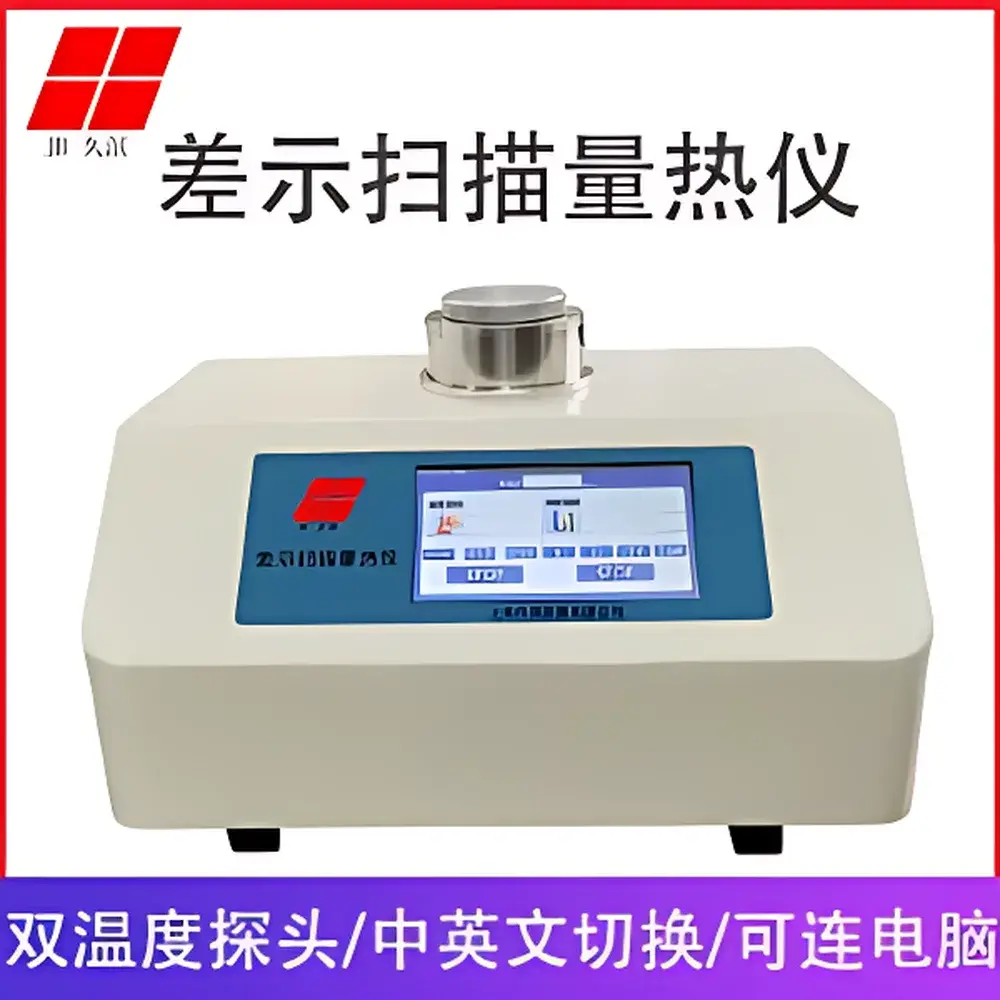
Jiubin JB-DSC-600 Differential Scanning Calorimeter
| Brand | Jiubin |
|---|---|
| Origin | Shanghai, China |
| Model | JB-DSC-600 |
| Sample Capacity | 1 |
| Temperature Range | Ambient to 600 °C |
| Heating/Cooling Rate | 0.1–100 K/min |
| DSC Heat Flow Range | ±500 mW |
| Sensitivity | 0.01 mW |
| Noise Level | 0.001 mW |
| Thermal Resolution | 0.001 mW |
| Temperature Repeatability | ±0.1 °C |
| Temperature Resolution | 0.1 °C |
| Gas Flow Control | 0–200 mL/min (0.2 MPa max) |
| Interface | USB |
| Display | 7-inch 24-bit color touchscreen LCD |
| Power Supply | AC 220 V, 50 Hz, 600 W |
Overview
The Jiubin JB-DSC-600 Differential Scanning Calorimeter is a precision thermal analysis instrument engineered for quantitative measurement of heat flow differences between a sample and inert reference as a function of temperature or time. Based on the principle of heat-flux DSC, it employs a symmetrical twin-furnace design with high-stability platinum resistance temperature sensors and micro-calorimetric detection to deliver reproducible thermodynamic data under controlled atmospheric conditions. Designed for routine and research-grade applications in polymer science, pharmaceutical development, materials engineering, and quality assurance laboratories, the JB-DSC-600 supports standardized thermal event characterization—including melting onset, crystallization exotherms, glass transition (Tg), oxidative induction time (OIT), cure kinetics, and phase transformation enthalpies—across a broad operational range from ambient to 600 °C.
Key Features
- Programmable heating and cooling rates from 0.1 to 100 K/min, enabling precise control over thermal scan profiles for kinetic analysis and method development.
- High-sensitivity heat flow detection (0.01 mW sensitivity, 0.001 mW noise floor, and 0.001 mW resolution) ensures accurate quantification of small thermal transitions, such as weak crystallization peaks or low-enthalpy polymorphic conversions.
- Integrated dual-gas manifold with automatic switching and digitally regulated mass flow control (0–200 mL/min, up to 0.2 MPa) supports inert (N2, Ar), oxidative (air, O2), or reducing atmospheres per ASTM E1269 and ISO 11357 standards.
- Self-contained calibration system with certified reference materials (e.g., indium, tin, zinc) and one-click thermal and enthalpy calibration routines—traceable to NIST-traceable standards—ensures ongoing measurement integrity without external service intervention.
- 7-inch high-resolution 24-bit color touchscreen interface with intuitive icon-driven navigation; real-time curve preview, parameter logging, and on-device data review eliminate dependency on external PCs during routine operation.
- Robust mechanical architecture featuring low-drift furnace design, symmetric sensor placement, and active thermal shielding minimizes baseline drift and improves long-term signal stability across repeated thermal cycles.
Sample Compatibility & Compliance
The JB-DSC-600 accommodates standard aluminum, gold-coated aluminum, or hermetic stainless-steel crucibles (60–100 µL capacity), supporting solid powders, granules (e.g., plastic pellets), thin films, and small-volume liquid samples. Its single-position sample stage is optimized for high-reproducibility comparative analysis, particularly suited for QC environments where batch-to-batch consistency is critical. The instrument complies with core thermal analysis regulatory expectations: temperature accuracy and repeatability meet requirements outlined in USP , ISO 11357-1, and ASTM E794 for melting point determination; enthalpy calibration protocols align with ISO 11357-2; and optional audit-trail-enabled software modules support GLP/GMP-aligned workflows including electronic signatures and 21 CFR Part 11–compliant data archiving when integrated with validated PC-based acquisition platforms.
Software & Data Management
Data acquisition and analysis are performed via optional Windows-based software (compatible with Windows 10/11, 64-bit), which provides full ICH Q5A-compliant reporting templates, peak deconvolution tools, multi-curve overlay, baseline correction algorithms (tangent, step, polynomial), and automatic onset/midpoint/peak temperature annotation. Raw DSC thermograms are stored in vendor-neutral ASCII (.txt) and universal .csv formats, ensuring interoperability with third-party statistical packages (e.g., JMP, OriginLab) and LIMS integration. All metadata—including operator ID, calibration timestamp, gas type, purge flow rate, and instrument firmware version—is embedded in each dataset header. Exported reports include digital signatures, revision history, and configurable QA/QC flags for internal audit readiness.
Applications
- Determination of melting point, melt enthalpy, and degree of crystallinity in polyolefins, PET, PA6, PEEK, and other thermoplastics per ISO 11357-3.
- Identification and quantification of polymorphic forms and amorphous content in active pharmaceutical ingredients (APIs) and excipients.
- Assessment of thermal stability, decomposition onset, and oxidative induction time (OIT) of lubricants, elastomers, and flame-retardant composites.
- Characterization of curing behavior, crosslink density, and residual reactivity in epoxy, phenolic, and silicone resin systems.
- Analysis of glass transition temperatures (Tg) in amorphous polymers, copolymers, and polymer blends—critical for processing window definition and shelf-life prediction.
- Quality control of incoming raw materials (e.g., plastic pellets, metal alloys, food-grade fats) against specification-defined thermal fingerprints.
FAQ
What sample mass is recommended for optimal DSC sensitivity and resolution?
Typical sample masses range from 3–10 mg for polymers and pharmaceuticals; larger masses (up to 20 mg) may be used for high-thermal-mass inorganic materials, provided crucible geometry and thermal lag are accounted for in interpretation.
Can the JB-DSC-600 perform modulated DSC (MDSC®) measurements?
No—the JB-DSC-600 implements conventional heat-flux DSC only. It does not support temperature-modulation functionality; users requiring reversing/non-reversing heat flow separation should consider dedicated MDSC-capable platforms.
Is the instrument compatible with purge gases other than nitrogen?
Yes—oxygen, argon, helium, and synthetic air are supported; gas selection must comply with pressure and flow specifications (≤0.2 MPa, ≤200 mL/min) and crucible compatibility guidelines.
How frequently should temperature and enthalpy calibration be performed?
Initial calibration is required before first use; subsequent verification is recommended before each analytical session or at least daily in regulated environments—and immediately after maintenance or environmental changes affecting thermal stability.
Does the system support automated sample changers or robotics integration?
Not natively—the JB-DSC-600 is a manually loaded single-sample platform. High-throughput configurations require external automation solutions and custom API-level integration, which are outside standard scope.



