
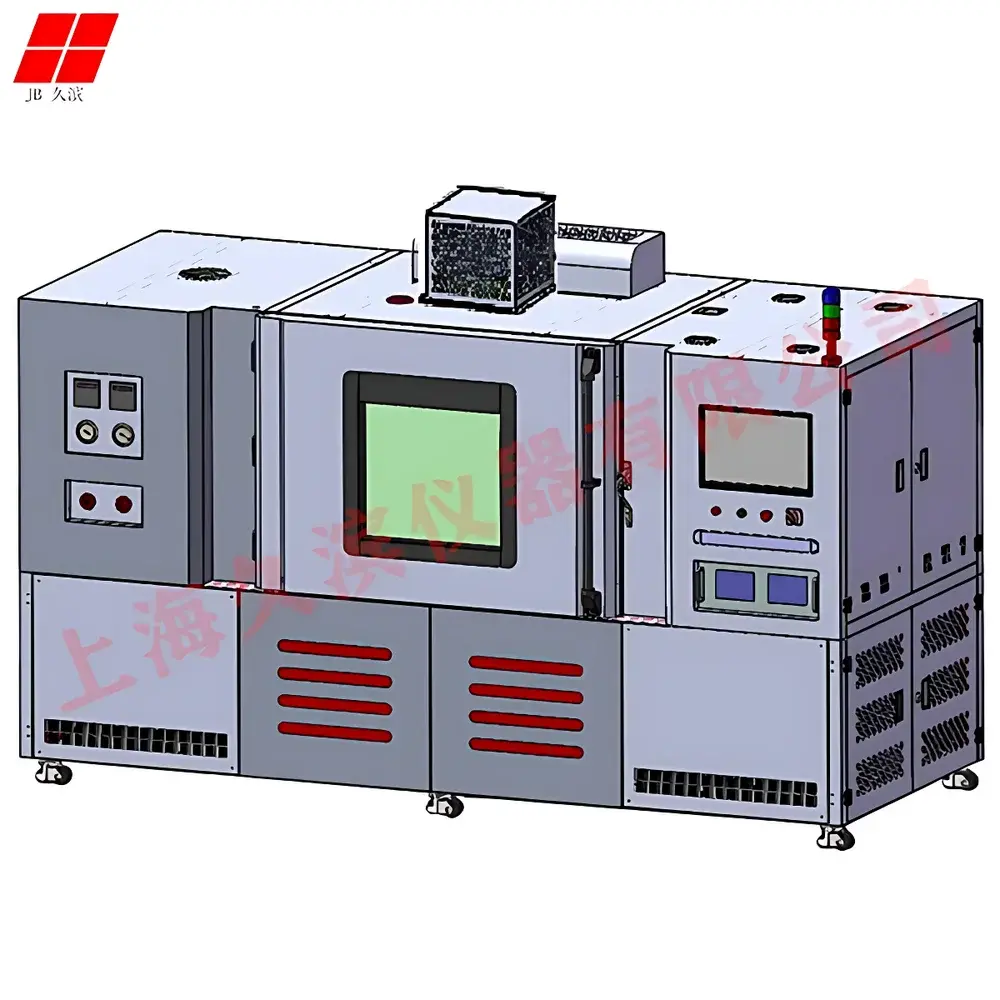
Jiubin JB-JM8 Automotive Brake Hose Pressure Pulse Test System
| Brand | Jiubin |
|---|---|
| Origin | Shanghai, China |
| Manufacturer Type | Authorized Distributor |
| Country of Origin | China |
| Model | JB-JM8 |
| Pricing | Available Upon Request |
| Test Medium | Oil, Water, or Ethylene Glycol Mixture |
| Medium Temperature Range | Ambient to 130 °C |
| Maximum Pulse Pressure | 0–70 MPa |
| Pressure Control Accuracy | ±0.01 MPa |
| Pulse Waveform | Square or Stepped Profile |
| Pulse Frequency | 5–60 cycles/min |
| Maximum Continuous Test Cycles | >100,000 (single run) |
| Continuous Operation Duration | ≥240 hours (10 days) |
| Compliance | Designed for ISO 6803, SAE J1401, GB/T 5563, ISO 6802, and FMVSS 106 test protocols |
Overview
The Jiubin JB-JM8 Automotive Brake Hose Pressure Pulse Test System is an engineered solution for evaluating the fatigue resistance and structural integrity of flexible fluid conveyance components under cyclic hydraulic pressure loading. It operates on the principle of controlled, repetitive pressurization and depressurization—mimicking real-world service conditions experienced by brake hoses, power steering lines, coolant hoses, and other critical automotive elastomeric assemblies. The system generates programmable pressure pulses using a high-fidelity hydraulic pulse generator, delivering precise waveforms (square or stepped) across a wide dynamic range (0–70 MPa) while maintaining tight control over amplitude, frequency, and dwell time. Its architecture supports long-duration endurance testing—capable of executing over 100,000 consecutive cycles without interruption—and is validated for continuous operation exceeding 240 hours, ensuring robustness for qualification-level validation in production QA and R&D environments.
Key Features
- Triple-zone modular design: segregated test chamber, hydraulic power unit, and electrical control & data acquisition cabinet for enhanced safety, serviceability, and electromagnetic compatibility.
- High-stability pressure regulation with ±0.01 MPa accuracy, achieved via servo-controlled proportional relief valves and redundant pressure transducers with NIST-traceable calibration paths.
- Programmable pulse profile generation supporting square, stepped, and custom-defined waveforms—configurable via front-panel interface or remote software command.
- Integrated thermal management subsystem enabling stable medium temperature control from ambient to 130 °C, compatible with oil, water, and ethylene glycol-based test fluids.
- Real-time leak detection logic embedded in the control firmware, triggering automatic shutdown upon pressure decay exceeding user-defined thresholds during hold phases.
- Industrial-grade PLC-based controller with dual-channel redundancy, compliant with IEC 61508 SIL2 functional safety requirements for test-critical shutdown sequences.
Sample Compatibility & Compliance
The JB-JM8 accommodates a broad spectrum of tubular and assembled components—including single-layer and multi-layer rubber/flexible composite brake hoses, crimped hose assemblies with metal or plastic fittings, heat exchanger inlet/outlet connections, reservoirs, and compact hydraulic actuators. Fixture adaptability supports SAE 100R1–R17, DIN EN 853, ISO 1436, and GB/T 3690-compliant coupling interfaces. The system is purpose-built to execute standardized tests per ISO 6803 (rubber hoses—hydraulic pulse resistance), SAE J1401 (brake hose pulse testing), FMVSS 106 (U.S. DOT brake hose certification), and GB/T 5563 (Chinese national standard for hose pulsation). Full audit trails—including operator ID, parameter sets, cycle logs, and anomaly timestamps—are retained to support GLP and GMP-aligned quality systems.
Software & Data Management
A Windows-based test management application provides intuitive setup, real-time monitoring, and post-test analysis. All test parameters—including pressure vs. time traces, cycle count progression, temperature profiles, and fault event logs—are stored in encrypted binary files with CSV export capability. Software enforces role-based access control (RBAC), electronic signatures, and 21 CFR Part 11-compliant audit trails—including immutable records of parameter changes, test initiation/termination, and manual overrides. Raw data archives are timestamped, digitally signed, and structured for seamless integration into LIMS platforms via OPC UA or TCP/IP socket protocols.
Applications
This system serves as a core validation tool across Tier-1 automotive suppliers, OEM engineering labs, third-party certification bodies (e.g., TÜV, UL, CATARC), and academic research centers focused on polymer aging, viscoelastic fatigue, and fluid-structure interaction. Typical use cases include: qualification testing of new hose formulations against OEM specifications; accelerated life-cycle assessment of crimp joint integrity; comparative evaluation of alternative elastomer compounds under thermal–mechanical coupling; and regulatory submission support for UN ECE R13/H, ISO/TS 16949, and IATF 16949 process audits. Its flexibility extends to aerospace hydraulic line testing (per AS5512 and MIL-DTL-24671) and industrial hydraulic hose validation (ISO 6802).
FAQ
What standards does the JB-JM8 natively support?
It is configured to execute ISO 6803, SAE J1401, FMVSS 106, GB/T 5563, and ISO 6802 test protocols out-of-the-box, with preloaded parameter templates and pass/fail criteria.
Can the system operate unattended for extended durations?
Yes—designed for 24/7 operation, it includes automatic fault recovery, fluid level monitoring, thermal cutouts, and email/SMS alerting via optional network module.
Is remote monitoring and control supported?
Standard Ethernet connectivity enables secure remote access via VPN, allowing parameter adjustment, live waveform viewing, and emergency stop from off-site locations.
What maintenance intervals are recommended?
Hydraulic fluid replacement every 6 months or 2,000 operating hours; pressure transducer recalibration annually or after 10,000 cycles; full system verification per ISO/IEC 17025 every 12 months.
Does the system provide raw data export for statistical process control (SPC)?
Yes—cycle-by-cycle pressure, temperature, and timing data are exported in ASCII-compatible formats suitable for Minitab, JMP, or Python-based SPC workflows.
Related Products



