
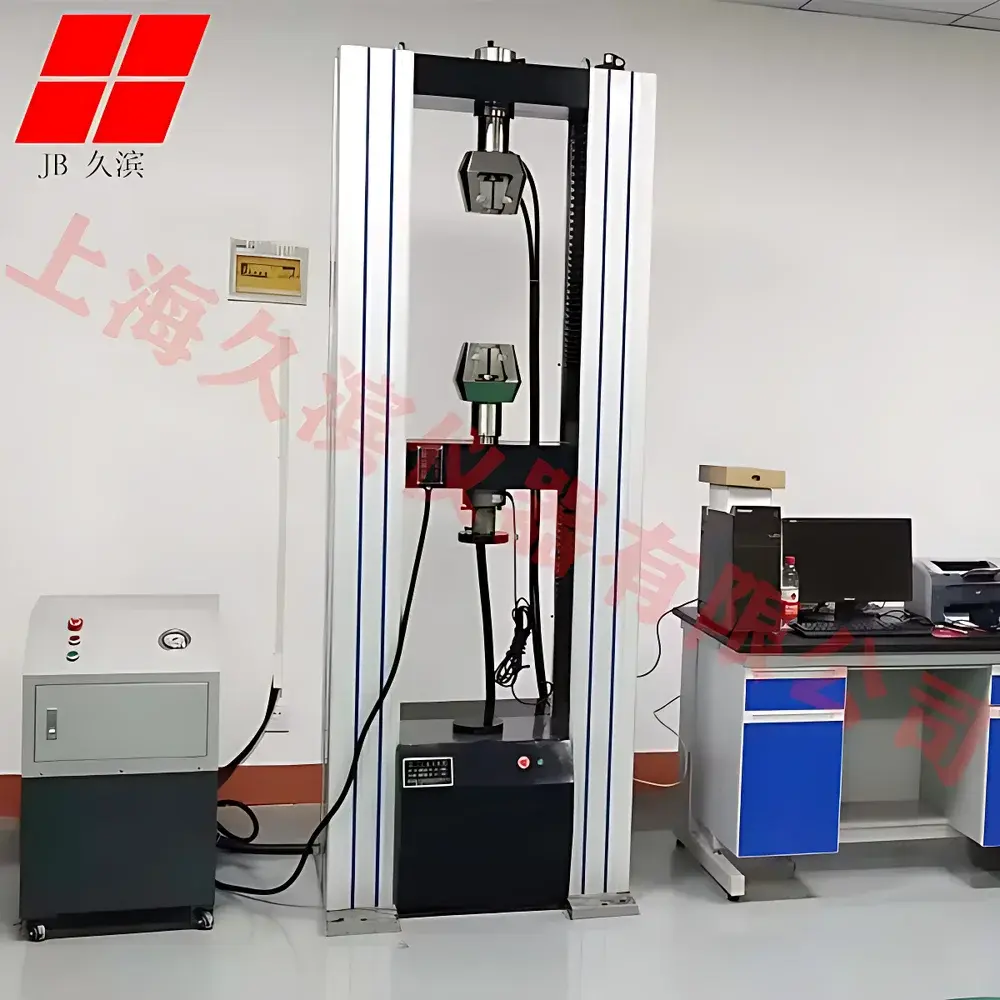
Jiubin JB-Series Floor-Standing Electronic Universal Testing Machine
| Brand | Jiubin |
|---|---|
| Origin | Shanghai, China |
| Manufacturer Type | Authorized Distributor |
| Country of Origin | China |
| Model | JB-Series |
| Instrument Type | Electronic Universal Testing Machine |
| Structural Configuration | Floor-standing |
| Control System | Integrated Controller with AC Servo Motor Drive |
| Protection Features | Dual-limit (mechanical & programmable), Overload Protection (5–10% threshold), Emergency Stop |
| Data Output | Automated Report Generation, Manual & Auto Result Calculation |
| Compliance Reference | GB/T 228.1, ISO 6892-1, ASTM E4, ASTM E8, ASTM D638, ASTM D790 |
Overview
The Jiubin JB-Series Floor-Standing Electronic Universal Testing Machine is an electromechanical static testing system engineered for high-stiffness, high-reproducibility mechanical characterization of materials under uniaxial tensile, compressive, flexural, and shear loading conditions. Unlike benchtop configurations, its floor-standing architecture anchors the load frame directly to a rigid base via four precision-ground vertical guide columns—each structurally integrated into the mainframe. This design eliminates lateral deflection and torsional compliance inherent in smaller platforms, delivering superior axial alignment stability and minimizing frame deformation during high-load testing (up to 300 kN, configurable per model variant). The crosshead, upper beam, and test table are fabricated from high-yield structural steel with controlled elastic modulus, balancing rigidity for measurement fidelity and ductility for long-term fatigue resistance. The system operates on closed-loop servo control principles, where displacement, load, or strain is continuously monitored and regulated via feedback from high-resolution load cells (±0.5% FS accuracy, typical) and linear variable differential transformers (LVDTs) or encoder-based position sensors.
Key Features
- Floor-standing monolithic frame with four-column load-bearing architecture for enhanced structural stiffness and minimal deflection under load
- Integrated digital controller supporting precise closed-loop control modes: constant-rate displacement, constant-rate load, and constant-strain rate (per ASTM E2309)
- AC servo motor drive system with regenerative braking, delivering smooth acceleration/deceleration profiles and repeatable speed control across 0.001–500 mm/min range
- Dual-stage safety protection: programmable software limits synchronized with hardened mechanical end stops on both upper and lower crossheads
- Overload safeguard activated at 5–10% above selected load cell capacity, triggering immediate drive shutdown and data logging freeze
- Compliant electrical architecture designed per GB/T 26804.1 and IEC 61000-6-2 standards, featuring EMI/RFI filtering and galvanic isolation for signal integrity in industrial lab environments
- Real-time data acquisition at ≥1 kHz sampling rate, with timestamped raw channel storage for post-test reanalysis
Sample Compatibility & Compliance
The JB-Series accommodates specimens ranging from miniature metallic coupons (e.g., ASTM E8 sub-size bars) to full-section polymer extrusions, composite laminates, and elastomeric strips up to 1,200 mm in gauge length. Standard grips include wedge-action tensile jaws (self-tightening via load-induced friction), compression platens with parallelism adjustment, and three-point/four-point bending fixtures traceable to ISO 178 calibration protocols. Optional accessories support peel testing (ASTM D903), tear resistance (ISO 34-1), and puncture (ASTM D3776). All firmware and embedded control logic comply with GLP audit requirements, including electronic signature support, user-access level management, and tamper-evident audit trails for test method parameters and result modifications—fully aligned with FDA 21 CFR Part 11 Annex 11 expectations for regulated laboratories.
Software & Data Management
The system ships with Jiubin TestSuite™ v4.x—a Windows-based application certified for Windows 10/11 (64-bit) and compatible with SQL Server Express for centralized database deployment. It supports automated test method templates conforming to ISO 527-2, ASTM D638, and GB/T 1040.1, enabling one-click execution of multi-step protocols (e.g., preconditioning → ramp → hold → unload → recovery). Raw data export is available in CSV, XML, and universal .tdms formats; graphical overlays allow comparative analysis across batches or material lots. Calibration certificates are digitally embedded and version-controlled; all user actions—including parameter edits, calibration events, and report approvals—are logged with ISO-compliant timestamps and operator IDs.
Applications
This instrument serves as a primary mechanical testing platform in quality control labs, R&D centers, and third-party certification bodies. Typical use cases include: tensile property verification of aerospace aluminum alloys (AMS 4027); modulus and elongation-at-break assessment of medical-grade thermoplastic polyurethanes (ISO 5840-3); compressive yield strength validation of structural foams (ASTM D1621); interlaminar shear strength evaluation of carbon fiber prepregs (ASTM D2344); and peel adhesion quantification of pressure-sensitive tapes (PSTC-101). Universities employ it for undergraduate mechanics of materials labs and graduate-level fracture mechanics research requiring high-fidelity load-displacement hysteresis capture.
FAQ
What standards does this machine natively support?
It includes preconfigured test methods for ASTM E8/E21, ISO 6892-1, GB/T 228.1, ASTM D638/D790, and ISO 178—with optional add-ons for ISO 1133 (melt flow index correlation) and ASTM D3410 (compressive properties of composites).
Can the system be integrated into a LIMS or MES environment?
Yes—via OPC UA server interface (included) or RESTful API (optional license), enabling bidirectional data exchange with LabWare LIMS, Thermo Fisher SampleManager, or Siemens Opcenter.
Is third-party calibration and traceability available?
Factory calibration is NIST-traceable; accredited field recalibration services are provided by CNAS-certified partners in China, EU, and North America upon request.
What maintenance intervals are recommended?
Biannual lubrication of guide columns and annual verification of load cell linearity and crosshead alignment per ISO 7500-1 Class 1 requirements.
Does the controller support custom PID tuning for specialized materials?
Yes—the embedded controller allows advanced users to modify proportional-integral-derivative gains for non-standard viscoelastic or creep-dominant testing protocols.



