
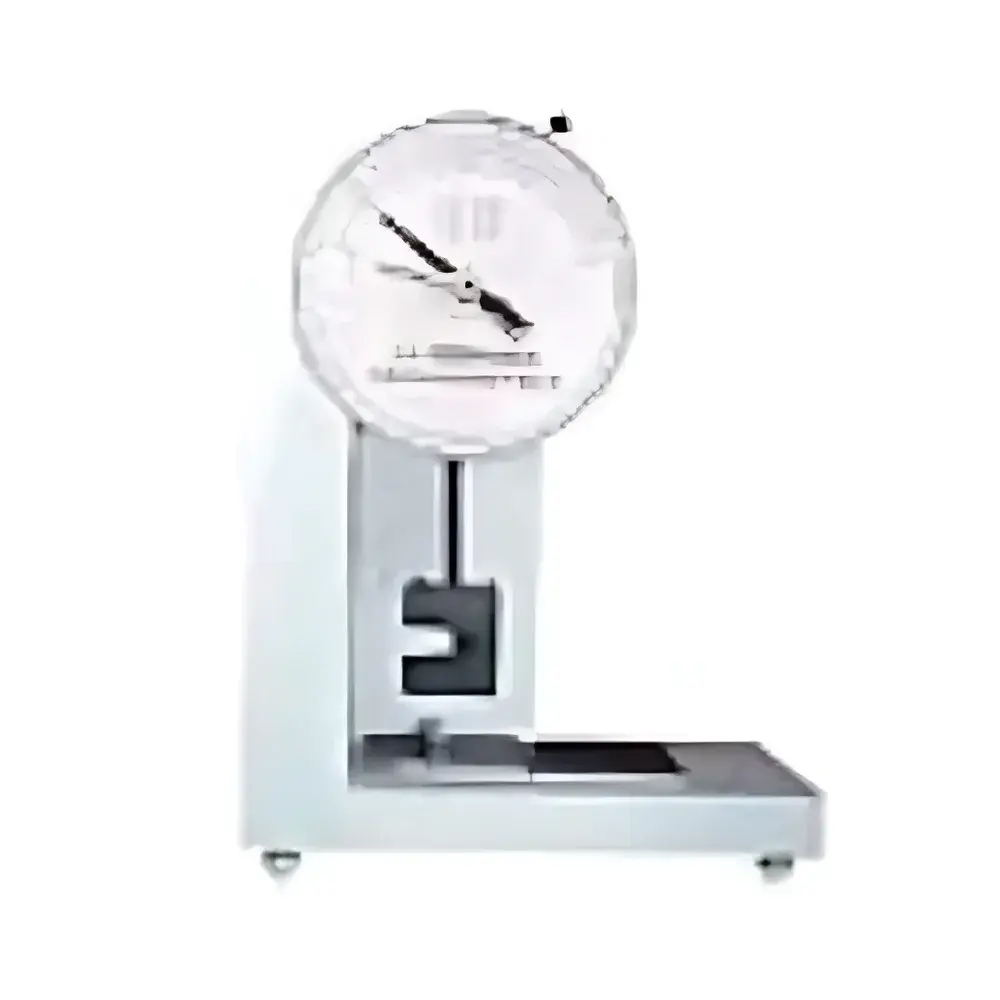
JJ-20 Pendulum Impact Tester
| Origin | Jilin, China |
|---|---|
| Manufacturer Type | Authorized Distributor |
| Origin Category | Domestic (China) |
| Model | JJ-20 |
| Quotation | Available Upon Request |
| Span Options | 40 mm, 60 mm, 62 mm, 70 mm, 95 mm |
| Specimen Width Range | 4–15 mm |
| Specimen Thickness Range | 3–10 mm |
| Pendulum Impact Velocity | 3.8 m/s |
| Pre-lift Angle | 150° |
| Distance from Pendulum Axis to Specimen Center | 380 mm |
| Charpy (Simply Supported Beam) Energy Levels | 4 J, 7.5 J, 15 J, 25 J |
| Izod (Cantilever Beam) Energy Levels | 5.5 J, 11 J, 22 J |
Overview
The JJ-20 Pendulum Impact Tester is a precision-engineered mechanical testing instrument designed for standardized determination of impact resistance in rigid and semi-crystalline thermoplastic polymers, engineering plastics, and composite materials. It operates on the fundamental principle of pendulum-based energy absorption measurement—where a calibrated hammer (pendulum) is released from a fixed height and strikes a notched or unnotched specimen under either simply supported beam (Charpy) or cantilever beam (Izod) configuration. The residual kinetic energy after fracture is measured via angular displacement of the pendulum arm, enabling direct calculation of absorbed impact energy per unit cross-sectional area. This method conforms to internationally recognized test standards including ISO 179-1 (Charpy), ISO 180 (Izod), ASTM D6110 (Charpy), and ASTM D256 (Izod), making the JJ-20 suitable for quality control laboratories, R&D centers, and third-party certification facilities requiring traceable, repeatable impact performance data.
Key Features
- Modular dual-mode testing capability: Switch between Charpy (simply supported beam) and Izod (cantilever beam) configurations using standardized fixtures and alignment jigs—ensuring compliance with both ISO and ASTM geometrical requirements.
- Four selectable Charpy impact energy ranges (4 J, 7.5 J, 15 J, 25 J) and three Izod energy levels (5.5 J, 11 J, 22 J), achieved via interchangeable pendulum hammers with calibrated mass and radius of gyration—minimizing operator-induced variability.
- Precision-machined anvil and support blocks with hardened steel surfaces (HRC ≥ 58) ensure consistent specimen positioning and minimal energy loss during transfer.
- Optimized pendulum geometry: 380 mm distance from axis to specimen center and 150° pre-lift angle guarantee stable release dynamics and reproducible impact velocity of 3.8 m/s across all energy scales.
- Adjustable span options (40 mm, 60 mm, 62 mm, 70 mm, 95 mm) accommodate standard and non-standard specimen geometries per material-specific test protocols.
- Specimen clamping system supports width (4–15 mm) and thickness (3–10 mm) ranges aligned with ISO 179/180 and ASTM D256 specimen dimensional tolerances.
Sample Compatibility & Compliance
The JJ-20 accommodates injection-molded, machined, or compression-molded specimens of engineering thermoplastics such as ABS, PC, PA6/66, POM, PBT, and reinforced composites (e.g., GF-PP, CF-PEEK). Specimens must be conditioned per ISO 291 or ASTM D618 prior to testing. The instrument meets mechanical accuracy requirements specified in ISO 13802 (verification of pendulum impact machines) and supports full traceability documentation for GLP/GMP environments. Calibration certificates for pendulum hammers and anvils are provided with NIST-traceable reference standards. Optional digital angle encoder upgrade enables automated energy readout with ±0.5% full-scale repeatability.
Software & Data Management
While the base JJ-20 operates as a manual analog instrument, it is fully compatible with optional PC-based data acquisition modules (sold separately) that interface via RS-232 or USB. These modules record pendulum arrest angle, compute absorbed energy in joules, and export timestamped results in CSV or XML format. Software supports user-defined test templates, multi-specimen batch logging, statistical summary (mean, SD, CV%), and audit trail generation compliant with FDA 21 CFR Part 11 requirements when configured with electronic signatures and role-based access control.
Applications
- Quality assurance of polymer batches in automotive interior trim, electrical housings, and medical device components.
- Comparative evaluation of toughening agent efficacy (e.g., elastomer blends, core-shell modifiers) in formulation development.
- Validation of thermal aging or UV exposure effects on impact ductility retention.
- Supporting failure analysis investigations where brittle-to-ductile transition behavior is critical.
- Teaching laboratories for hands-on instruction in polymer mechanics and standardization principles (ISO/ASTM).
FAQ
What standards does the JJ-20 comply with for Charpy and Izod testing?
It supports ISO 179-1 (Charpy), ISO 180 (Izod), ASTM D6110 (Charpy), and ASTM D256 (Izod) through mechanical configuration, fixture geometry, and energy calibration.
Can the JJ-20 test specimens thicker than 10 mm?
No—the maximum supported thickness is 10 mm per ISO 179/180 and ASTM D256 dimensional limits; exceeding this may compromise support rigidity and energy transfer fidelity.
Is verification and calibration documentation included?
Yes—each unit ships with a factory calibration certificate for pendulum hammers and support anvils, referencing NIST-traceable reference specimens and ISO 13802 verification procedures.
Does the JJ-20 require external power?
No—it is a purely mechanical system; only optional digital readout modules require 100–240 V AC power.
How is specimen notch preparation handled?
Notching is performed externally using standardized milling fixtures (e.g., ISO 2818-compliant notching machines); the JJ-20 itself does not include notching capability.



