
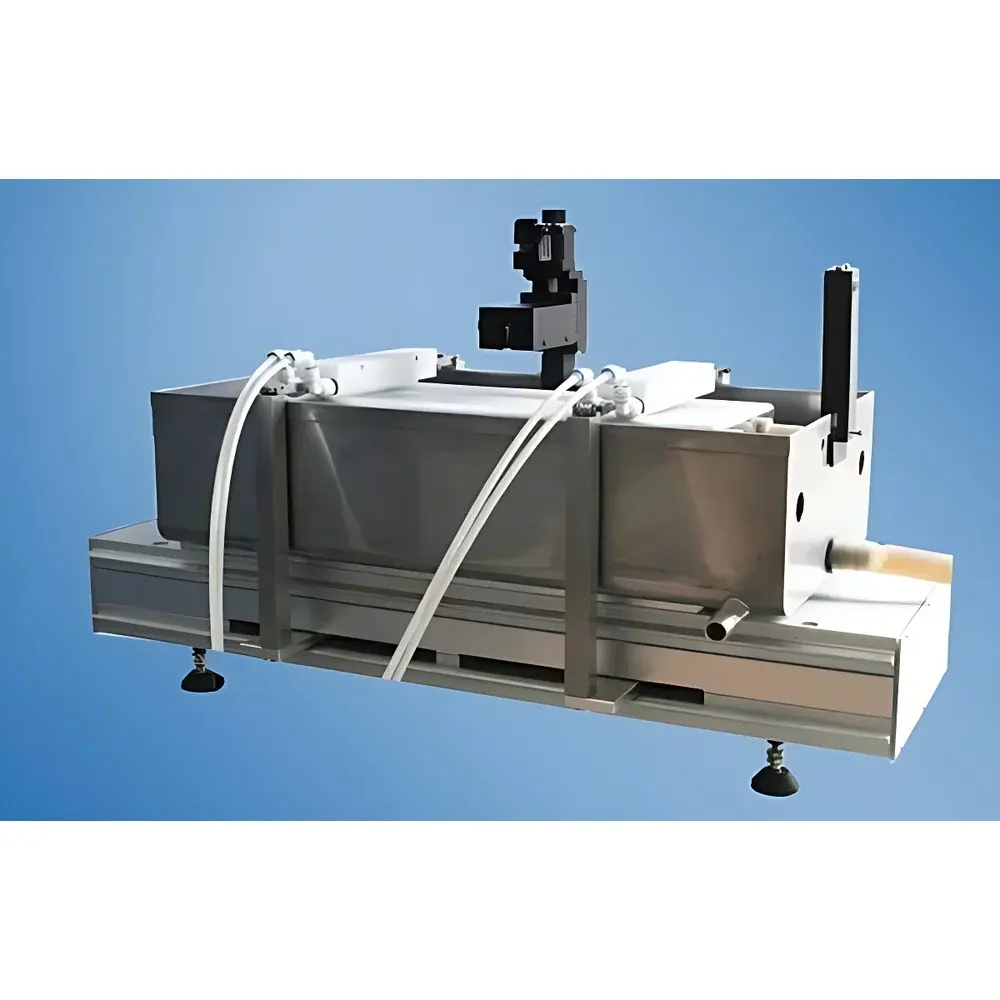
JML15A Langmuir-Blodgett Trough with Wilhelmy Plate Surface Tensiometer
| Origin | Beijing, China |
|---|---|
| Manufacturer Type | Authorized Distributor |
| Regional Origin | Domestic (PRC) |
| Model | JML15A |
| Price Range | USD 14,000 – 28,000 |
| Surface Tension Range | 0–150 mN/m |
| Resolution | < 0.05 mN/m |
| Measurement Principle | Wilhelmy Plate Method |
| Trough Dimensions | 700 mm × 140 mm |
| Compression/Expansion Speed | 10–100 mm/min (infinitely variable) |
| Temperature Control | Dual independent water jackets (30 L pure water tank & 10 L trough jacket), both stabilized at 35 ± 0.5 °C |
| Compliance | ASTM D971, ISO 6295, USP <721>, GLP-ready data logging |
Overview
The JML15A Langmuir-Blodgett Trough with integrated Wilhelmy plate surface tensiometer is a precision instrument engineered for quantitative monolayer characterization at the air–water interface. It operates on the fundamental principle of Langmuir film physics: amphiphilic molecules—such as fatty acids, phospholipids, or surfactants—spontaneously form ordered, two-dimensional monolayers when spread on ultrapure water. The trough measures surface pressure (π, in mN/m) as a function of molecular area (A, in Ų/molecule) by monitoring the force exerted on a vertically immersed Wilhelmy plate during controlled lateral compression of the monolayer. This enables derivation of thermodynamic parameters including collapse pressure, compressibility modulus, phase transition thresholds, and molecular packing density. Designed for reproducible, low-drift operation under ambient laboratory conditions, the JML15A supports both static surface tension measurement and dynamic Langmuir isotherm acquisition—critical for R&D in soft matter science, biomimetic membrane studies, and functional thin-film fabrication.
Key Features
- Fully automated operation via embedded microcontroller and Windows-based host software, minimizing operator-induced variability in barrier positioning, dipping speed, and data sampling intervals.
- High-stability Wilhelmy plate sensor (NMB, full-scale 98 mN/m) with resolution better than 0.05 mN/m and thermal drift compensation enabled by dual independent temperature-controlled water jackets.
- Large-area Langmuir trough (700 mm × 140 mm) fabricated from white PTFE-coated stainless steel, offering low background contamination, minimal evaporation, and negligible leakage (< 0.02 mL/h).
- Motorized barrier system with optical encoder feedback and infinitely variable speed control (10–100 mm/min), supporting both constant-area and constant-pressure protocols per ISO 9277 and ASTM D1331.
- Integrated automatic cleaning sequence: programmable solenoid valves activate high-purity water spray nozzles over the trough surface and Wilhelmy plate; waste fluid drains through a dedicated 90 mm Ø sump with anti-surge baffling.
- Dual thermal management: 30 L pure water reservoir (temperature setpoint 35 ± 0.5 °C) supplies the trough submersion bath, while a separate 10 L jacket circulates thermostatically controlled fluid around the trough body to eliminate thermal gradients across the monolayer.
- Compliance-ready architecture: timestamped raw force and position data are logged with audit-trail metadata; software supports user-defined calibration curves, export to CSV/Excel, and post-acquisition fitting of π–A isotherms using standard equation-of-state models (e.g., van der Waals, Frumkin).
Sample Compatibility & Compliance
The JML15A accommodates a broad spectrum of amphiphilic compounds—including synthetic surfactants (e.g., SDS, CTAB), natural lipids (DPPC, cholesterol), polymerizable monomers (diacetylene derivatives), and nanoparticle-laden dispersions—provided they exhibit sufficient spreading coefficient on deionized water (resistivity ≥ 18.2 MΩ·cm). All wetted components contact only PTFE, borosilicate glass, or electropolished stainless steel, ensuring chemical inertness toward organic solvents (chloroform, chloroform/methanol 2:1), aqueous buffers (pH 3–11), and mild oxidants. Instrument design conforms to key international standards for interfacial rheology and monolayer analysis: ASTM D971 (surface tension of petroleum products), ISO 6295 (emulsion stability), USP <721> (surface activity testing), and ISO 9277 (BET surface area reference methodology for Langmuir-derived molecular areas). Data handling meets GLP documentation requirements, with optional 21 CFR Part 11 compliance achievable via encrypted user authentication and electronic signature modules.
Software & Data Management
The proprietary Windows-native software provides a fully localized GUI with real-time plotting of π–A isotherms, r–A (surface excess vs. area) profiles, and time-resolved surface pressure traces. All acquisitions include embedded metadata: operator ID, date/time stamp, environmental humidity/temperature (via optional external sensors), trough temperature setpoint and actual reading, barrier speed profile, and calibration file version. Graphs support annotation, zoom, curve overlay, and export in PNG, SVG, or EMF formats. Raw data files (.jml) store unprocessed force (µV) and encoder pulse counts at user-selectable sampling rates (1–10 Hz). Batch processing tools enable normalization to molecular weight, conversion to area per molecule (Ų), and calculation of compressibility modulus (Cs⁻¹ = −A(dπ/dA)). Export options include ANSI-standard CSV for integration with MATLAB, OriginLab, or Python-based analysis pipelines.
Applications
- Quantitative characterization of lung surfactant analogs and model biomembranes under physiologically relevant compression regimes.
- Optimization of Langmuir–Schaefer and Langmuir–Blodgett transfer parameters for organic electronics (e.g., pentacene, C₆₀ derivatives) and 2D material heterostructures.
- Stability assessment of oil-in-water emulsions and Pickering systems via interfacial rheology and dilatational modulus extraction.
- Structure–function correlation of peptide–lipid interactions in antimicrobial or amyloidogenic systems.
- Quality control of industrial surfactants used in coatings, agrochemical formulations, and enhanced oil recovery fluids.
- Evaluation of environmental pollutant behavior (e.g., PAHs, alkylphenols) at aquatic interfaces using competitive adsorption isotherms.
FAQ
What surface pressure range does the JML15A support, and how is calibration performed?
The instrument measures surface pressures from 0 to 150 mN/m using a factory-calibrated NMB load cell. Calibration is traceable to NIST-certified weights and includes temperature-compensated zero drift correction. Users may perform routine verification using standard surfactant solutions (e.g., octanol) per ASTM D1331.
Can the trough accommodate custom subphase compositions beyond pure water?
Yes—the system supports buffered aqueous subphases (e.g., CaCl₂, NaCl, HEPES), provided conductivity remains below 500 µS/cm to avoid electrochemical interference with the Wilhelmy plate signal. Optional corrosion-resistant barrier materials are available for high-ionic-strength applications.
Is remote operation or networked data acquisition supported?
The control board features RS-232 and USB-C interfaces; TCP/IP communication is enabled via optional Ethernet adapter, allowing integration into centralized lab data management systems and SCADA environments.
What maintenance is required to ensure long-term measurement fidelity?
Routine tasks include weekly cleaning of the Wilhelmy plate with ethanol and flame-annealing, monthly inspection of PTFE sealing surfaces, and quarterly recalibration of temperature sensors against certified RTDs. No consumables beyond standard glass slides and high-purity solvents are required.
Does the system comply with FDA or pharmaceutical regulatory requirements?
While not pre-certified, the JML15A’s architecture satisfies core elements of 21 CFR Part 11 when configured with password-protected user roles, electronic audit trails, and secure data archiving—making it suitable for method validation in pharmaceutical interfacial testing labs operating under ICH Q5C or Q5D guidelines.



