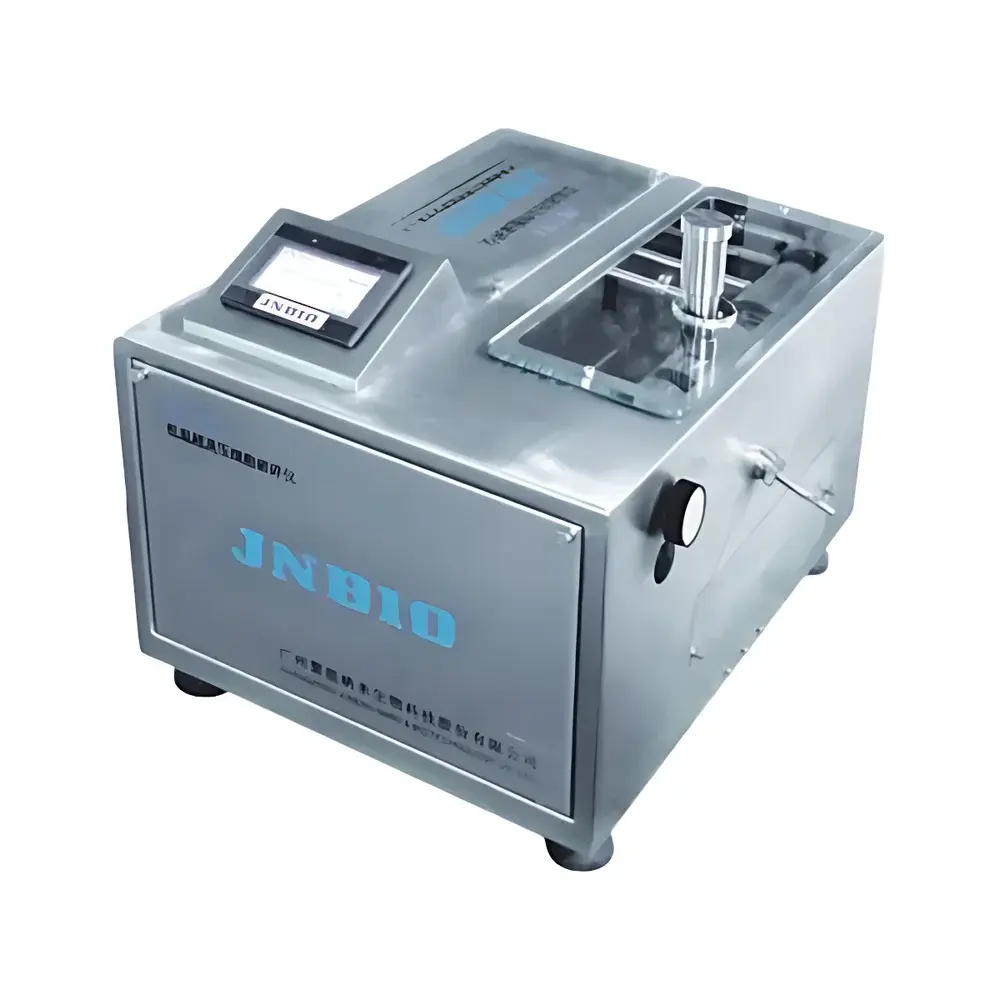
JNBIO JN-Mini Pro Ultra-High-Pressure Continuous-Flow Cell Disruptor
| Brand | JNBIO (Guangzhou JNBIO Biotech Co., Ltd.) |
|---|---|
| Origin | Guangdong, China |
| Model | JN-Mini Pro |
| Maximum Operating Pressure | 207 MPa (2070 bar) |
| Minimum Sample Volume | 3 mL |
| Temperature Control Range | 4–6 °C (integrated recirculating chiller required) |
| Flow Path Materials | 316L stainless steel |
| Disruption Valve | Diamond-coated |
| Drive System | Hydraulic |
| In-line CIP/SIP Capability | Yes |
| Regulatory Compliance | Designed for GLP/GMP-aligned workflows |
Overview
The JNBIO JN-Mini Pro is an ultra-high-pressure continuous-flow cell disruptor engineered for precise, scalable, and thermally controlled lysis of biological and nanomaterial samples. It operates on the physical principle of pressure-driven homogenization: samples are forced through a narrow micro-orifice under precisely regulated hydraulic pressure (up to 207 MPa), inducing instantaneous pressure drop that triggers three synergistic disruption mechanisms—intense shear stress, transient cavitation collapse, and inter-particle collision. Critically, the entire fluidic path—including sample inlet, homogenization chamber, and outlet—is submerged in a temperature-stabilized recirculating water bath maintained at 4–6 °C. This integrated cryo-homogenization architecture preserves labile biomolecules (e.g., enzymes, membrane proteins, nucleic acids), prevents thermal denaturation, and minimizes aggregation—making it suitable for structural biology, biopharmaceutical process development, and high-fidelity nanomaterial synthesis.
Key Features
- Diamond-coated disruption valve with >50× wear resistance versus tungsten carbide or ceramic equivalents—ensuring long-term pressure stability and consistent particle size distribution across hundreds of operational cycles.
- Hydraulic drive system enabling true zero-drift pressure hold: system can be paused, restarted, or idled at maximum pressure without pressure decay or manual re-tuning.
- Patented air-purge protocol: after loading, a single-point stainless-steel needle actuation evacuates entrapped air from the flow path while maintaining set pressure—eliminating bubble-induced flow instability and sample loss.
- Full 316L stainless-steel wetted surfaces—from inlet tubing to discharge manifold—guarantee corrosion resistance, non-reactivity with acidic/alkaline lysates, and compatibility with aggressive cleaning agents (e.g., NaOH, peracetic acid).
- In-place cleaning (CIP) and steam-in-place (SIP) readiness: validated for automated sanitation protocols aligned with ISO 13485 and EU Annex 1 requirements for bioprocess equipment.
- Modular chiller integration: optional recirculating chiller (220 V, 0.75 kW) delivers ±0.3 °C temperature control over extended operation—critical for heat-sensitive applications such as liposome extrusion or crystallization seeding.
Sample Compatibility & Compliance
The JN-Mini Pro accommodates diverse biological matrices including Gram-negative bacteria (e.g., E. coli), yeast (S. cerevisiae), filamentous fungi (e.g., Ganoderma lucidum spores), cyanobacteria, microalgae, nematodes, plant protoplasts, and mycobacterial strains. It also supports non-biological applications: nano-emulsification of lipid nanoparticles (LNPs), size reduction of graphene oxide dispersions, deagglomeration of carbon nanotubes, and stabilization of polymeric nanosuspensions. All wetted materials comply with USP Class VI biocompatibility testing and FDA 21 CFR Part 11–ready data logging when paired with validated control software. The system meets ISO 14001 environmental design criteria and conforms to IEC 61000-6-2/6-4 electromagnetic compatibility standards.
Software & Data Management
While the JN-Mini Pro operates via analog pressure regulation and manual chiller interface in base configuration, it supports digital upgrade paths for GxP environments. Optional Ethernet-enabled controller modules log real-time pressure, temperature, flow rate (via calibrated rotameter), and runtime—storing timestamped records with audit trail functionality. Data export formats include CSV and XML, compatible with LIMS integration and electronic batch record (EBR) systems. Software validation packages (IQ/OQ/PQ) are available upon request for laboratories operating under FDA 21 CFR Part 11, EU GMP Annex 11, or ISO/IEC 17025 frameworks.
Applications
- High-yield extraction of intracellular proteins and enzymes from recombinant E. coli and yeast—achieving >95% lysis efficiency verified by SDS-PAGE and ATP release assays.
- Preparation of sub-100 nm liposomes and solid lipid nanoparticles (SLNs) with PDI <0.15 and mean diameter tunable between 28–55 nm (DLS-confirmed).
- Cell-free synthesis feedstock generation: intact ribosome isolation from thermophiles and acidophiles due to rapid, cold lysis minimizing nuclease activity.
- Nanomaterial processing: exfoliation of graphite into few-layer graphene, dispersion of TiO2 nanoparticles in aqueous polymer matrices, and stabilization of quantum dot suspensions.
- Traditional medicine R&D: selective release of bioactive alkaloids and polysaccharides from herbal cell walls without solvent degradation.
- Strain improvement: high-pressure mutagenesis of microbial cultures with controlled energy deposition and reproducible survival curves.
FAQ
What is the minimum viable sample volume for method development?
The JN-Mini Pro is validated for reliable operation down to 3 mL total sample volume—ideal for early-stage screening where material conservation is critical.
Can the system be validated for GMP manufacturing use?
Yes. With optional digital controller, IQ/OQ/PQ documentation, and stainless-steel SIP-compatible configuration, the system meets core equipment qualification requirements for Phase I–III biomanufacturing support.
Is diamond valve replacement required after every 500 cycles?
No. Accelerated wear testing shows <1.2% pressure deviation after 1,200 full-pressure cycles (207 MPa); routine inspection is recommended every 500 hours of cumulative operation.
Does the unit support sterile processing of therapeutic cell lysates?
When equipped with SIP-capable manifolds and pre-sterilized disposable inlet/outlet tubing sets, the system supports aseptic processing of lysates intended for downstream purification under Grade A conditions.
How is temperature uniformity maintained across the flow path?
The entire homogenization block—including valve housing, capillary restrictor, and exit coil—is fully immersed in the recirculating bath; thermal imaging confirms <±0.5 °C spatial variance across all wetted zones during steady-state operation.