
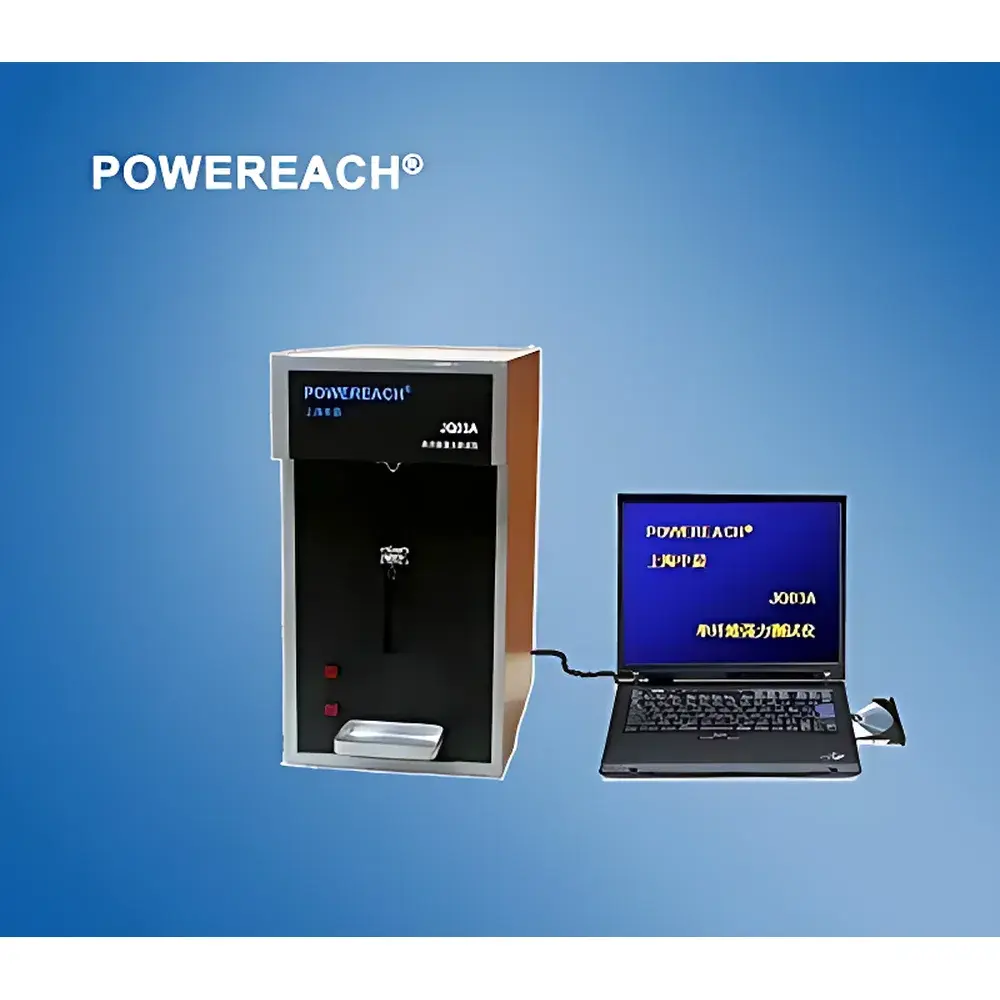
JQ03A Single-Fiber Tensile Tester
| Origin | Shanghai, China |
|---|---|
| Manufacturer Type | Authorized Distributor |
| Origin Category | Domestic (China) |
| Model | JQ03A |
| Price Range | USD 7,000 – 14,000 |
| Force Range & Accuracy | 0–200 cN, ±0.1% f.s. |
| Elongation Range & Resolution | ≤150 mm, 0.01 mm |
| Gauge Lengths | 10, 20, 25 mm (software-selectable) |
| Clamping | Pneumatic fiber grippers |
| Tensile Speed | 2–100 mm/min |
| Test Modes | Constant-elongation cyclic tensile, constant-load cyclic tensile, stress relaxation, creep, overload & overtravel protection, auto-zero calibration |
| Data Acquisition | PC-controlled real-time acquisition and curve visualization |
| Compliance Standards | GB/T 9997, GB/T 14337, BS EN ISO 5079:1996 |
Overview
The JQ03A Single-Fiber Tensile Tester is an electromechanical precision instrument engineered for the quantitative mechanical characterization of individual textile fibers under controlled uniaxial tension. It operates on the principle of force-displacement transduction using a high-stability load cell and linear encoder-based position feedback, enabling reproducible measurement of tensile strength, breaking elongation, initial modulus, work-to-break, and stress relaxation behavior. Designed specifically for single-fiber evaluation—where specimen geometry, clamping integrity, and environmental consistency critically influence data fidelity—the JQ03A eliminates inter-fiber interference inherent in bundle testing, delivering results aligned with internationally recognized fiber-level test protocols. Its architecture supports both static and dynamic mechanical assessments, including multi-cycle loading sequences and time-dependent deformation analysis, making it suitable for R&D laboratories, quality control departments, and certification bodies engaged in fiber development, standardization, and regulatory compliance.
Key Features
- Pneumatic fiber clamping system ensures consistent grip pressure and minimizes slippage or crushing—critical for delicate natural fibers (e.g., cotton, wool) and fine synthetic filaments (e.g., polyester, nylon)
- Digital gauge length selection (10 mm, 20 mm, 25 mm) via software interface enables rapid adaptation to fiber type and standard requirements without mechanical recalibration
- Adjustable tensile speed range (2–100 mm/min) accommodates diverse fiber viscoelastic responses—from brittle cellulose derivatives to highly extensible spandex filaments
- Real-time force-elongation curve plotting with synchronized data logging at configurable sampling intervals (≥100 Hz)
- Integrated safety logic: automatic load cutoff upon reaching user-defined thresholds, travel limit enforcement, and hardware-triggered emergency stop
- Self-calibrating zero-point compensation prior to each test cycle enhances measurement repeatability across extended operational periods
Sample Compatibility & Compliance
The JQ03A is validated for testing discrete fibers with diameters ranging from 5 µm to 50 µm and lengths ≥25 mm. It accommodates staple fibers (e.g., viscose, acrylic), continuous filaments (e.g., PET, PA6), and regenerated biopolymers (e.g., lyocell, modal). Its mechanical design conforms to the dimensional and procedural constraints specified in GB/T 9997 (determination of breaking force and elongation of chemical fibers), GB/T 14337 (tensile properties of man-made staple fibers), and BS EN ISO 5079:1996 (determination of tensile properties of single textile fibers). While not certified to ISO/IEC 17025 as a standalone testing laboratory, the instrument’s traceable force and displacement metrology supports GLP-compliant data generation when operated within documented SOPs and maintained per manufacturer-recommended calibration schedules.
Software & Data Management
The proprietary Windows-based control software provides intuitive test configuration, live parameter monitoring, and post-test analysis tools—including hysteresis loop quantification, modulus calculation via tangent or secant methods, and statistical summary reporting (mean, SD, CV%). Raw ASCII data exports (CSV/TXT) are compatible with third-party statistical packages (e.g., JMP, Minitab, Python pandas). Audit trails record operator ID, timestamp, test parameters, and calibration history—supporting alignment with FDA 21 CFR Part 11 requirements when deployed in regulated environments with appropriate IT governance controls. Software updates are delivered via secure vendor portal; no cloud connectivity or remote telemetry is embedded.
Applications
- Comparative evaluation of fiber strength retention after dyeing, finishing, or UV exposure
- Correlation of molecular architecture (e.g., crystallinity, orientation) with macroscopic tensile response
- Validation of spinning process parameters during pilot-scale fiber production
- Supporting ASTM D3822 and ISO 5079 method transfers for international trade documentation
- Input generation for finite element modeling of nonwoven web mechanics
- Teaching laboratories demonstrating fundamental polymer physics concepts (e.g., strain hardening, necking, time–temperature superposition)
FAQ
What fiber types can be tested on the JQ03A?
Natural fibers (cotton, wool, silk), regenerated cellulose (viscose, lyocell), synthetics (polyester, nylon, acrylic), and high-performance fibers (aramid, PBI) — provided individual filaments meet minimum length and diameter specifications.
Is the instrument compliant with ISO/IEC 17025?
The JQ03A itself is not accredited, but its measurement subsystems (load cell, encoder) are supplied with NIST-traceable calibration certificates, enabling users to establish measurement uncertainty budgets required for ISO/IEC 17025 accreditation of their own laboratory scope.
Can custom gauge lengths be added beyond 10/20/25 mm?
Yes—custom firmware configurations supporting additional gauge lengths (e.g., 5 mm, 30 mm) are available upon request and subject to mechanical validation by the manufacturer.
Does the system support automated sample loading?
No—manual fiber placement and alignment are required to ensure axial orientation and avoid torsional artifacts; however, pneumatic actuation reduces operator-induced variability.
How frequently must the load cell be recalibrated?
Annual recalibration is recommended; interim verification using certified reference weights (e.g., 50 cN, 100 cN) should be performed weekly in QC environments.






