
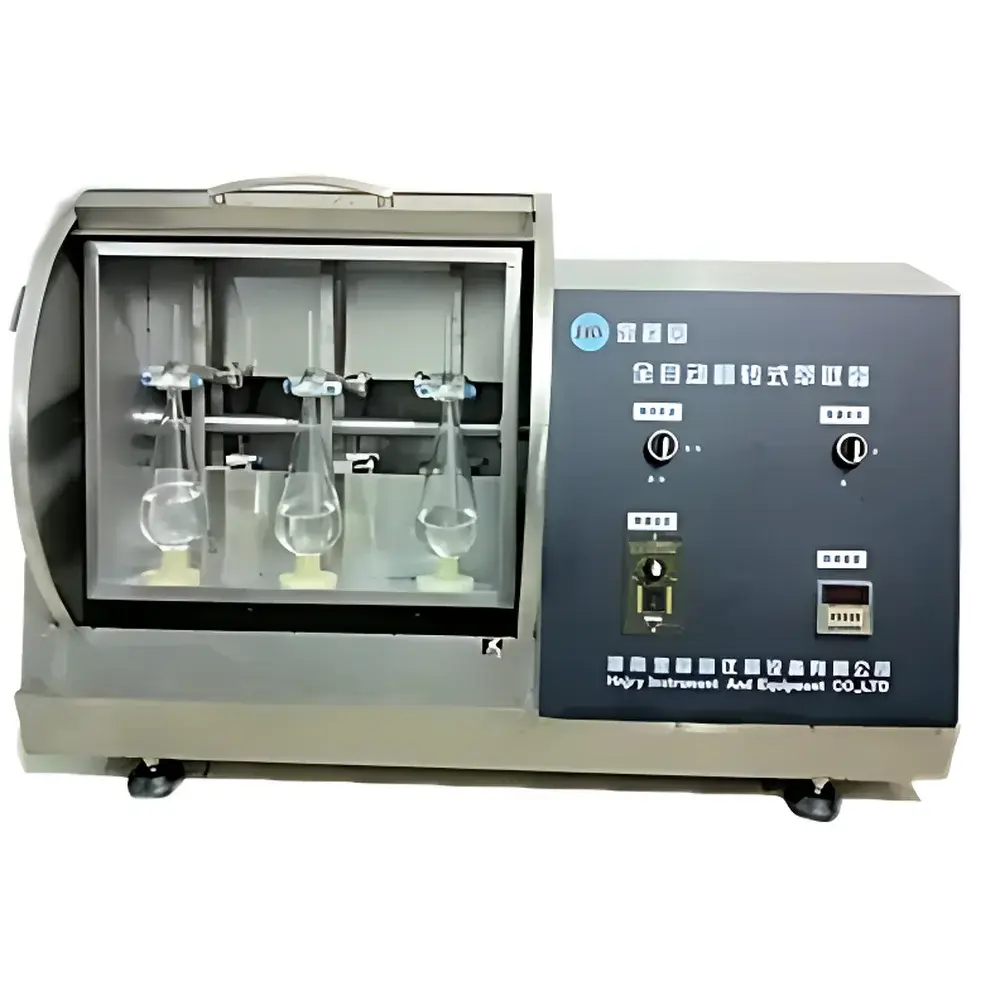
JRY FC-Series Automated Inversion Extractor
| Origin | Hunan, China |
|---|---|
| Manufacturer Type | Authorized Distributor |
| Origin Category | Domestic (China) |
| Model | JRY-FC06 / FC08 / FC10 / FC24 |
| Sample Capacity | 6 / 8 / 10 / 24 positions |
| Compatible Vessel Sizes | 50 mL, 125 mL, 250 mL, 500 mL, 1000 mL separatory funnels |
| Rated Voltage | 220 V AC, 50 Hz |
| Motor Power | 90 W / 120 W / 140 W / 160 W |
| Rotation Mode | Unidirectional or Bidirectional (programmable) |
| Speed Range | 0–60 rpm (adjustable) |
| Time Control Range | 0.5–24 h (0.5 h increments) |
| Temperature Control | Real-time ambient temperature monitoring with minimal fluctuation |
| Enclosure Material | Full stainless steel (304) |
| Safety Features | Interlocked transparent polycarbonate guard door, overload protection, earth leakage protection, automatic power cutoff upon door opening |
| Dimensions (W×D×H, mm) | 800×550×700 / 980×550×700 / 1160×550×700 / 1400×550×700 |
| Net Weight | 45 kg / 55 kg / 65 kg / 75 kg |
| Compliance | ISO 9001 certified design, manufacturing, and after-sales service |
Overview
The JRY FC-Series Automated Inversion Extractor is an engineered solution for liquid–liquid extraction in regulated analytical laboratories. It operates on the principle of controlled mechanical inversion—repetitive, programmable 180° rotation of sealed separatory funnels—to maximize interfacial contact between immiscible phases without agitation-induced emulsification or solvent loss. Unlike vortex shakers or orbital mixers, inversion ensures gentle yet thorough phase mixing while maintaining physical containment of volatile organic solvents (e.g., hexane, dichloromethane, ethyl acetate), thereby eliminating vapor exposure risks and improving method reproducibility. Designed for compliance-critical workflows—including EPA Method 3510C (acid digestion/extraction), ASTM D7067 (oil & grease in water), and ISO 11348 (toxicity testing)—the system supports fully traceable, auditable extraction protocols under GLP and ISO/IEC 17025 frameworks.
Key Features
- Hermetically sealed extraction environment: All operations occur within closed separatory funnels, preventing solvent evaporation, operator exposure, and cross-contamination.
- High-efficiency mass transfer: Optimized inversion kinematics achieve >95% analyte recovery across diverse matrices (soil leachates, wastewater, petroleum distillates, biological tissues).
- Modular capacity architecture: Four standardized configurations (FC06 to FC24) accommodate varying throughput demands without compromising mechanical stability or thermal uniformity.
- Programmable bidirectional motion control: Users define independent durations for forward rotation, reverse rotation, and dwell intervals—enabling method-specific optimization per EPA or ISO standard requirements.
- Robust stainless-steel chassis (AISI 304) with integrated anti-spill recessed base and polycarbonate observation window for real-time process verification.
- Dual-safety interlock system: Motor halts instantly upon guard door displacement; additional circuit-level protections include thermal overload cutoff and residual-current device (RCD) integration.
- Precise time-resolution control: Timer resolution of 0.5 h (1800 s), with continuous operation mode activated at zero-set duration—ideal for extended extractions per USP or AOAC 993.14.
- Thermally stable platform: Ambient temperature monitoring ensures consistent kinetic conditions; no active heating/cooling but minimal drift (<±1.5°C over 24 h) under typical lab HVAC conditions.
Sample Compatibility & Compliance
The FC-Series accommodates standard glass and PTFE-lined separatory funnels ranging from 50 mL to 1000 mL, including tapered-stem and stopcock-equipped variants. Universal clamping fixtures—adjustable via spring-loaded cam locks—secure vessels regardless of neck diameter or wall thickness. The system complies with ISO 9001:2015 for quality management throughout its lifecycle. Its closed-vessel operation aligns with OSHA 29 CFR 1910.1200 (HCS) and EU CLP Regulation (EC No. 1272/2008) for hazardous chemical handling. For regulated environments, the instrument’s deterministic timing logic and mechanical repeatability support 21 CFR Part 11-compliant data integrity when paired with validated LIMS or ELN software.
Software & Data Management
While the FC-Series operates via embedded microcontroller-based hardware interface (no PC dependency), it provides full parameter logging via non-volatile memory: start time, total runtime, rotation direction sequence, speed setpoint, and cycle count. Optional RS-232 or USB-to-serial interface enables integration with laboratory information management systems (LIMS) for automated metadata capture. Audit trails—including operator ID, timestamped parameter changes, and safety event logs (e.g., door-open interruption)—are exportable as CSV for QA review. Firmware updates follow IEC 62304 Class B medical-device-grade validation protocols, ensuring change control traceability.
Applications
This extractor is routinely deployed in environmental testing labs performing EPA SW-846 Methods 3510C (inversion extraction), 3520C (Soxhlet alternatives), and 3540C (sonication-assisted prep). It is equally suited for food safety labs quantifying pesticide residues (AOAC 2007.01), pharmaceutical QC assessing residual solvents (ICH Q3C), and petrochemical QA verifying hydrocarbon content in lubricants (ASTM D524). Academic research groups utilize it for natural product isolation, metal speciation studies (e.g., Cr(VI) vs Cr(III) separation), and nanoparticle surface functionalization protocols requiring phase-transfer control.
FAQ
What extraction standards does the JRY FC-Series support?
It is validated for EPA Method 3510C, ASTM D7067, ISO 11348-3, and AOAC 993.14—providing documented equivalence to manual inversion procedures.
Can the system handle corrosive solvents like concentrated HCl or HF?
Only when using chemically resistant funnels (e.g., PTFE-coated glass or fluoropolymer vessels); the stainless-steel frame and motor housing are not exposed to reagents.
Is temperature control active or passive?
Passive ambient monitoring only; no integrated heating/cooling elements. Users must maintain lab ambient within 15–30°C per ISO/IEC 17025 clause 5.3.2.
How is calibration verified?
Speed and time accuracy are factory-verified using NIST-traceable tachometers and atomic-clock-referenced timers; annual verification kits (with calibration certificate) are available.
Does the system meet electrical safety standards for export?
Yes—CE-marked models comply with EN 61010-1:2010 (Safety Requirements for Electrical Equipment for Measurement, Control, and Laboratory Use).



