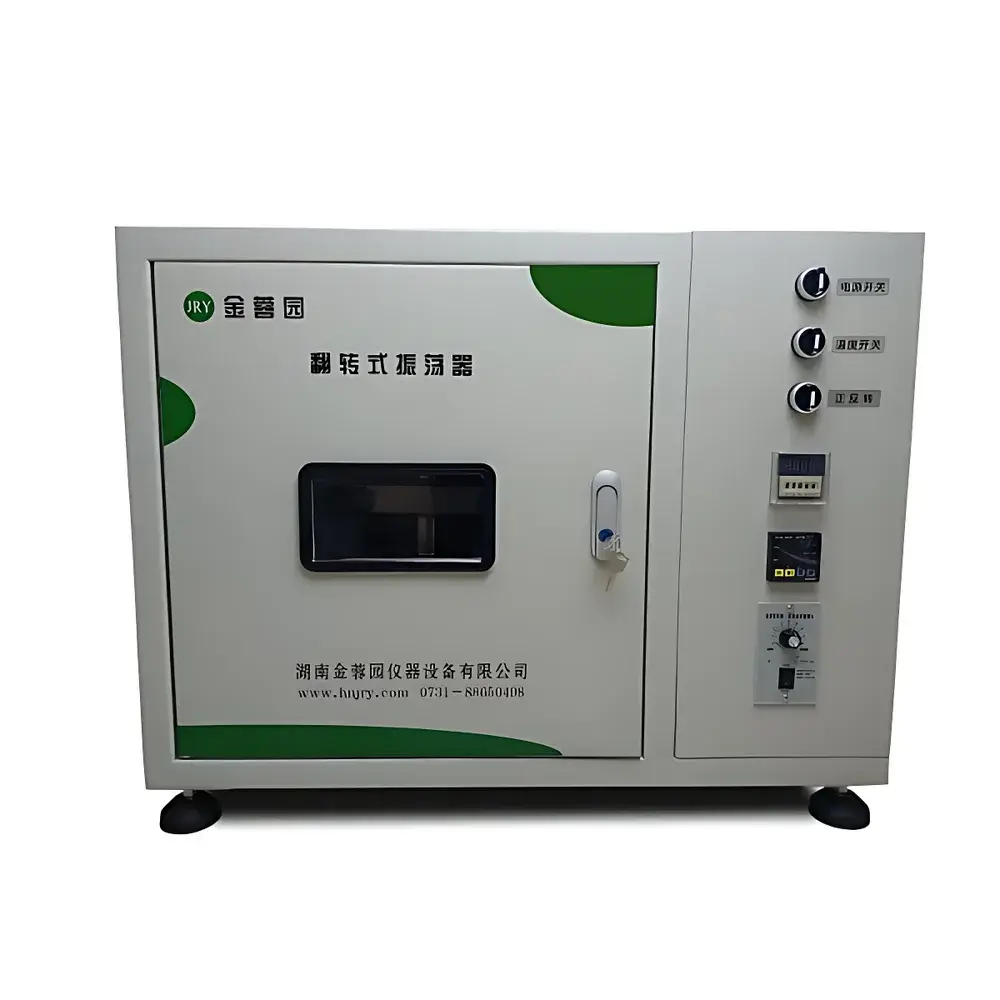
JRY JRY-HJ-06 Constant-Temperature Inverting Shaker
| Brand | JRY |
|---|---|
| Origin | Hunan, China |
| Manufacturer Type | Direct Manufacturer |
| Product Category | Domestic |
| Model | JRY-HJ-06 |
| Instrument Type | Inverting Shaker |
| Timer Range | 0–24 h (adjustable) |
| Oscillation Speed | 0–100 rpm |
| Rotation Amplitude | 360° continuous inversion |
| Temperature Range | Ambient to 50 °C |
| Number of Platforms | 6 |
| Temperature Control Accuracy | ±0.5 °C (at 30 rpm) |
| Power | Heating Module <1000 W, Compressor <300 W |
| Dimensions (L×W×H) | 740 × 520 × 540 mm |
| Net Weight | <65 kg |
Overview
The JRY JRY-HJ-06 Constant-Temperature Inverting Shaker is an engineered platform for standardized solid waste leaching toxicity testing in environmental laboratories and regulatory compliance facilities. Designed specifically to meet the mechanical and thermal requirements of U.S. EPA Method 1311 (TCLP), ASTM D5233, and Chinese national standards—including HJ/T 299–2007 (Sulfuric-Nitric Acid Leaching Procedure), HJ/T 300–2007 (Acetic Acid Buffer Extraction), and GB 5085.3–2007 (Hazardous Waste Identification Standard: Leaching Toxicity)—this shaker implements controlled 360° rotational inversion to ensure uniform, reproducible contact between solid matrices and extraction fluids. Unlike orbital or reciprocating shakers, the inverting motion minimizes particle settling and promotes complete suspension during extended leaching cycles, critical for accurate quantification of heavy metals, cyanide, volatile organic compounds, and semi-volatile organics from heterogeneous waste samples.
Key Features
- Modular stackable cabinet design—enables stable vertical integration of multiple units without structural reinforcement or floor space expansion.
- Six independently mounted sample platforms, each accommodating one standard 2 L PE leaching bottle (supplied as standard configuration).
- Precise bidirectional control: programmable forward-only, reverse-only, or alternating forward-reverse inversion sequences to accommodate method-specific agitation profiles.
- Wide-speed range (0–100 rpm) with digital feedback regulation ensures consistent torque delivery across load variations and temperature setpoints.
- Integrated Peltier-assisted heating/cooling system maintains chamber temperature within ±0.5 °C tolerance at 30 rpm—validated per ISO/IEC 17025 calibration protocols.
- Tempered glass observation window enables real-time visual monitoring of sample homogeneity and bottle integrity without interrupting operation.
- Triple-layer safety architecture: leakage current protection, interlocked door sensor (halts rotation immediately upon opening), and motor overload detection with auto-shutdown.
- Energy-optimized thermal management: heating module power consumption <1000 W; refrigeration compressor <300 W—compliant with IEC 61000-3-2 harmonic emission limits.
Sample Compatibility & Compliance
The JRY-HJ-06 supports standard EPA-compliant 2 L polyethylene (PE) leaching bottles (ASTM D2477), as well as alternative containers up to Ø120 mm × 300 mm height. Its rigid aluminum alloy platform mounting system ensures minimal vibration transmission between adjacent units in stacked configurations. All electrical components meet CE marking requirements under Directive 2014/30/EU (EMC) and 2014/35/EU (LVD). The unit operates within the environmental test conditions defined in IEC 60068-2-1 (cold) and IEC 60068-2-2 (dry heat), ensuring reliability in laboratory environments ranging from 15 °C to 30 °C ambient with ≤80% RH non-condensing. Documentation includes factory calibration certificates traceable to NIM (National Institute of Metrology, China) and conforms to GLP documentation requirements for audit-ready recordkeeping.
Software & Data Management
While the JRY-HJ-06 operates via intuitive front-panel membrane keypad with LED display, optional RS-485 serial interface enables integration into centralized lab automation systems (e.g., LIMS or SCADA). Time-stamped operational logs—including start/stop timestamps, actual vs. setpoint temperature curves, and cumulative runtime per platform—are exportable via USB flash drive in CSV format. Firmware supports user-defined method templates aligned with HJ/T 299–2007 Annex B and USP leaching protocol structures. Audit trail functionality complies with FDA 21 CFR Part 11 principles when paired with validated third-party data acquisition software.
Applications
- Regulatory leaching tests for landfill disposal qualification (TCLP, SPLP, EP Toxicity)
- Extraction efficiency validation for contaminated soils, sediments, and industrial sludges
- Method development and inter-laboratory comparison studies under ISO 5725-2
- Stability assessment of encapsulated hazardous materials under simulated landfill conditions
- Preparatory homogenization step prior to ICP-MS, AAS, or GC-MS analysis of leachates
FAQ
What is the maximum allowable bottle size and material compatibility?
Standard configuration supports 2 L PE bottles (ASTM D2477 compliant); glass, HDPE, and fluoropolymer bottles up to 120 mm diameter × 300 mm height may be used with platform adapter kits.
Does the unit support GLP-compliant electronic records?
Yes—when connected to validated external data logging software, the RS-485 interface provides time-stamped, immutable operational metadata meeting ALCOA+ data integrity criteria.
Can the shaker operate unattended overnight?
Yes—24-hour programmable timer, automatic shutdown, and redundant thermal cutoffs enable safe unattended operation for full leaching cycles.
Is temperature uniformity validated across all six platforms?
Yes—per internal QA protocol, temperature mapping is performed at nine points per chamber using NIST-traceable Pt100 probes; deviation remains ≤±0.8 °C across all platforms at 40 °C setpoint.
What maintenance intervals are recommended?
Bearing lubrication and door seal inspection every 12 months; calibration verification against reference thermometer annually or after 500 operating hours—whichever occurs first.
Related Products