
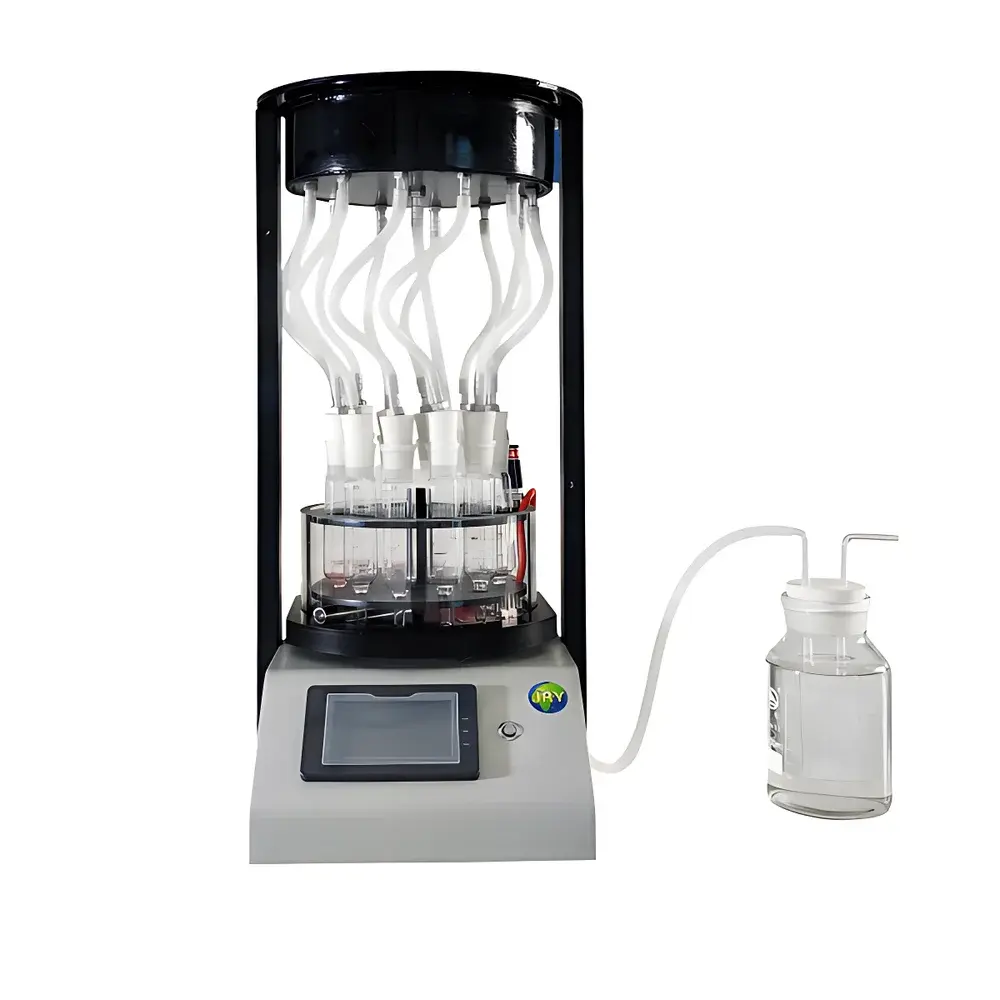
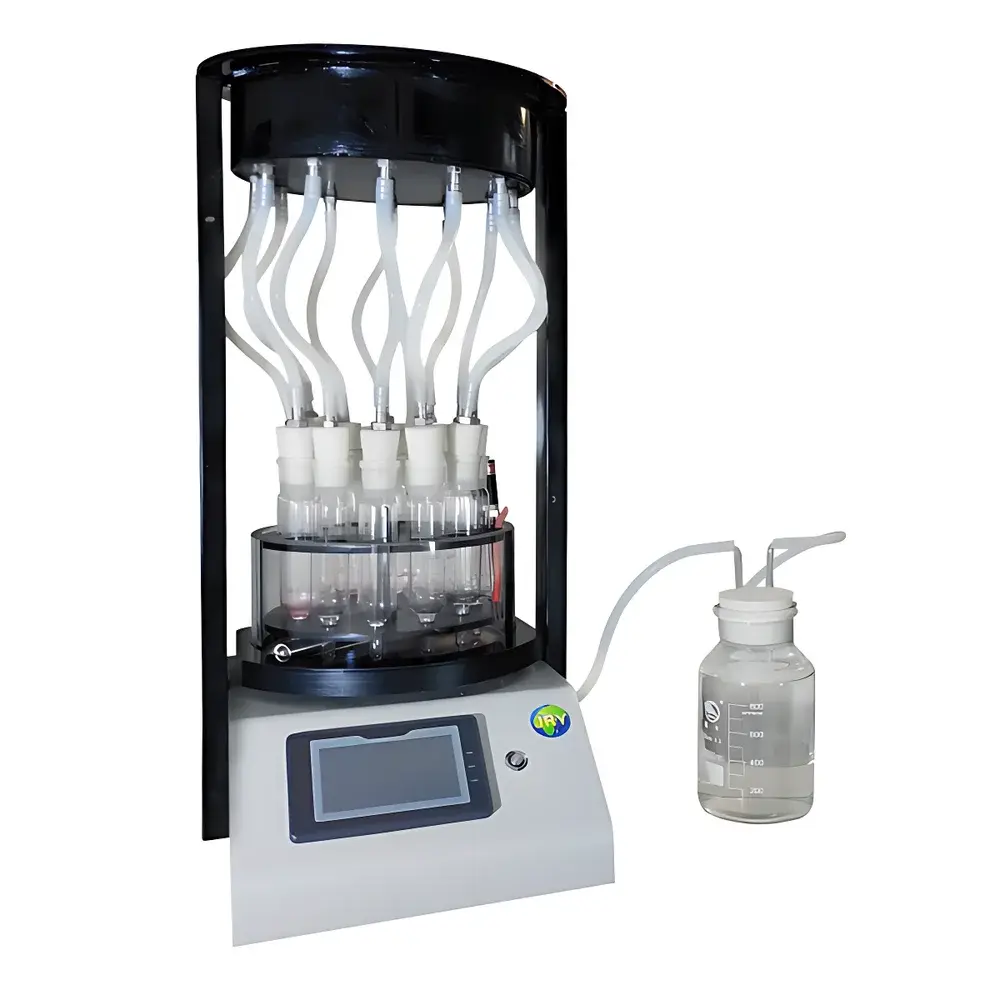
JRY JRY-NS01 High-Throughput Parallel Concentrator
| Brand | JRY |
|---|---|
| Origin | Hunan, China |
| Manufacturer Type | Direct Manufacturer |
| Country of Origin | China |
| Model | JRY-NS01 |
| Price | USD 7,000 (approx.) |
| Temperature Control Accuracy | ±0.1 °C |
| Temperature Uniformity | ≤1 °C |
| Sample Capacity | 24 positions |
| Drive System | Hall-effect DC motor |
| Oscillation Frequency | Adjustable and Precise |
| Display | High-resolution color touchscreen |
| Real-time Data | Dynamic temperature curve + operational parameter logging |
| Tube Compatibility | 100 mL, 200 mL, 250 mL evaporative tubes (optional) |
Overview
The JRY JRY-NS01 High-Throughput Parallel Concentrator is an engineered solution for rapid, reproducible solvent removal from multiple liquid samples under controlled thermal and mechanical conditions. Designed around a precisely regulated heated aluminum block platform combined with programmable orbital shaking and gentle nitrogen gas sweeping, the system operates on the principle of simultaneous evaporation enhancement via surface area exposure, convective heat transfer, and vapor pressure differential management. Unlike single-sample rotary evaporators or vacuum centrifuges, the NS01 enables true parallel processing—24 samples processed identically within the same thermal environment—making it ideal for laboratories performing routine sample preparation in environmental analysis, pharmaceutical QC, clinical toxicology, and food safety testing where throughput, inter-run consistency, and trace-level analyte recovery are critical.
Key Features
- Thermal precision: ±0.1 °C control accuracy with ≤1 °C uniformity across all 24 well positions—validated per ASTM E2251–22 guidelines for laboratory thermal equipment calibration.
- Hall-effect DC motor drive ensures stable, low-vibration oscillation with digitally adjustable frequency (30–300 rpm range), minimizing sample splashing and maximizing evaporation efficiency without compromising analyte integrity.
- Integrated high-resolution color touchscreen interface supports real-time visualization of temperature profiles, runtime countdown, and dynamic curve plotting—data logged internally with timestamping and exportable via USB.
- Modular tube holder design accommodates interchangeable aluminum blocks for 100 mL, 200 mL, and 250 mL conical-bottom concentration tubes—no tools required for configuration changeover.
- Robust aluminum heating block with optimized thermal mass delivers fast ramp-up and minimal overshoot; cooling time to ambient is accelerated by passive convection design (no active cooling module required).
- Gas manifold interface supports standardized nitrogen or compressed air supply (0.1–0.6 MPa input); flow rate per port is independently adjustable using calibrated needle valves to prevent foaming or bumping in volatile matrices.
Sample Compatibility & Compliance
The JRY-NS01 is compatible with common laboratory glassware and polypropylene concentration tubes used in EPA Method 525.3, ISO 17025-accredited residue labs, and USP chromatographic sample prep workflows. Its open architecture allows integration into existing fume hood environments or dedicated prep stations. All electrical components comply with IEC 61010-1:2010 safety standards for laboratory equipment. The instrument’s firmware supports audit-trail-enabled operation when paired with optional external LIMS interfaces—meeting baseline requirements for GLP-compliant documentation per OECD Series on Principles of Good Laboratory Practice.
Software & Data Management
No proprietary software installation is required—the built-in embedded OS handles all scheduling, parameter storage, and data logging. Up to 99 user-defined methods can be saved locally, each with independent setpoints for temperature, shake speed, duration, and gas flow. Temperature curves and run logs are stored in CSV format on removable USB drives for traceability. While the device does not natively support FDA 21 CFR Part 11 electronic signature functionality, its deterministic behavior, immutable timestamped logs, and method-lock capability provide foundational elements for internal validation protocols under GMP Annex 11 and ISO/IEC 17025 clause 7.7.
Applications
- Pre-concentration of aqueous and organic extracts prior to GC-MS or LC-MS/MS analysis in environmental monitoring (e.g., PAHs, pesticides, PFAS).
- High-volume sample cleanup in pharmaceutical stability studies requiring batch-wise evaporation of dissolution media or extraction solvents.
- Routine reduction of urine, plasma, or tissue homogenate supernatants in clinical toxicology screening workflows.
- Standardized solvent removal during method development for solid-phase extraction (SPE) and QuEChERS protocols.
- Parallel drying of calibration standards and QC reference materials to ensure consistent final volume and concentration across multi-level dilution series.
FAQ
What types of solvents can be safely concentrated using the JRY-NS01?
The system is validated for use with common low-boiling-point solvents including methanol, acetonitrile, ethyl acetate, dichloromethane, and hexane—provided appropriate ventilation and gas sweep rates are maintained per OSHA PEL guidelines.
Is the instrument suitable for thermally labile compounds?
Yes—by combining low-temperature operation (ambient to 80 °C), precise ramp control, and adjustable agitation, the NS01 minimizes thermal degradation risk compared to uncontrolled hotplate evaporation or high-vacuum systems.
Can the JRY-NS01 be integrated into automated lab workflows?
While it lacks robotic arm interfaces or Ethernet-based remote control, its USB data export, repeatable method recall, and physical footprint (W × D × H: 320 × 380 × 260 mm) allow seamless placement within semi-automated benchtop sequences managed via external scheduling software.
Does the unit include solvent recovery capability?
No built-in condenser or cold trap is included; however, the gas outlet port is threaded (G1/8″) to accept third-party inline dry-ice or Peltier-cooled condensers for solvent capture where regulatory or sustainability policies mandate recovery.
What maintenance is required for long-term reliability?
Routine cleaning of the aluminum block wells and gas nozzles is recommended after each batch; Hall-effect motor and heater elements require no scheduled servicing—mean time between failures exceeds 15,000 hours under standard operating conditions.



