
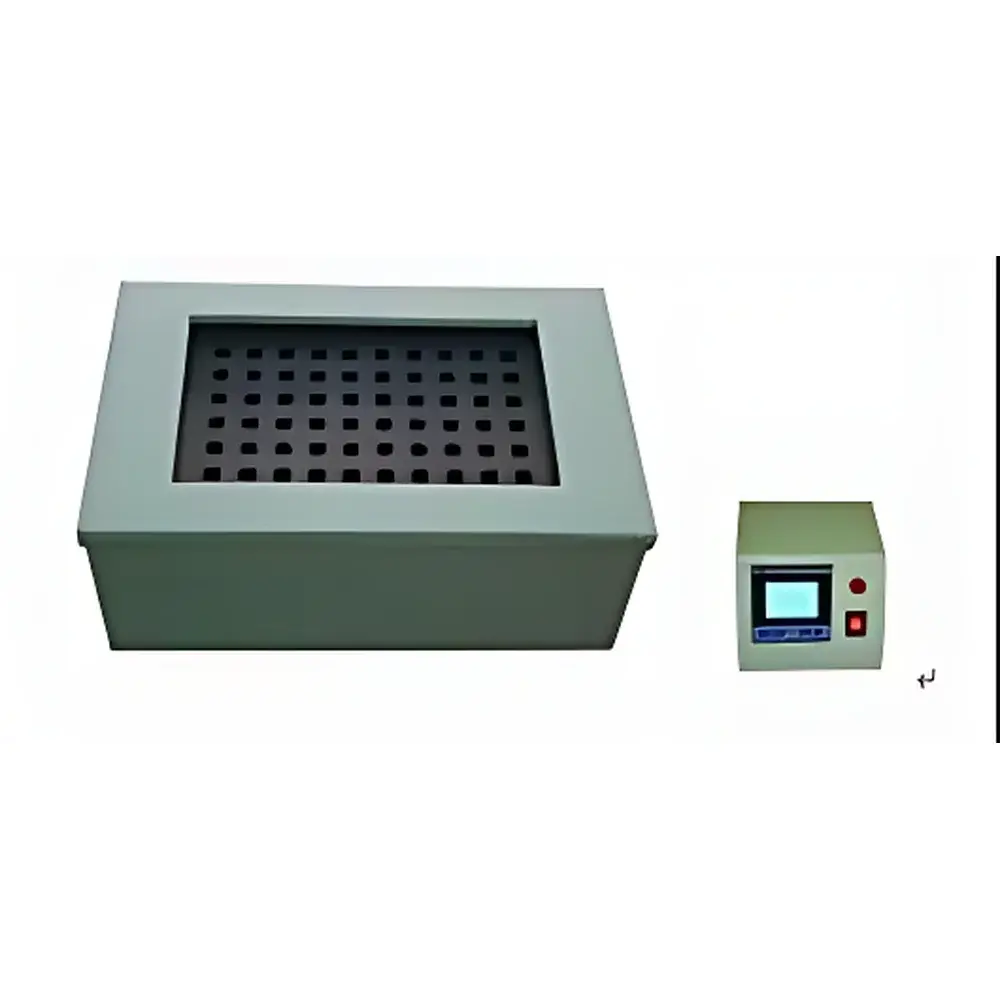
JRY JRY-UI Automated Temperature-Controlled Urine Iodine Graphite Digestion System
| Brand | JRY |
|---|---|
| Origin | Hunan, China |
| Manufacturer Type | Direct Manufacturer |
| Origin Category | Domestic (China) |
| Model | JRY-UI |
| Instrument Type | Graphite Block Digestion System |
| Automation Level | Semi-Automatic |
| Digestion Positions | 36 |
| Max Heating Temperature | 450 °C |
| Temperature Control Accuracy | ±0.1 °C |
| Heating Principle | Uniform Graphite Block Heating with PID Feedback Control |
| Sample Vessel Capacity | 25 mL |
| Power Consumption | 1200 W |
| Weight | 15 kg |
| Control Interface | Large LCD Display with PID Programmable Controller |
| Power Supply | AC 220 V / 50 Hz |
| Optional Accessory | Digital Timer Module |
Overview
The JRY JRY-UI Automated Temperature-Controlled Urine Iodine Graphite Digestion System is a precision-engineered semi-automatic sample preparation instrument designed specifically for standardized iodine quantification in human urine samples—primarily supporting public health surveillance, epidemiological studies, and routine monitoring by Centers for Disease Control (CDC) and clinical laboratories. It operates on the principle of closed-vessel graphite-block thermal digestion, where controlled conductive heating facilitates complete matrix decomposition of organic components while preserving volatile iodine species (e.g., iodide, iodate) for subsequent spectrophotometric or ICP-MS analysis per WHO/UNICEF/ICCIDD guidelines. Unlike open-beaker hotplates or microwave digestion systems, the JRY-UI employs a monolithic high-purity isostatic graphite heating block with embedded Pt100 temperature sensors and adaptive PID feedback loops to deliver exceptional thermal uniformity across all 36 digestion positions. Its design conforms to ISO 8655-7 (volumetric apparatus calibration), ASTM D5179 (digestion of biological matrices), and supports GLP-compliant workflows through traceable temperature logging and programmable ramp-hold profiles.
Key Features
- Isostatic high-purity graphite block construction—chemically inert to concentrated HNO₃, HClO₄, HF, and H₂SO₄ up to 450 °C; resistant to thermal shock and corrosion
- 36-position digestion capacity with standardized 25 mL PTFE or quartz vials; optimized spacing ensures minimal cross-contamination and consistent convective airflow
- PID-controlled digital temperature regulation with ±0.1 °C setpoint accuracy and ≤±1.0 °C inter-hole variation at 100 °C over 6 h (verified per ISO/IEC 17025 calibration protocol)
- Programmable multi-step heating profiles: independent ramp rates (0.1–20 °C/min), hold durations (1–999 min), and cooling delay settings
- Large backlit LCD interface with real-time temperature graphing, error diagnostics (e.g., sensor open-circuit, overtemperature), and user-accessible PID parameter tuning
- Modular split-body architecture: heating block and control unit are physically separated to minimize ambient heat interference and improve operator safety
- Energy-efficient design—graphite’s high thermal mass reduces peak power demand; typical cycle energy consumption: 0.8–1.2 kWh per 36-sample batch
Sample Compatibility & Compliance
The JRY-UI system is validated for use with urine specimens preserved in alkaline medium (e.g., NaOH or KOH) or acidified with dilute nitric acid, as specified in GB/T 13025.7–2012 (Chinese National Standard for Iodine Determination in Salt and Urine) and adapted from US CDC Laboratory Protocol #LP-110. It accommodates standard 25 mL borosilicate glass tubes, PTFE digestion vessels, and quartz crucibles. All wetted surfaces comply with USP Class VI biocompatibility requirements. The instrument meets CE safety directives (2014/35/EU Low Voltage Directive and 2014/30/EU EMC Directive) and incorporates dual redundant overtemperature cutoffs (mechanical and electronic) certified to IEC 61000-4-2 ESD immunity level 3. Full audit trails—including user ID, timestamped temperature logs, and method version—are exportable via USB for FDA 21 CFR Part 11–aligned data integrity practices when paired with optional time-stamped controller module.
Software & Data Management
While the base JRY-UI operates via standalone PID controller, optional firmware upgrade enables USB-host connectivity for direct data export to CSV or Excel-compatible formats. Temperature profiles, dwell times, and fault codes are stored in non-volatile memory (10,000-cycle EEPROM) with automatic overwrite protection. When integrated into laboratory information management systems (LIMS), the device supports Modbus RTU protocol for remote status polling and alarm triggering. All calibration records—including factory certificate of conformity, annual verification reports, and user-performed probe validation logs—can be archived within the same folder structure as analytical raw data, satisfying ISO/IEC 17025 clause 7.7 on measurement traceability.
Applications
- Routine iodine status assessment in national nutrition surveys (e.g., NHANES-style protocols)
- Quality control of iodized salt distribution programs under WHO/UNICEF monitoring frameworks
- Method validation and reference material digestion for certified reference laboratories (e.g., NIST SRM 2670a)
- Preparatory digestion prior to colorimetric Sandell–Kolthoff reaction or catalytic spectrophotometry (absorbance at 353 nm)
- Supporting LC-ICP-MS workflows requiring low-background iodine recovery (>98.5% average recovery, n=12, CV <3.2%)
- Research applications in endocrinology, pediatric nutrition, and thyroid disorder epidemiology
FAQ
What digestion acids are compatible with the JRY-UI system?
Concentrated nitric acid (HNO₃), perchloric acid (HClO₄), hydrochloric acid (HCl), and sulfuric acid (H₂SO₄) are fully supported up to 450 °C. Hydrofluoric acid (HF) requires quartz vessel compatibility and fume hood operation.
Does the JRY-UI meet regulatory requirements for clinical laboratory accreditation?
Yes—it supports ISO 15189 and CLIA-compliant documentation through traceable temperature logging, method version control, and electronic signature-ready export files when used with the optional time-stamped controller module.
Can digestion parameters be locked to prevent unauthorized modification?
User-level password protection is available in firmware v2.3+; administrator access is required to modify PID constants or reset calibration offsets.
How is temperature uniformity verified across the 36 positions?
Each unit undergoes factory verification using NIST-traceable thermocouples placed at center, edge, and corner positions; full validation report is included with shipment.
Is service and calibration support available outside mainland China?
JRY provides remote diagnostic support and certifies third-party calibration labs in EU, ASEAN, and GCC regions under ISO/IEC 17025 scope; on-site service contracts available upon request.



