
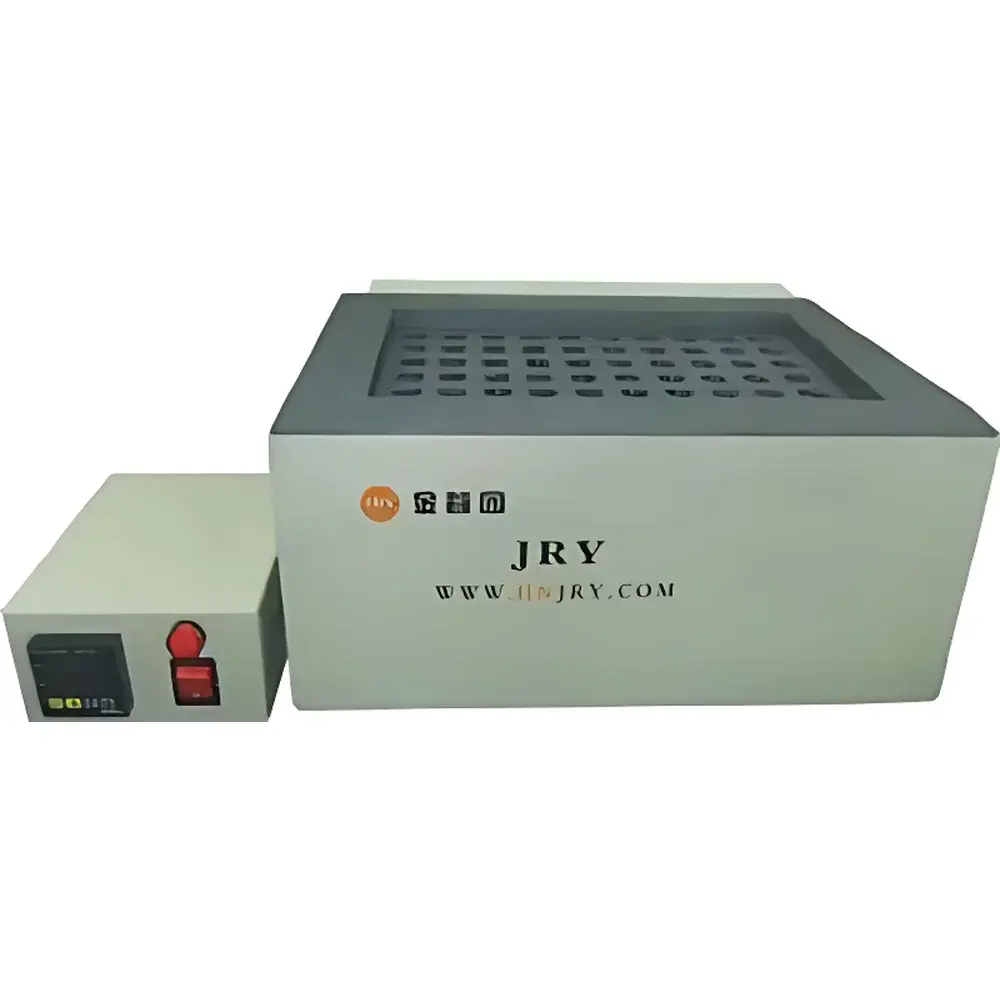
JRY JRY-UI20/40/60 Graphite Block Urine Iodine Digestion System
| Brand | JRY |
|---|---|
| Origin | Hunan, China |
| Manufacturer Type | Direct Manufacturer |
| Instrument Type | Graphite Block Digestion System |
| Automation Level | Semi-Automatic |
| Digestion Positions | 36 |
| Max Heating Temperature | 350 °C |
| Temperature Control Accuracy | ±1 °C |
| Heating Principle | Uniform Graphite Block Heating |
| Reagent Channels | 60 |
| Sample Capacity | 25 mL per position |
| Power Consumption | 1000–1800 W (model-dependent) |
| Weight | 12–20 kg (model-dependent) |
| Control Method | PID Intelligent Programmable Digital Controller |
| Power Supply | AC 220 V / 50 Hz |
| Optional | External Timer Module |
Overview
The JRY JRY-UI20/40/60 Graphite Block Urine Iodine Digestion System is a purpose-engineered semi-automatic sample preparation instrument designed specifically for the quantitative determination of iodine in human urine matrices. It operates on the principle of controlled, uniform conductive heating via high-purity isostatic graphite blocks—optimized to meet the thermal and chemical stability requirements of the arsenic-cerium catalytic spectrophotometric method specified in the Chinese Health Industry Standard WS/T 107–2006 (and its predecessor WS/T 107–1999). Unlike open-flame or hotplate-based digestion, this system delivers reproducible thermal profiles across all 36 digestion positions, minimizing inter-sample variability and ensuring compliance with analytical pre-treatment protocols required for trace iodine quantification at sub-µg/L levels. The graphite block architecture provides exceptional resistance to concentrated nitric, perchloric, and sulfuric acids—common reagents used in urine matrix decomposition—while maintaining structural integrity up to 350 °C.
Key Features
- Isostatic High-Purity Graphite Block: Engineered for long-term corrosion resistance against strong oxidizing acids and alkaline digestants; surface hardness and low porosity enable rapid cleaning and prevent cross-contamination.
- Uniform Surrounding Heating Design: Patented circumferential heat distribution ensures ±1 °C inter-position temperature consistency at 100 °C over 6 hours—critical for parallel processing of epidemiological urine cohorts.
- PID Intelligent Programmable Control: Real-time digital display with auto-tuning capability; supports multi-step ramp-hold programs, adjustable heating rate, and user-defined time/temperature setpoints.
- Scalable Configuration Options: Three standard models (JRY-UI20, UI40, UI60) accommodate 20, 40, or 60 × 25 mL PTFE or quartz digestion tubes (Ø16 mm × H50 mm), enabling throughput alignment with laboratory workflow volume.
- Integrated Reagent Management: 60 independent reagent channels support automated or manual sequential addition—compatible with post-digestion dilution, reducing manual pipetting errors during colorimetric assay setup.
- Energy-Efficient Thermal Architecture: Low thermal mass graphite combined with optimized insulation achieves target temperatures in under 15 minutes (from ambient to 210 °C), reducing standby energy consumption by >30% versus conventional ceramic heaters.
Sample Compatibility & Compliance
This digestion system is validated for use with human urine specimens preserved in sodium hydroxide or ammonium hydroxide (pH ≥12), as required by WS/T 107–2006. It accommodates standard digestion vessels including borosilicate glass, quartz, and acid-washed PTFE tubes. All wetted components comply with ISO 8573-1 purity class 4 for particulate and hydrocarbon content, ensuring no background iodine leaching. While not certified to GLP or FDA 21 CFR Part 11 out-of-the-box, the system’s programmable controller logs timestamped temperature profiles (when paired with optional external data logger), supporting audit-ready documentation for laboratories operating under ISO/IEC 17025 or CAP-accredited quality management systems.
Software & Data Management
The JRY-UI series features a standalone digital controller with non-volatile memory capable of storing up to 10 pre-programmed digestion methods. Each method includes up to three temperature ramps with hold times, maximum power limits, and audible end-of-cycle alerts. For laboratories requiring electronic records, the system offers analog voltage output (0–5 V DC) compatible with third-party SCADA or LIMS interfaces. Optional timer modules provide hardware-based run-time validation, satisfying internal QA checks for method adherence. No proprietary software installation is required—configuration remains accessible via front-panel keypad and LED display.
Applications
- Population-level iodine nutrition surveillance in public health laboratories and CDC-affiliated institutions
- Routine quality control of iodized salt programs via urinary iodine excretion analysis
- Method validation studies comparing arsenic-cerium vs. ICP-MS iodine quantification workflows
- Pre-analytical processing for WHO-recommended spot urine sampling protocols (e.g., median urinary iodine concentration reporting)
- Research applications involving iodine speciation after alkaline ashing or enzymatic hydrolysis pretreatment
FAQ
What regulatory standards does the JRY-UI series comply with?
It is engineered to fulfill the instrumental requirements of WS/T 107–2006 and WS/T 107–1999, and its thermal performance aligns with ASTM D5504–20 for trace element digestion uniformity.
Can the system be integrated into an automated liquid handling platform?
Yes—via dry-contact relay outputs and analog signal interface; full robotic integration requires custom mounting brackets and third-party motion control coordination.
Is the graphite block replaceable, and what is its service life under routine use?
Each block is field-replaceable and rated for ≥5,000 cycles at ≤210 °C with proper acid rinsing between runs; lifetime extends beyond 8 years in typical public health lab usage.
Does the system support digestion of other biological matrices besides urine?
While optimized for urine, it has been successfully applied to serum, breast milk, and seaweed extracts—though method validation per matrix is required per ISO 17025 clause 5.4.2.
What safety certifications are available for export to EU or North American markets?
CE marking is available upon request with EN 61000-6-3 (EMC) and EN 61000-6-4 testing reports; UL/CSA certification requires model-specific evaluation and is offered as an OEM option.



