
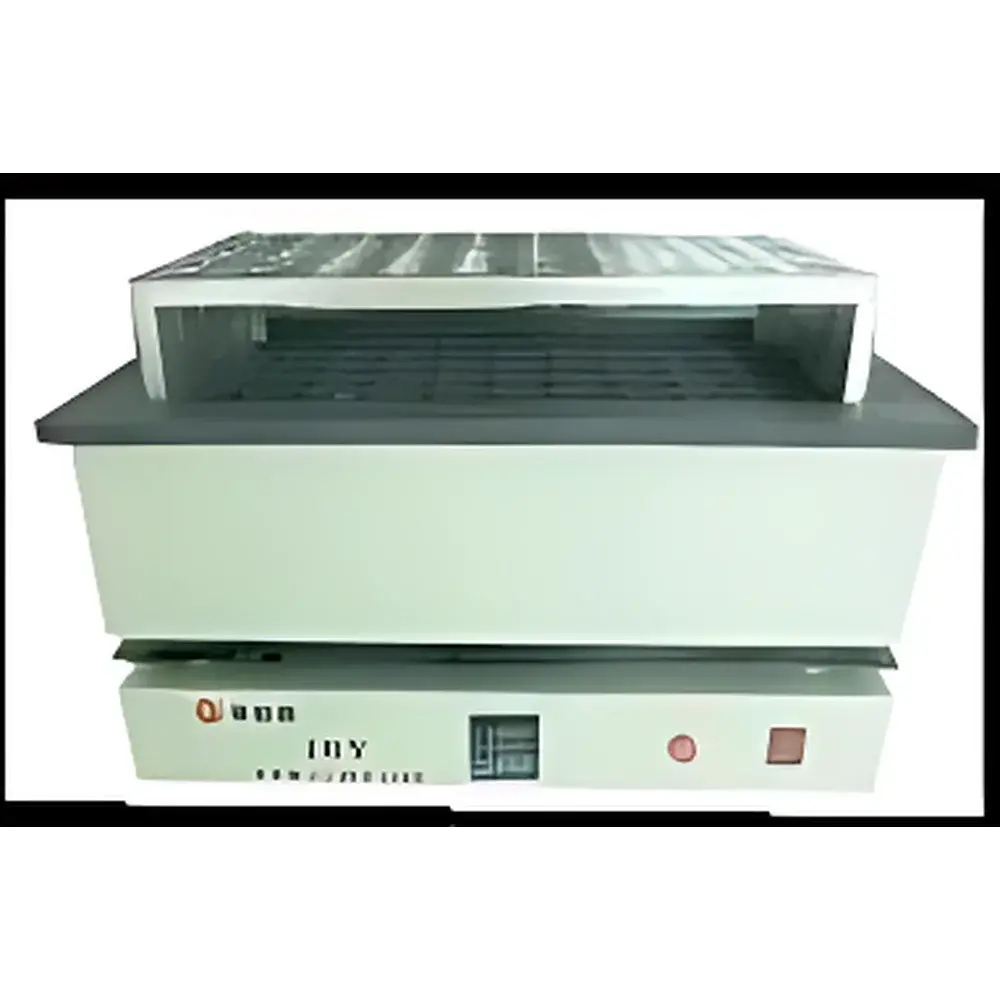
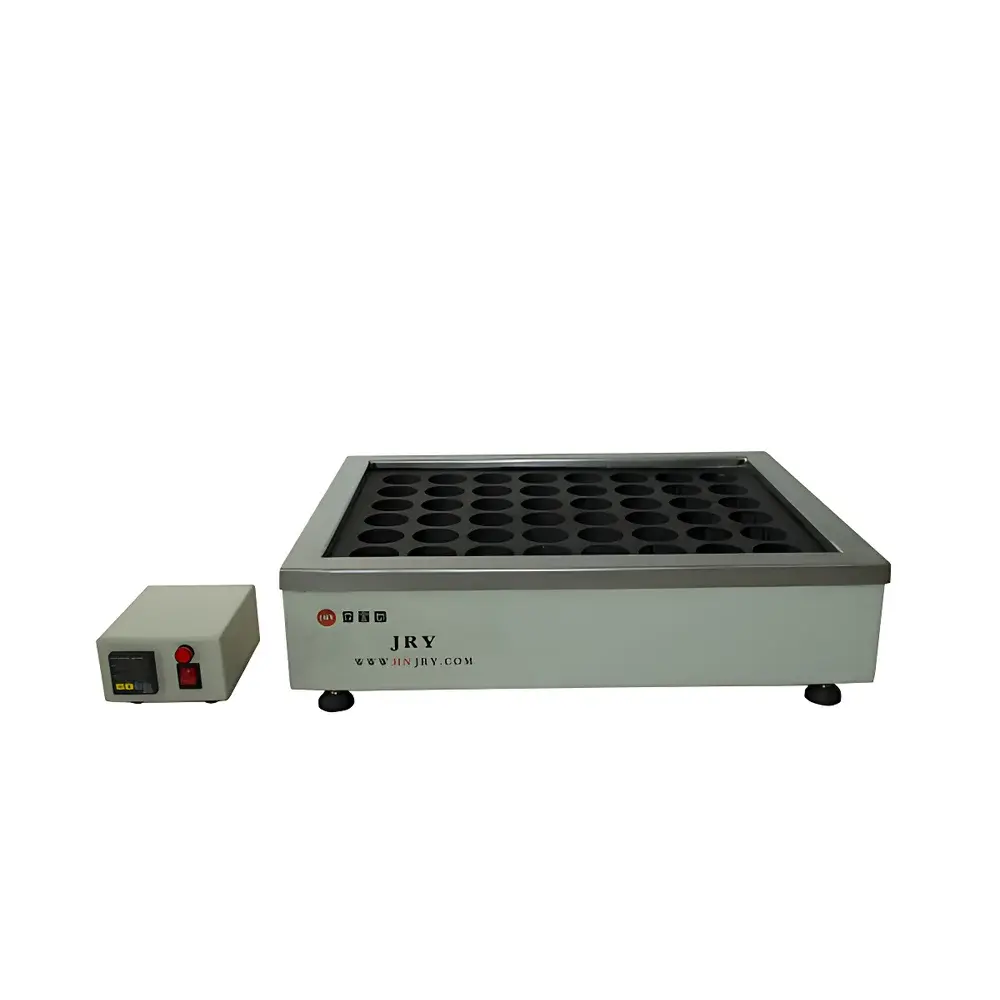
JRY JRY-X350-60 Graphite Block Digestion System
| Brand | JRY |
|---|---|
| Origin | Hunan, China |
| Manufacturer Type | Direct Manufacturer |
| Equipment Type | Graphite Block Digestion Instrument |
| Model | JRY-X350-60 |
| Heating Block Material | High-Purity Graphite |
| Max Temperature | 350 °C |
| Temperature Uniformity | ±0.2 °C |
| Control Method | PID Digital Display |
| Power Rating | 3000 W |
| Continuous Operation Time | Up to 48 h |
| Sample Capacity | 60 positions |
| Compliance | Designed for ASTM D3682, ISO 11047, EPA Method 3050B, and USP <231> sample preparation workflows |
Overview
The JRY JRY-X350-60 Graphite Block Digestion System is an engineered solution for controlled, reproducible open-vessel acid digestion of solid and semi-solid samples prior to elemental analysis by ICP-OES, ICP-MS, AAS, or HG-AFS. Unlike ceramic or metal heating blocks, this system employs a monolithic high-purity graphite block with integrated heating elements, enabling rapid thermal response, exceptional temperature homogeneity across all 60 sample wells, and long-term chemical resistance to aggressive mineral acids—including HNO₃, HCl, HF (with appropriate safety protocols), and H₂O₂—under sustained operation up to 350 °C. Its design adheres to the fundamental principles of conductive heat transfer and thermal mass stabilization, minimizing radial and axial temperature gradients that compromise digestion completeness and analyte recovery. The system serves as both a primary digestion platform and a dedicated post-microwave acid removal (‘acid evaporation’ or ‘赶酸’) station—addressing a critical bottleneck in multi-step sample preparation workflows where residual acid interferes with downstream instrumental analysis.
Key Features
- 60-position high-density graphite block with precision-machined, chemically inert sample wells (depth: 50 mm; diameter: 16 mm) optimized for standard 50 mL PTFE or quartz digestion tubes.
- PID digital temperature controller with real-time display, programmable ramp-hold profiles, and ±0.2 °C accuracy at setpoints between ambient and 350 °C—validated per ASTM E220 calibration standards.
- Uniform circumferential heating architecture ensures ≤1.5 °C inter-well variation across full load, verified by NIST-traceable thermocouple mapping at 100 °C, 200 °C, and 300 °C.
- Robust thermal insulation and low-thermal-loss housing reduce energy consumption by ~22% compared to conventional ceramic-block digesters operating under identical duty cycles.
- Integrated overtemperature cut-off, ground-fault circuit interrupter (GFCI), and auto-shutdown after 48 h continuous operation meet IEC 61010-1 safety requirements for laboratory electrical equipment.
- Front-panel interface supports time-based digestion scheduling, user-defined method storage (up to 10 protocols), and manual override without software dependency.
Sample Compatibility & Compliance
The JRY-X350-60 accommodates a broad spectrum of matrices requiring total digestion: soils (EPA 3050B/3051A), plant tissues (AOAC 999.10), food composites (ISO 6869), biological tissues (ISO 11047), wastewater sludges (EN 13656), and cosmetic powders (USP ). All wet chemistry protocols are compatible with nitric-perchloric, nitric-hydrogen peroxide, and aqua regia systems. The graphite block’s acid resistance has been verified through 500+ hour immersion testing in boiling 6 mol/L HNO₃, showing no measurable mass loss or surface pitting (per ASTM C657). The instrument conforms to GLP documentation requirements for sample preparation traceability and supports audit-ready operation when paired with external lab notebooks or LIMS-integrated loggers.
Software & Data Management
While fully functional in standalone mode, the JRY-X350-60 includes an optional RS-485 serial interface (Modbus RTU protocol) for integration into centralized laboratory automation networks. When connected to compliant data acquisition software, it logs timestamped temperature setpoints, actual block temperatures (sample-zone averaged), elapsed run time, and alarm events—including overtemperature, power interruption, and door-open detection (if equipped with safety interlock). All logged data comply with FDA 21 CFR Part 11 electronic record integrity criteria when deployed with validated software and access-controlled user accounts. No proprietary cloud service or vendor-hosted platform is required.
Applications
- Preparation of certified reference materials (CRMs) for calibration of ICP instruments in environmental monitoring labs.
- Routine heavy metal screening (Pb, Cd, As, Hg, Cr) in agricultural soils per ISO 11466 and China GB/T 22105.1–2008.
- Digestion of protein-rich matrices (e.g., milk powder, meat homogenates) using two-stage HNO₃/H₂O₂ protocols prior to Se and Zn quantification by GF-AAS.
- Acid evaporation of microwave-digested samples to near-dryness while preserving volatile elements (e.g., As, Sb) via controlled 120–150 °C hold steps.
- High-throughput batch processing in contract testing laboratories handling >200 soil samples per week under ISO/IEC 17025-accredited methods.
FAQ
What sample tube materials are compatible with the JRY-X350-60?
Standard 50 mL polytetrafluoroethylene (PTFE), quartz, and borosilicate glass tubes are supported. PTFE is recommended for HF-containing digestions; quartz is preferred for ultra-trace metal work due to lower background leaching.
Can the unit be used for reflux digestion?
Yes—when fitted with condenser adapters and appropriate cooling water supply, the system supports reflux configurations for organic-rich samples requiring extended low-temperature acid contact.
Is calibration verification included with purchase?
A factory-issued calibration certificate (traceable to CNAS-accredited standards) is provided, documenting temperature uniformity and accuracy at three points (100 °C, 200 °C, 300 °C) using dual-junction Pt100 sensors.
How often does the graphite block require maintenance?
Under normal use with proper acid handling, the block requires no scheduled replacement. Annual visual inspection for micro-cracking or localized corrosion is advised; cleaning is performed with dilute NaOH followed by deionized water rinse.
Does the system support method validation per ISO/IEC 17025?
Yes—the deterministic thermal profile, documented repeatability (<0.5% RSD in triplicate digestions), and built-in data logging enable full method validation including precision, accuracy (spike recovery), and robustness assessment.
Related Products



