
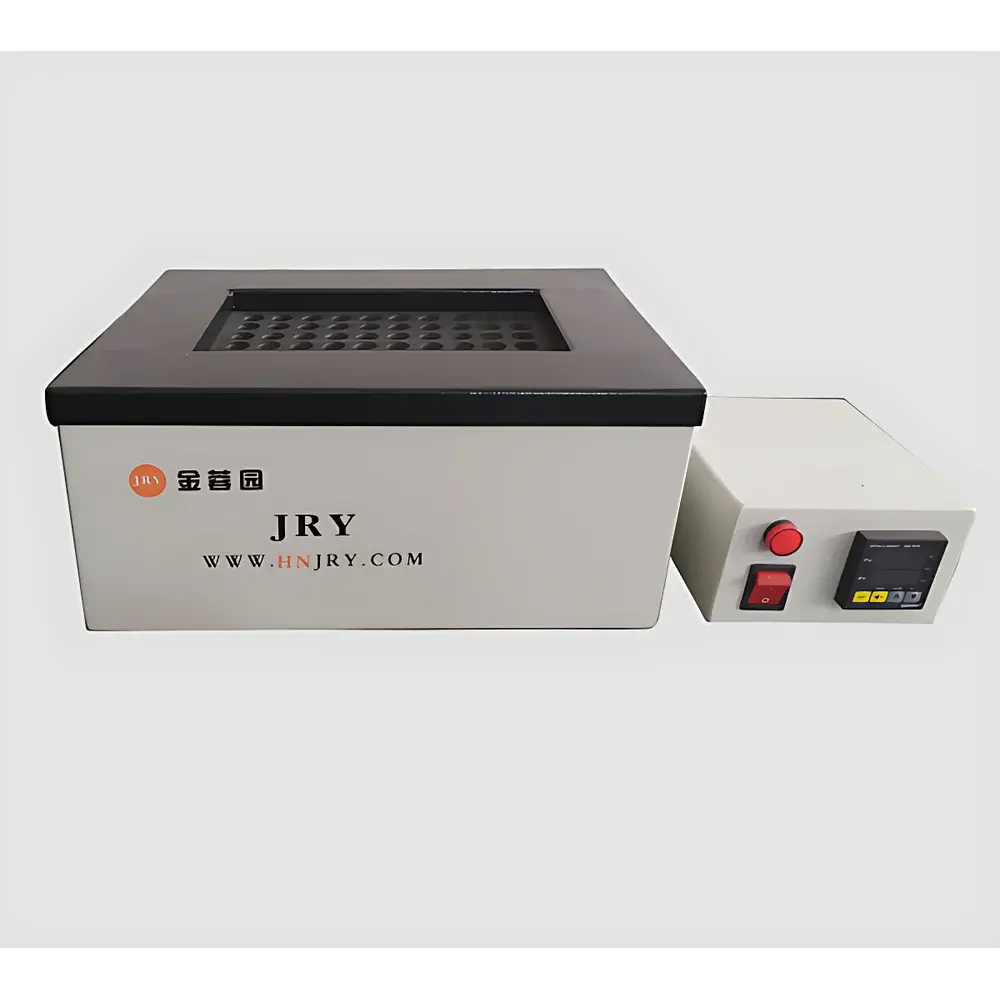
JRY UI-Series Automated Constant-Temperature Urine Iodine Digestion System
| Brand | JRY |
|---|---|
| Origin | Hunan, China |
| Manufacturer Type | Direct Manufacturer |
| Product Category | Domestic |
| Model | JRY-UI36 / JRY-UI48 / JRY-UI60 |
| Instrument Type | Graphite Block Digestion System |
| Automation Level | Semi-Automatic |
| Digestion Positions | 36 / 48 / 60 |
| Heating Temperature Range | Ambient to 210 °C |
| Temperature Control Accuracy | ±0.1 °C |
| Heating Principle | Aluminum-Block Heated Graphite Platform |
| Reagent Channels | 36 |
| Sample Vessel Capacity | 25 mL |
| Power Consumption | 1000 W (UI36) / 1200 W (UI48) / 1800 W (UI60) |
| Weight | 12 kg / 15 kg / 20 kg |
| Control Method | PID Intelligent Programmable Digital Control |
| Power Supply | AC 220 V / 50 Hz |
| Optional | Programmable Timer Module |
Overview
The JRY UI-Series Automated Constant-Temperature Urine Iodine Digestion System is a purpose-built semi-automatic graphite digestion platform engineered for precise, reproducible sample preparation in compliance with the Chinese Health Industry Standard WS/T 107–2006 and its predecessor WS/T 107–1999, both specifying the arsenic-cerium catalytic spectrophotometric method for urinary iodine quantification. Unlike general-purpose hot plates or open-flame digesters, this system integrates an isostatically pressed high-purity graphite block mounted on an aluminum heating base—ensuring exceptional thermal conductivity, chemical inertness, and mechanical stability under prolonged exposure to aggressive acid mixtures (e.g., HNO₃–H₂SO₄–H₂O₂). The core operational principle relies on uniform conductive heating across all digestion positions, eliminating convective variability and enabling tightly controlled thermal ramping, hold times, and endpoint stabilization—critical parameters for quantitative iodine recovery in biological matrices.
Key Features
- Isostatically pressed ultra-high-purity graphite digestion block: Resistant to concentrated nitric, sulfuric, and perchloric acids; withstands continuous operation up to 210 °C without degradation or carbon leaching.
- Aluminum-block-supported heating architecture: Delivers rapid thermal response (<6 min to reach 150 °C from ambient), high energy efficiency, and superior temperature homogeneity (±0.1 °C inter-hole deviation at 100 °C over 6 h).
- PID-intelligent programmable digital controller: Enables multi-step temperature ramping, dwell time definition, and real-time monitoring of setpoint vs. actual temperature; auto-tuning capability minimizes overshoot and stabilizes control within ±0.1 °C accuracy.
- Modular configuration: Three standard models support 36, 48, or 60 simultaneous 25 mL PTFE or quartz digestion vessels—optimized for batch processing of urine specimens in public health laboratories.
- Integrated reagent dispensing interface: 36 independent reagent channels allow synchronized, low-volume acid addition aligned with thermal program stages—reducing manual intervention and contamination risk.
- Ergonomic design: Front-accessible vessel loading, corrosion-resistant stainless-steel housing, and integrated ventilation-compatible mounting flanges for fume hood integration.
Sample Compatibility & Compliance
The JRY UI-Series is validated for use with human urine samples preserved in sodium hydroxide or acetic acid, as specified in WS/T 107–2006. It supports digestion protocols requiring sequential acid additions (e.g., 1 mL HNO₃ + 0.5 mL H₂SO₄), followed by controlled heating to 100–130 °C for 60–90 minutes to achieve complete organic matrix mineralization while retaining volatile iodine species. The system’s thermal stability and low background contamination profile meet the analytical requirements of iodine quantification at sub-µg/L levels (LOD ≤ 0.5 µg/L). While not certified to ISO/IEC 17025 or FDA 21 CFR Part 11 out-of-the-box, its programmable logging capability (when paired with optional timer module) supports GLP-aligned recordkeeping—including operator ID, method version, start/end timestamps, and temperature/time profiles—for internal audit readiness.
Software & Data Management
The system operates via embedded firmware with a front-panel LCD interface supporting dual-parameter display (setpoint/actual temperature) and editable program sequences (up to 5 user-defined methods). Optional timer modules provide RS232 or USB output for external data capture, enabling traceable export of temperature logs in CSV format. No proprietary software installation is required; exported files are compatible with standard LIMS platforms and statistical analysis tools (e.g., JMP, Minitab). All parameter changes are timestamped and non-volatile—retained after power cycling—supporting basic audit trail functionality essential for quality assurance workflows in CDC-affiliated and provincial health laboratories.
Applications
- Routine urinary iodine surveillance in national nutrition monitoring programs.
- Method validation and reference material analysis per WS/T 107–2006 protocol.
- High-throughput sample prep for epidemiological studies involving >1000 urine specimens/month.
- Pre-digestion conditioning of clinical urine samples prior to ICP-MS or GC-MS iodine speciation analysis.
- Teaching laboratory implementation of standardized iodine assay methodology in public health curricula.
FAQ
What regulatory standards does the JRY UI-Series comply with?
It is designed and validated specifically for use with the Chinese Health Industry Standard WS/T 107–2006 and WS/T 107–1999.
Can the system be integrated into a fully automated workflow?
As a semi-automatic platform, it requires manual sample loading and acid addition; however, its 36-channel reagent interface and programmable timing support partial automation when paired with third-party liquid handlers.
Is the graphite block replaceable, and what is its expected service life?
Yes—the graphite block is field-replaceable and rated for ≥5,000 digestion cycles under routine use with HNO₃/H₂SO₄ mixtures at ≤180 °C.
Does the instrument support GLP-compliant data archiving?
With the optional timer module, temperature/time logs can be exported in timestamped CSV format—sufficient for internal QA review, though formal 21 CFR Part 11 compliance requires additional IT infrastructure.
What maintenance is required for long-term thermal accuracy?
Annual calibration verification using NIST-traceable PT100 probes is recommended; no routine recalibration of the PID controller is necessary under stable ambient conditions.
Related Products



