
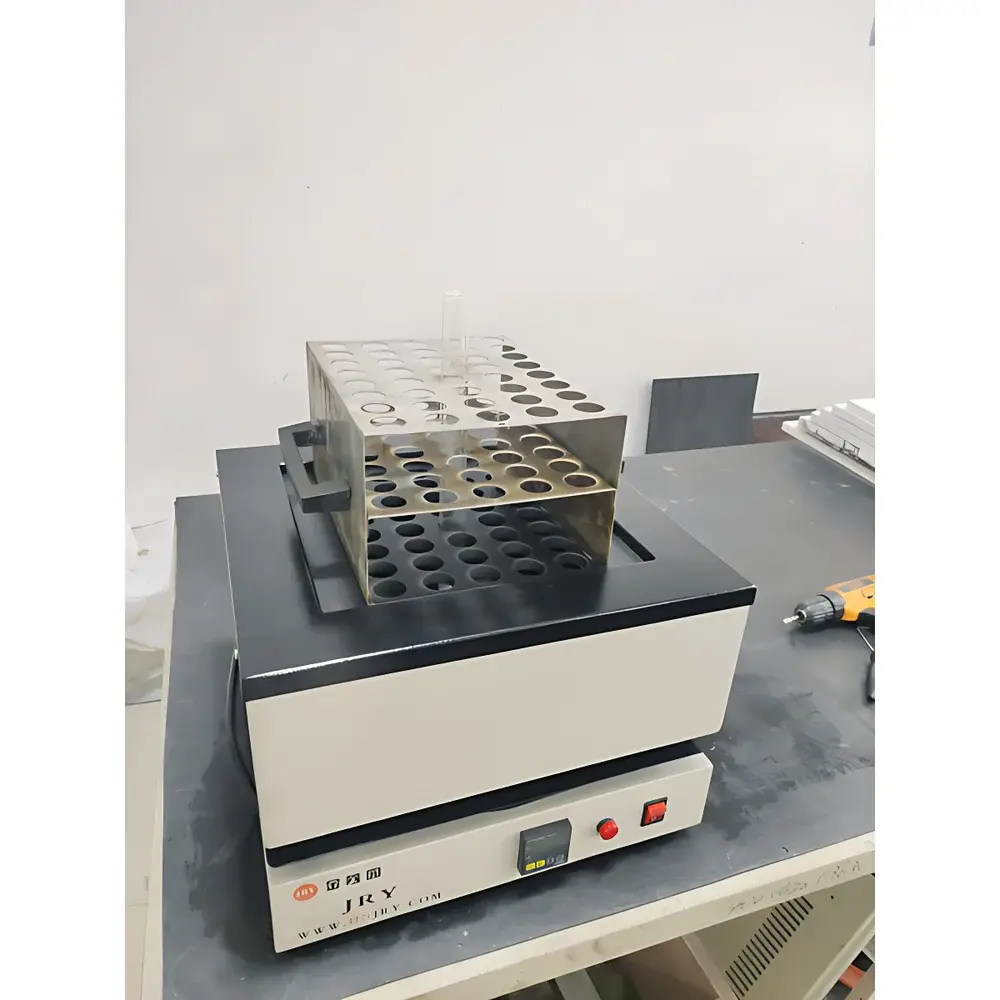
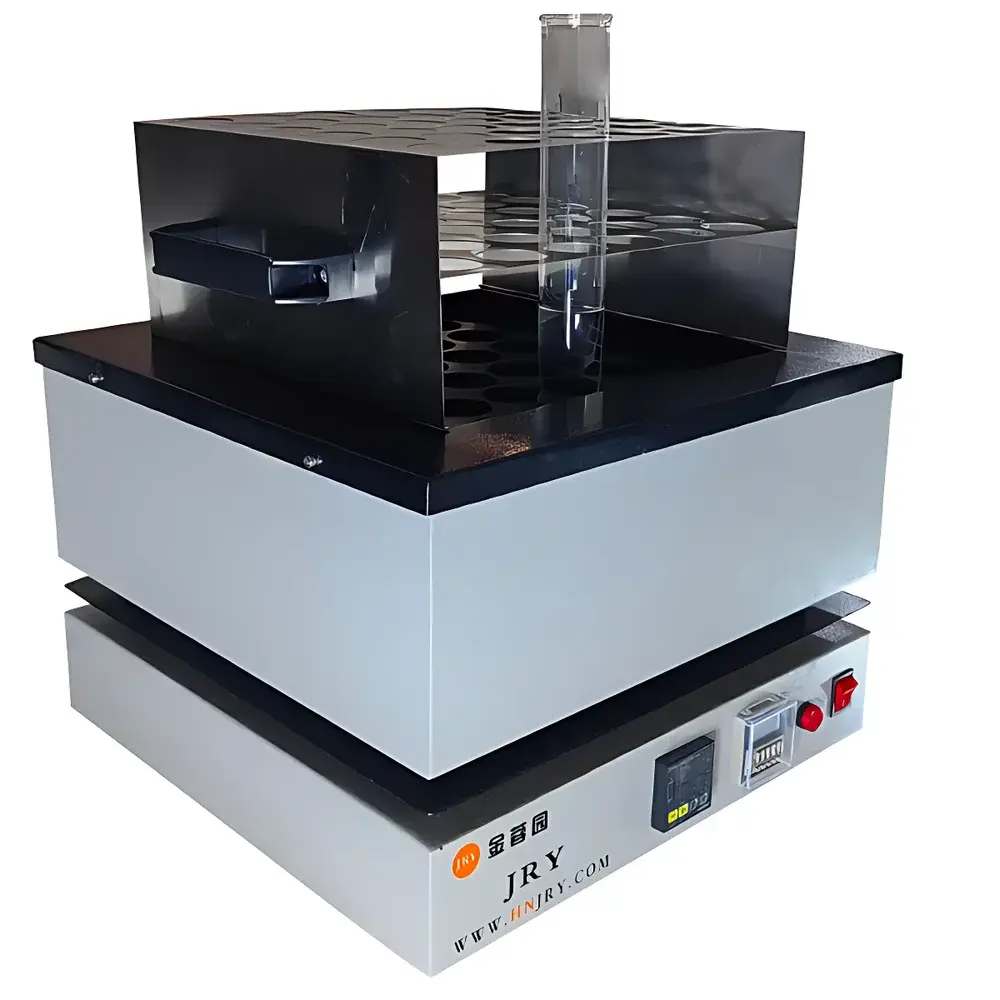
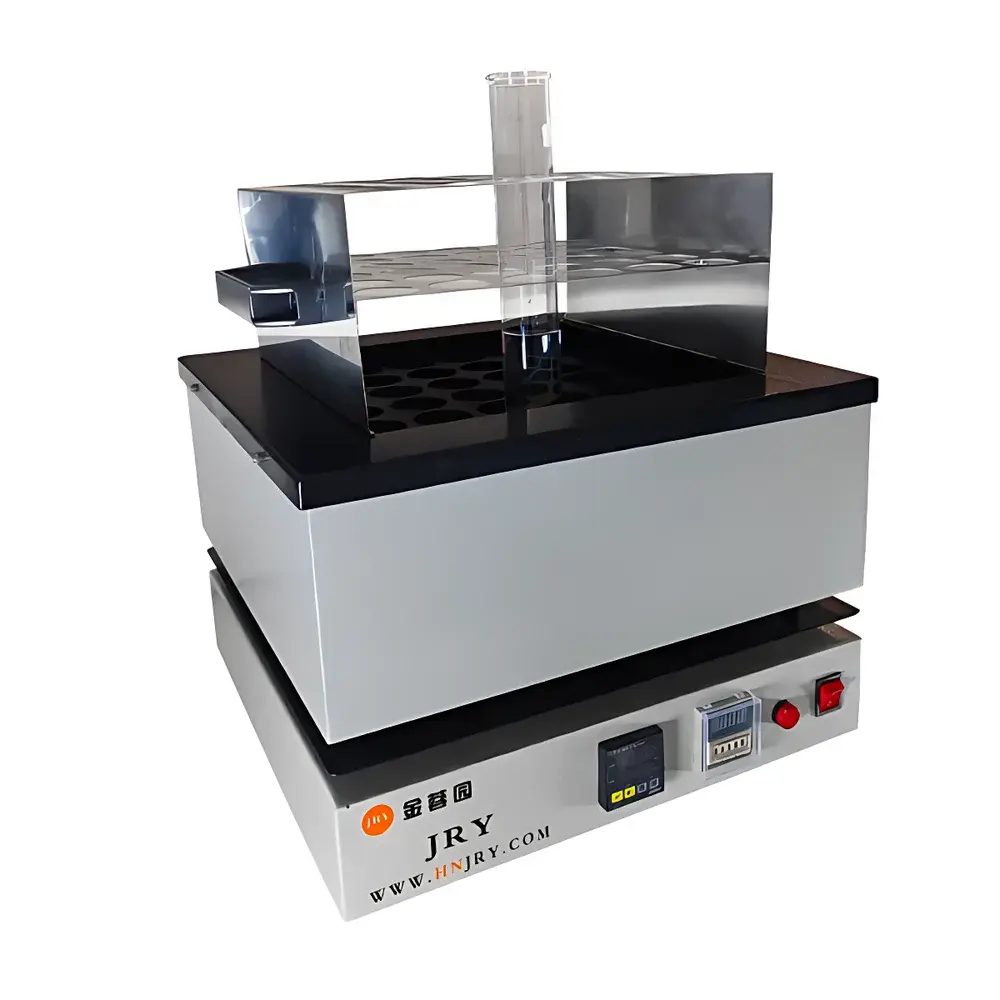
JRY-XZ-40 High-Throughput Graphite Block Digestion System for Kjeldahl Nitrogen Analysis
| Brand | JRY |
|---|---|
| Origin | Hunan, China |
| Manufacturer Type | Direct Manufacturer |
| Instrument Type | Graphite Block Digester |
| Digestion Positions | 40 or 56 |
| Max Heating Temperature | 500 °C |
| Temperature Control Accuracy | ±0.1 °C |
| Heating Principle | PTFE-Coated High-Purity Graphite Block |
| Reagent Channels | 40 or 56 |
| Dimensions (W×D×H) | 430 × 430 × 315 mm |
| Power Supply | 220 V AC |
| Rated Power | 4 kW |
| Net Weight | 25 kg |
| Temperature Uniformity | <5 °C at 350 °C |
| Ramp Rate | >3 °C/min |
| Timer Range | 1–999 min |
| Integrated Probe | Core-block temperature sensing (optional external probe compatible) |
Overview
The JRY-XZ-40 is a high-throughput, programmable graphite block digestion system engineered for reproducible, trace-metal-safe sample preparation in compliance with standardized wet digestion protocols for Kjeldahl nitrogen determination, ICP-OES, ICP-MS, and AAS analysis. Unlike conventional hot plates or ceramic heating blocks, this instrument employs a monolithic high-purity graphite heating block coated with chemically inert polytetrafluoroethylene (PTFE), ensuring uniform thermal distribution, resistance to acid corrosion (including HNO₃, HCl, HF, and H₂SO₄ mixtures), and minimal risk of elemental contamination. The system operates on the principle of conductive heating—where heat is transferred directly from the graphite matrix to digestion tubes—enabling precise ramp-and-hold thermal programming across up to 56 positions simultaneously. Designed for integration into regulated laboratory environments, it supports method-defined digestion sequences required by ASTM D5178, ISO 14852, USP , and EPA Methods 3010B, 3050B, and 3052.
Key Features
- Simultaneous digestion of up to 56 samples using standardized Kjeldahl digestion tubes (e.g., 150 mm × 25 mm borosilicate glass) or alternative PTFE/tube-compatible vessels.
- PID-controlled programmable temperature profile with ramp rates adjustable from 0.1 to 10 °C/min and hold times configurable from 1 to 999 minutes per step.
- Real-time core-block temperature monitoring via embedded Pt100 sensor; optional external thermocouple input for independent tube-level validation (traceable to NIST standards).
- Temperature stability of ±0.1 °C at setpoint (verified at 580 °C under load); spatial uniformity <5 °C across all positions at 350 °C (per ISO/IEC 17025 calibration practice).
- Robust mechanical architecture: 25 kg unit with reinforced chassis, integrated ventilation slots, and low-profile footprint (430 × 430 × 315 mm) optimized for under-fume-hood installation.
- 4 kW power delivery via 220 V AC supply with overtemperature cutoff, short-circuit protection, and auto-shutdown upon lid removal or timer completion.
Sample Compatibility & Compliance
The JRY-XZ-40 accommodates diverse solid and semi-solid matrices—including soil, sludge, wastewater solids, agricultural products (grains, tobacco, vegetables), dairy powders, fish tissue, cosmetics, fertilizers, and industrial polymers—following validated digestion procedures outlined in AOAC 984.27, ISO 11260, and DIN EN 13656. Its PTFE-coated graphite surface prevents leaching of Fe, Cr, Ni, or Zn during prolonged exposure to aggressive reagents, meeting stringent blank requirements for sub-ppq metal quantification. All electrical components comply with IEC 61010-1 safety standards for laboratory equipment. When operated with documented SOPs and calibrated thermoprobes, the system satisfies GLP and GMP documentation prerequisites for audit readiness, including traceable temperature logs and user-accessible parameter change history.
Software & Data Management
While the JRY-XZ-40 operates via an intuitive front-panel interface with LED display and membrane keypad, it supports optional RS-485 or USB-to-serial connectivity for integration into LIMS or ELN platforms. Time-stamped temperature profiles, setpoint changes, and runtime events are stored internally (non-volatile memory) for ≥1,000 cycles and exportable as CSV files. For laboratories requiring 21 CFR Part 11 compliance, third-party software modules enable electronic signatures, role-based access control, and audit-trail generation—fully aligned with FDA expectations for analytical instrument data integrity.
Applications
- Kjeldahl nitrogen digestion prior to distillation and titration on automated Kjeldahl systems.
- Acid digestion of environmental samples (EPA 3050B/3052) for multi-element analysis by ICP-MS.
- Organic matrix destruction in food safety testing (e.g., heavy metals in infant formula per EU Regulation No. 1881/2006).
- Preparation of geological and metallurgical samples for XRF or fusion bead analysis.
- Routine QC/QA digestion in contract testing labs serving pharmaceutical, agrochemical, and municipal wastewater sectors.
FAQ
Is the JRY-XZ-40 suitable for hydrofluoric acid (HF) digestion?
Yes—its PTFE-coated graphite block and compatible glassware support HF-containing mixtures when used with appropriate safety protocols and fume hood containment.
Can digestion temperature be verified independently per tube position?
Yes—via optional external thermocouples connected to the auxiliary port; recommended for method validation and uncertainty budgeting per ISO/IEC 17025 Clause 7.7.
What maintenance is required for long-term thermal accuracy?
Annual recalibration of the embedded Pt100 sensor against a certified reference thermometer is advised; visual inspection of PTFE coating integrity should occur quarterly.
Does the system meet CE or UL certification requirements?
It conforms to IEC 61010-1; CE marking is available upon request for EU-distributed units with full technical file submission.
How is cooling managed after digestion cycles?
Passive air cooling only—the unit lacks active cooling; users must allow natural cooldown before tube removal or initiate post-digestion purge protocols in the fume hood.



