
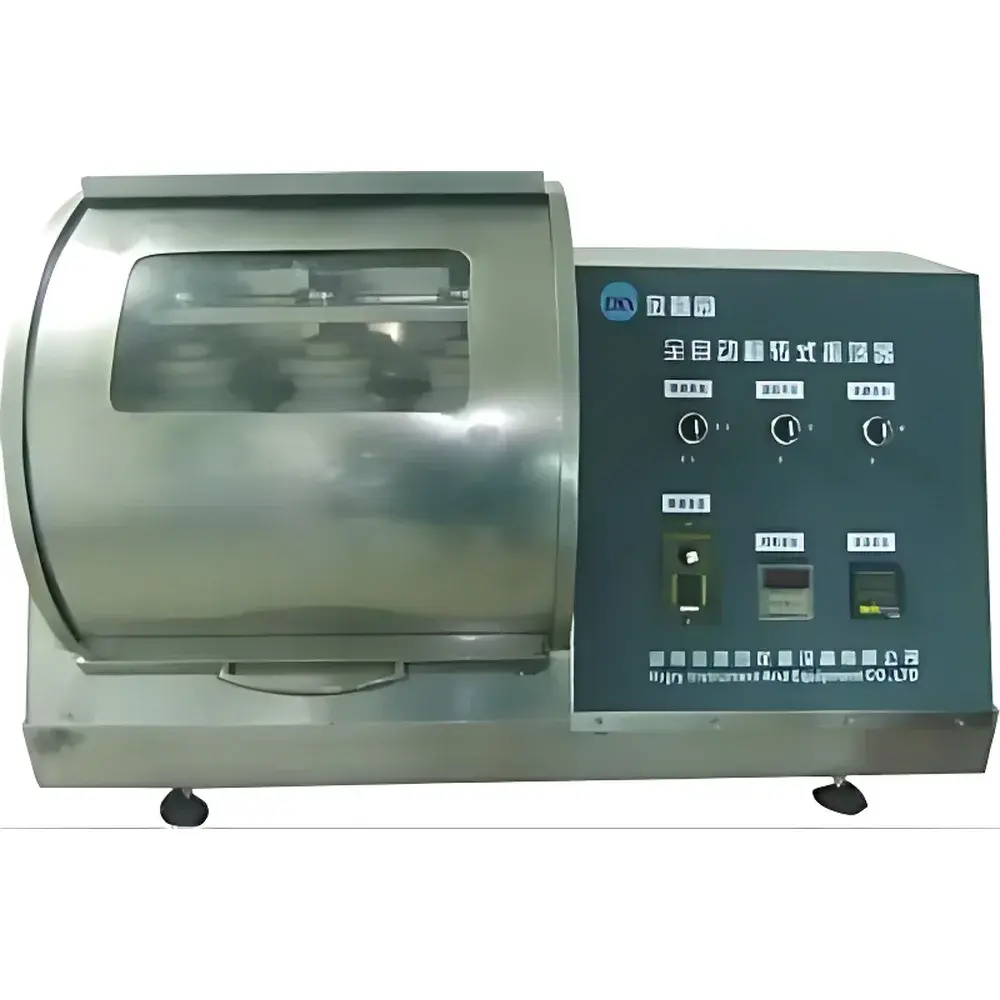
JRY-Z10 Automated Tumbling Extractor for Toxicity Characterization
| Origin | Hunan, China |
|---|---|
| Manufacturer Type | Authorized Distributor |
| Origin Category | Domestic (PRC) |
| Model | JRY-Z10 |
| Price | Upon Request |
| Sample Bottle Capacity | 2 L × 10 units |
| Rotation Mode | Unidirectional or Bidirectional (programmable dwell-interval cycling) |
| Speed Range | 0–60 rpm (adjustable) |
| Temperature Control Range | Ambient to 65 °C |
| Temperature Accuracy | ±1 °C |
| Timing Range | 0.5–24 h (0.5-h increments) |
| Dimensions (W×D×H) | 1160 × 550 × 700 mm |
| Net Weight | 75 kg |
| Housing Material | Full 304 Stainless Steel |
| Power Supply | 220 V AC, 50 Hz |
| Motor Power | 140 W |
Overview
The JRY-Z10 Automated Tumbling Extractor is an engineered solution for standardized leaching procedures used in regulatory toxicity characterization of solid waste matrices. Designed in strict conformance with multiple national and international leaching protocols—including China’s HJ/T 299–2007 (Sulfuric-Nitric Acid Method), HJ/T 300–2007 (Acetic Acid Buffer Extraction), GB 5085.3–2007 (Toxicity Characteristic Leaching Procedure), GB 16889–2008 (for municipal solid waste landfill disposal criteria), and U.S. EPA Method 1311 (TCLP)—this instrument delivers reproducible tumbling motion under controlled thermal and temporal conditions. Its core operational principle relies on gravity-driven rotational tumbling within sealed 2-L extraction vessels, simulating dynamic leachate generation under standardized agitation intensity, contact duration, and temperature profiles. The system is not a generic shaker but a purpose-built extractor calibrated for regulatory compliance testing in environmental laboratories performing waste classification, landfill acceptance testing, and hazardous waste determination.
Key Features
- Programmable bidirectional tumbling mode with configurable forward/reverse rotation intervals and dwell periods—enabling precise replication of HJ/T 299–2007 and EPA 1311 oscillation cycles.
- Integrated PID temperature control system maintaining ±1 °C accuracy across the full 20–65 °C operating range, critical for pH-dependent leaching kinetics in acetic acid buffer extractions (HJ/T 300–2007).
- Stainless-steel monocoque housing (304 grade) ensures corrosion resistance against acidic and buffered leachants, supporting long-term use in high-throughput regulatory labs.
- Dual-mode timing architecture: discrete cycle timing (0.5–24 h, 0.5-h resolution) and continuous run mode (activated at 0 h setting) for extended leaching studies or method development.
- Modular bottle tray accommodating ten 2-L EPA-compliant polyethylene or borosilicate glass extraction bottles, with mechanical retention to prevent displacement during bidirectional motion.
- Low-vibration, brushless DC motor drive (140 W nominal) delivering stable torque output across the full 0–60 rpm range without speed drift or thermal derating.
Sample Compatibility & Compliance
The JRY-Z10 accommodates standard 2-L extraction vessels compliant with EPA SW-846 and Chinese HJ-series specifications, including HDPE, PET, and borosilicate glass containers rated for chemical resistance to sulfuric/nitric acid mixtures (pH ≤ 2.0) and acetic acid buffers (pH 4.93 ± 0.05). It supports sample-to-leachant ratios per protocol requirements (e.g., 1:10 w/v for TCLP and HJ/T 299–2007). All operational parameters—including rotation sequence, dwell time, temperature setpoint, and total duration—are fully documentable and repeatable, facilitating audit readiness under GLP frameworks. The instrument meets mechanical performance criteria referenced in ISO/IEC 17025:2017 for test equipment used in accredited environmental testing laboratories.
Software & Data Management
While the JRY-Z10 operates via an embedded microcontroller interface (no PC dependency), it provides non-volatile parameter storage for up to 10 user-defined methods. Each method retains independent settings for speed, direction logic, temperature, and timing—enabling rapid reconfiguration between HJ/T 299–2007, HJ/T 300–2007, and custom leaching protocols. An optional RS-232 serial interface (available upon request) permits integration with laboratory information management systems (LIMS) for automated log export of start time, end time, actual temperature profile, and motor status. Audit trails comply with basic data integrity principles aligned with FDA 21 CFR Part 11 Annex A expectations for electronic records in regulated environments.
Applications
- Regulatory toxicity screening of industrial sludge, fly ash, mining tailings, and construction/demolition debris per GB 5085.3–2007 and EPA TCLP.
- Leachate generation for subsequent analysis by ICP-MS, ICP-OES, AAS, or ion chromatography in environmental monitoring and waste treatment facilities.
- Method validation and interlaboratory comparison studies requiring strict adherence to HJ/T 299–2007 and HJ/T 300–2007 mechanical agitation specifications.
- Research into contaminant mobilization kinetics under varying pH, temperature, and contact time conditions in academic and government research institutes.
- Preparation of representative leachates for ecotoxicity bioassays (e.g., Daphnia magna, Vibrio fischeri) in environmental risk assessment workflows.
FAQ
Does the JRY-Z10 meet U.S. EPA Method 1311 requirements for TCLP testing?
Yes—the mechanical tumbling profile, bottle geometry support, temperature control range, and timing resolution fully satisfy the agitation parameters specified in EPA Method 1311, including the 18-hour tumbling duration and 30-rpm nominal speed requirement.
Can the instrument operate unattended for 18 hours?
Yes—its 24-hour programmable timer and robust thermal management allow fully autonomous execution of TCLP and HJ/T 299–2007 protocols without operator intervention.
Is calibration documentation provided with the unit?
A factory calibration certificate is included, covering temperature sensor traceability to national standards and rotational speed verification using NIST-traceable tachometry.
What maintenance is required for long-term reliability?
Routine cleaning of the stainless-steel chamber and periodic inspection of motor coupling integrity are recommended; no lubrication or consumable parts are required under normal operation.
Are custom bottle configurations supported?
Yes—custom trays for alternative vessel sizes (e.g., 1-L or 4-L) or specialized materials (e.g., fluoropolymer-lined) can be supplied as OEM options upon technical review.




