
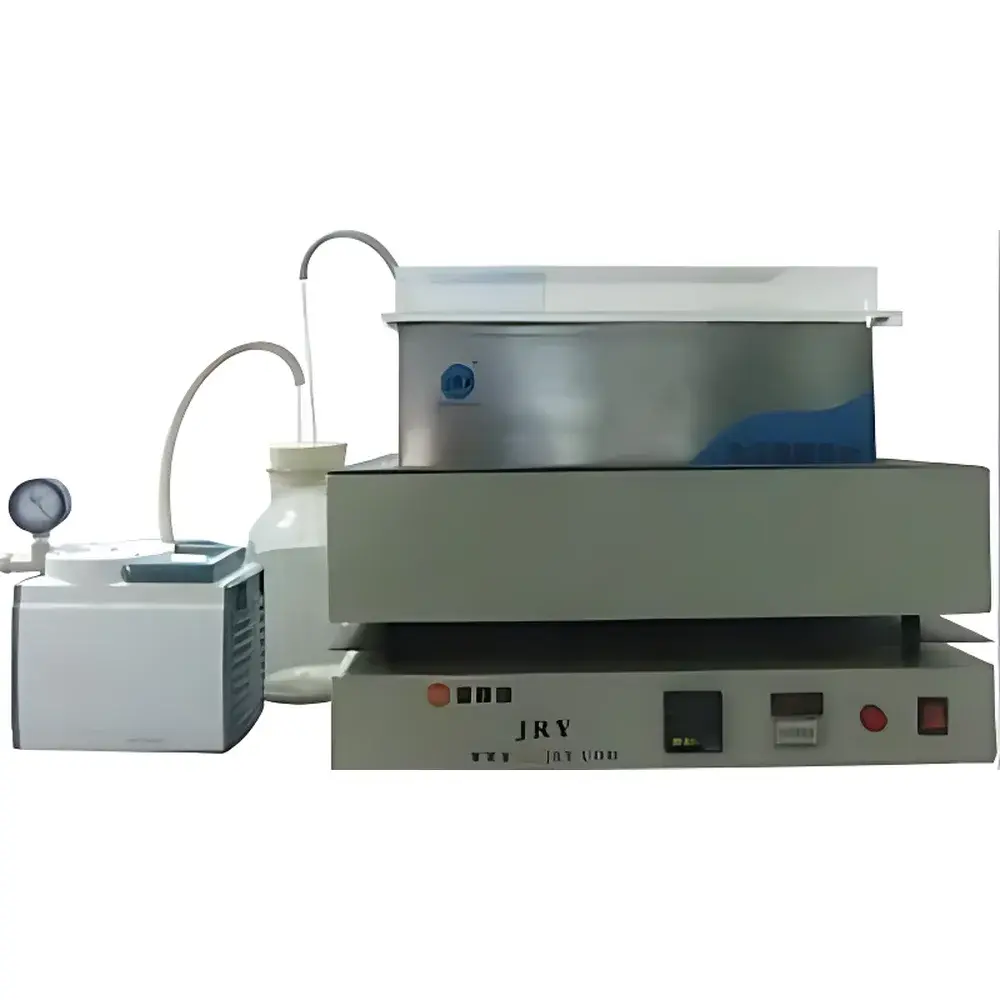
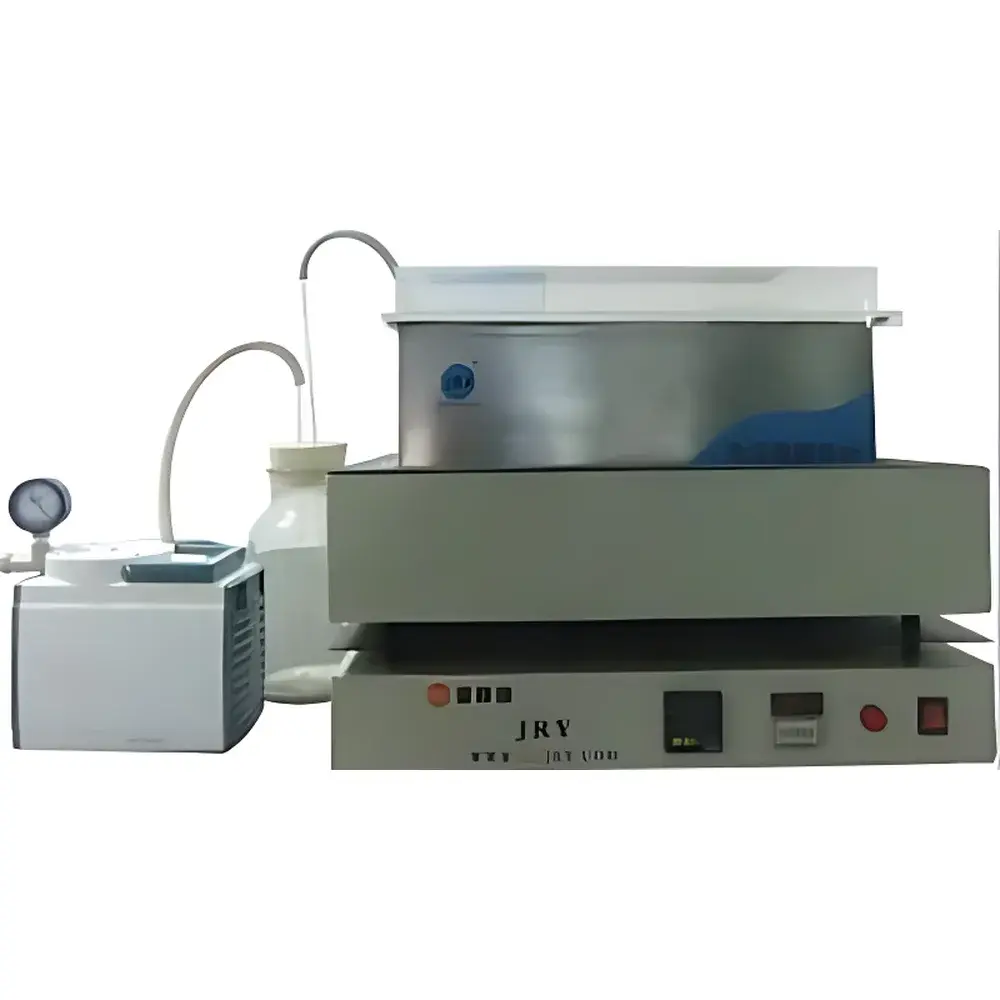
JRY-ZD350-A Graphite Electric Hot Block Digestion System
| Brand | JRY |
|---|---|
| Origin | Hunan, China |
| Manufacturer Type | Direct Manufacturer |
| Product Origin | Domestic (China) |
| Model | JRY-ZD350-A |
| Price | USD 1,280 (FOB Hunan) |
| Block Dimensions | 20 × Ø25 mm × 150 mm wells |
| Heating Plate Material | High-Purity Graphite (≥99.99% carbon) |
| Chemical Resistance | Resistant to concentrated HNO₃, HCl, HF, H₂SO₄, and NaOH up to 50% w/w |
Overview
The JRY-ZD350-A Graphite Electric Hot Block Digestion System is a precision-engineered thermal platform designed for controlled, uniform acid digestion and solvent evaporation in analytical sample preparation workflows. Unlike conventional ceramic or aluminum heating blocks, this system employs a monolithic high-purity graphite heating plate (≥99.99% carbon), offering exceptional thermal conductivity, long-term dimensional stability, and inherent resistance to aggressive reagents. It operates on the principle of conductive heat transfer—where thermal energy is delivered directly and uniformly from the graphite surface to PTFE- or quartz-lined digestion vessels placed within its precisely machined wells. This architecture ensures minimal temperature gradients (<±1.5 °C across all 20 wells at 150 °C), critical for reproducible trace-metal recovery in environmental, geological, and regulatory-compliant food testing laboratories.
Key Features
- 20-well configuration with standardized Ø25 mm × 150 mm deep well geometry—optimized for standard 50 mL conical digestion tubes and tall-form PFA vials.
- Monolithic high-purity graphite block (density ≥1.75 g/cm³, ash content <50 ppm), thermally aged prior to machining to eliminate residual volatiles and ensure dimensional integrity under repeated thermal cycling (−20 °C to 280 °C).
- Integrated PID-controlled digital thermostat with ±0.5 °C setpoint accuracy and real-time temperature display; adjustable range: ambient +5 °C to 280 °C.
- Chemically inert surface finish resistant to full-strength nitric acid (HNO₃), hydrochloric acid (HCl), hydrofluoric acid (HF), sulfuric acid (H₂SO₄), and sodium hydroxide (NaOH) solutions up to 50% w/w concentration—validated per ASTM D4294 and ISO 11885 protocols.
- Modular design supports OEM customization: well diameter (Ø16–Ø35 mm), depth (80–200 mm), and total well count (12–48) can be specified without compromising thermal homogeneity or structural rigidity.
- Front-panel safety lockout and overtemperature cutoff (290 °C threshold) compliant with IEC 61010-1:2010 for laboratory electrical equipment.
Sample Compatibility & Compliance
The JRY-ZD350-A accommodates a broad range of digestion vessel materials—including PTFE (Teflon™), PFA, quartz, and borosilicate glass—enabling method flexibility across EPA Method 3050B (acid digestion of sediments and soils), ISO 17294-2 (water analysis), and USP heavy metals testing. Its graphite construction eliminates metal leaching risks associated with stainless-steel or aluminum blocks, ensuring ultra-trace elemental analysis integrity (detection limits <0.1 ng/g achievable when paired with ICP-MS). The system meets GLP documentation requirements through optional RS-232/USB data logging interfaces, supporting audit-ready temperature profiling and electronic record retention per FDA 21 CFR Part 11 Annex 11 guidelines.
Software & Data Management
While the base unit operates via standalone digital controller, optional PC connectivity enables integration with JRY’s Digistat™ Control Suite (v3.2). This validated software provides real-time multi-channel temperature monitoring, programmable ramp-hold profiles (up to 10 segments), automatic calibration logging, and CSV export compatible with LIMS platforms (e.g., LabWare, Thermo Fisher SampleManager). All temperature events—including deviations exceeding ±2 °C—are timestamped and stored with user ID attribution, satisfying ALCOA+ data integrity principles (Attributable, Legible, Contemporaneous, Original, Accurate).
Applications
- Acid digestion of soil, sediment, sludge, and plant tissue prior to ICP-OES or ICP-MS analysis.
- Open-vessel evaporation of hydrochloric acid matrices in chloride removal for boron isotopic ratio determination.
- Controlled fuming of perchloric acid mixtures during organic matrix destruction (when used inside certified fume hoods).
- Standardized drying and charring steps in AOAC 999.10 (total mercury in seafood) and ISO 11885 (metals in water).
- Pre-concentration of large-volume environmental extracts (e.g., EPA 1613B dioxins) using low-temperature nitrogen-assisted evaporation.
FAQ
Is the graphite block certified for trace-metal analysis?
Yes—the graphite material undergoes batch-specific ICP-MS screening for 32 elements (including Cr, Ni, Cu, Zn, Cd, Pb, U) with total extractable metals <10 ng/g per ASTM D5685.
Can this system be used with hydrofluoric acid (HF)?
Yes—graphite exhibits excellent resistance to HF up to 48% w/w at temperatures ≤120 °C; however, PTFE or PFA vessels must be used exclusively, and strict PPE and fume hood protocols apply.
What is the maximum recommended operating temperature for long-term stability?
260 °C continuous duty; above this, gradual oxidation of graphite surface may accelerate, reducing service life beyond 5,000 operational hours.
Does the system support 21 CFR Part 11 compliance out of the box?
The hardware includes essential controls (user authentication, audit trail buffer); full Part 11 compliance requires Digistat™ Control Suite with electronic signatures and role-based access control enabled.
How is temperature uniformity verified during factory calibration?
Each unit undergoes 3-point spatial mapping (center, quadrant, edge wells) using NIST-traceable Pt100 probes per ISO/IEC 17025-accredited procedures, with certificates supplied.



