
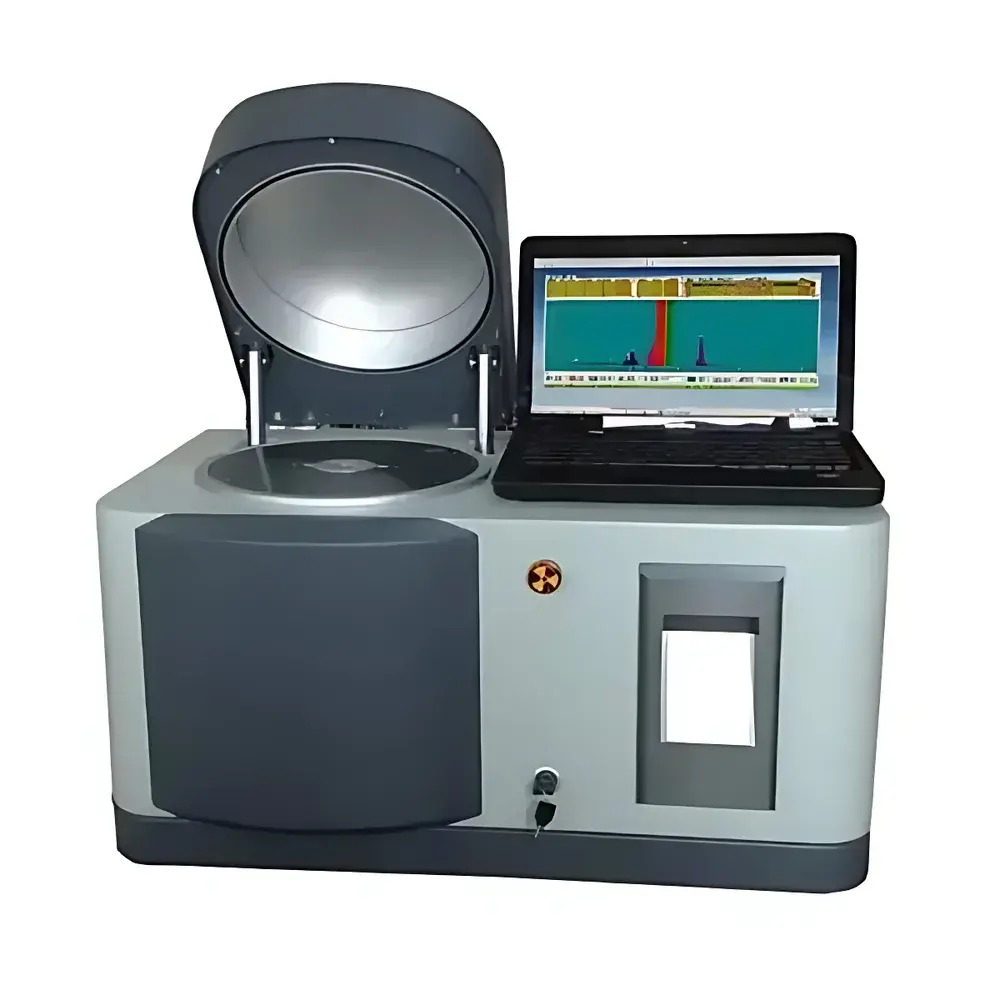
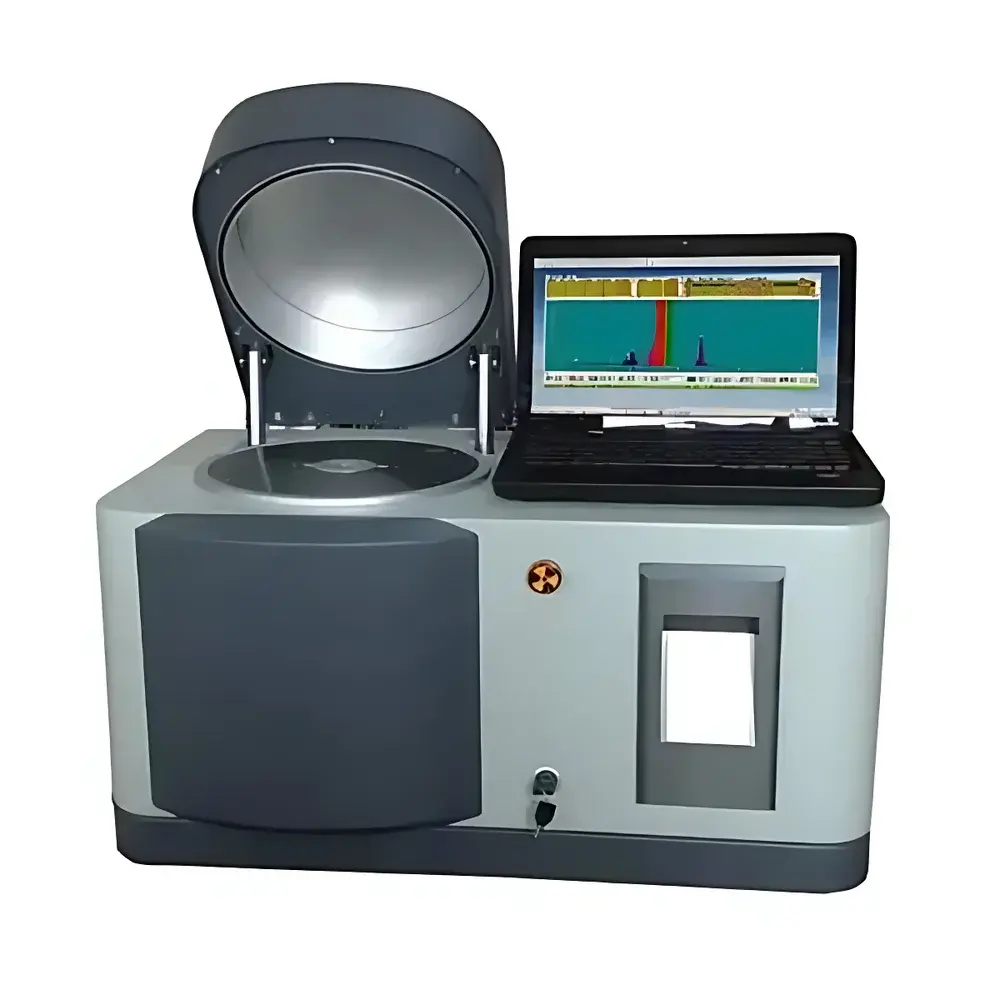
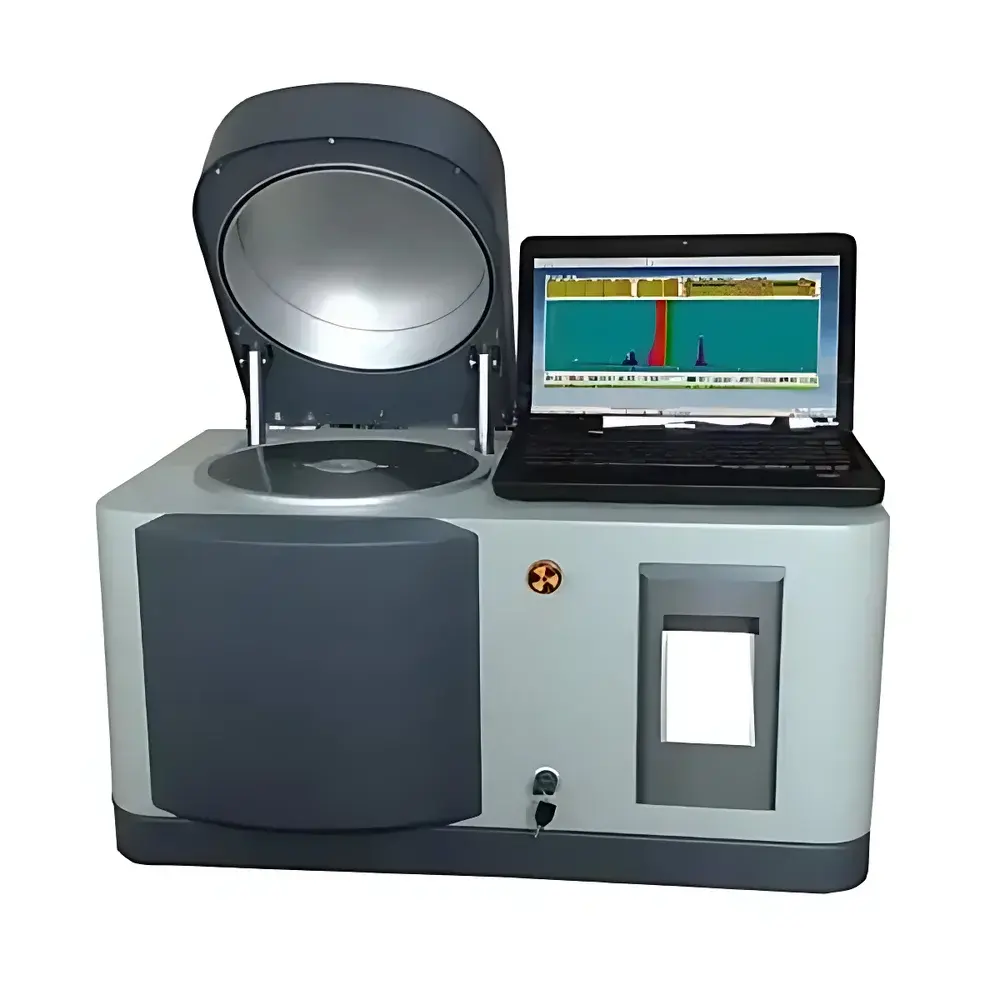
Ju Chuang JC-350X Energy Dispersive X-Ray Fluorescence Spectrometer
| Brand | Ju Chuang Environmental |
|---|---|
| Origin | Shandong, China |
| Manufacturer Type | Authorized Distributor |
| Country of Origin | China |
| Model | JC-350X |
| Form Factor | Benchtop/Floor-Standing |
| Instrument Type | Conventional EDXRF |
| Application Scope | General-Purpose |
| Detection Range | 0.07 ppm – 99.9% |
| Energy Resolution | 125 eV (at Mn Kα) |
| Repeatability | ≤0.1% RSD (for major elements, 100 s counting) |
| Detector | Peltier-cooled Silicon Drift Detector (SDD) |
| Measurement Range | 1–45 keV |
| High Voltage | 5–50 kV |
| Tube Current | 5–1000 µA |
| Vacuum Level | ≤10⁻² Pa within 10 s (operational range: 10⁻¹–10⁻⁵ Pa) |
| Sample Imaging | 5 MP CCD camera with real-time positioning |
| Power Consumption | 50 W (main unit), 550 W (vacuum pump) |
| Dimensions | 720 × 440 × 435 mm (W×D×H) |
| Weight | 65 kg |
Overview
The Ju Chuang JC-350X is a benchtop/floor-standing energy dispersive X-ray fluorescence (EDXRF) spectrometer engineered for precise, non-destructive elemental analysis of solid, powder, and liquid samples across metallurgical, foundry, and quality assurance environments. Based on fundamental EDXRF principles, the instrument excites atomic inner-shell electrons using a high-stability X-ray tube (5–50 kV, 5–1000 µA), inducing characteristic secondary X-ray emission from elements ranging from sodium (Na, Z=11) to uranium (U, Z=92). Emitted photons are collected by a Peltier-cooled silicon drift detector (SDD) with <125 eV resolution at Mn Kα, enabling high-fidelity spectral deconvolution and quantitative determination of up to 30+ elements simultaneously. Its design emphasizes robustness in industrial QA/QC workflows—particularly in copper, aluminum, zinc, and cast iron alloy production—where rapid verification of compositional conformity against specification limits is critical for process control, material certification, and regulatory compliance.
Key Features
- High-resolution SDD detector (≤125 eV at Mn Kα) ensures accurate peak separation for overlapping lines (e.g., Cr/Kα vs. Fe/Lα, Pb/Mα vs. Sb/Kα), essential for multi-element alloys.
- Integrated high-vacuum chamber (reaching ≤10⁻² Pa in ≤10 s; operational range 10⁻¹–10⁻⁵ Pa) minimizes atmospheric absorption of low-energy X-rays (<2 keV), enabling reliable quantification of light elements including Mg, Al, Si, P, S, and Cl.
- Programmable X-ray tube with continuously adjustable voltage (5–50 kV) and current (5–1000 µA) optimizes excitation conditions per sample matrix—enhancing sensitivity for trace heavy metals (e.g., Cd, Pb, As) while maintaining linearity for major constituents (e.g., Cu, Zn, Ni).
- Motorized filter wheel with auto-selection reduces bremsstrahlung background and improves peak-to-background ratio, particularly critical for detecting trace elements in high-Z matrices.
- Real-time 5-megapixel CCD imaging system enables precise spatial registration of measurement spots—documenting sample homogeneity, surface condition, and analysis location for audit-ready reporting.
- Automated sample stage with motorized lid and infinite-height accommodation supports irregular, oversized, or height-variable specimens without manual repositioning.
- Digital multichannel analyzer (2048-channel spectrum acquisition) provides high count-rate capability (>100,000 cps) and real-time dead-time correction, ensuring data integrity under varying flux conditions.
- USB-CAN interface ensures deterministic communication latency and electromagnetic compatibility in industrial lab environments with multiple connected instruments.
Sample Compatibility & Compliance
The JC-350X accommodates solids (metals, ceramics, coatings), powders (pressed pellets, loose), and liquids (in sealed cells), with no requirement for acid digestion or destructive preparation. It complies with IEC 61000-6-3 (EMC) and meets national radiation safety standards (GBZ 117–2020) via interlocked shielding, beam-stop redundancy, and real-time dose monitoring. While not pre-certified for FDA 21 CFR Part 11, its software architecture supports implementation of electronic signatures, audit trails, and user access controls required for GLP/GMP-aligned laboratories. Method validation protocols align with ISO 12885 (XRF for metals), ASTM E1621 (standard practice for EDXRF analysis of metals), and RoHS Directive Annex II analytical requirements for restricted substances (Cd, Pb, Hg, Cr⁶⁺, Br).
Software & Data Management
The bundled Chinese-language software includes a relational database for method storage, calibration curve management, and batch result archiving. Quantitative analysis employs fundamental parameter (FP) algorithms with matrix correction, supplemented by empirical calibration options. All spectra are stored in standardized .rtd format (compatible with third-party spectral processing tools). Audit trail functionality logs operator ID, timestamp, method parameters, and raw spectrum metadata—supporting traceability per ISO/IEC 17025:2017 clause 7.10. Data export supports CSV, PDF, and XML formats for integration into LIMS or ERP systems. Firmware updates are delivered via secure USB key with cryptographic signature verification.
Applications
- Raw material verification: Rapid screening of incoming copper, aluminum, and zinc ingots against EN 1774, ASTM B117, or GB/T 5231 specifications.
- Process control in melting and casting: Real-time monitoring of melt composition during furnace tapping to adjust alloying additions before casting.
- Finished product certification: Final QA release testing for automotive brake calipers (Al-Si alloys), plumbing fittings (Cu-Zn brass), or aerospace fasteners (Ni-based superalloys).
- RoHS/WEEE compliance screening: Detection of regulated elements (Pb, Cd, Cr, Hg, Br) at sub-100 ppm levels in electronic components and metal housings.
- Failure analysis support: Identification of segregation, contamination, or incorrect alloy grade in rejected parts without sectioning.
- Scrap sorting: Discrimination between stainless steel grades (304 vs. 316), aluminum series (1xxx vs. 6xxx), or leaded vs. unleaded brass.
FAQ
What elements can the JC-350X detect and quantify?
It detects elements from Na (Z=11) to U (Z=92); quantification accuracy is validated for Mg through U in metallic matrices, with detection limits as low as 0.07 ppm for Cd in Cu matrix under optimized vacuum and counting conditions.
Does it require liquid nitrogen or external cooling?
No—it uses a thermoelectric (Peltier) cooling system for the SDD detector, eliminating cryogen handling and enabling continuous unattended operation.
Can it analyze coated or plated samples?
Yes; with appropriate calibration and geometry control, it performs layer-thickness and composition analysis of electroplated layers (e.g., Ni/Cu on steel) using FP modeling and differential excitation techniques.
Is vacuum operation mandatory for all analyses?
Vacuum is required for light element analysis (Na–Cl); for heavier elements (K and above), helium flush or air-mode operation is supported via optional gas purge module.
How is instrument performance verified and maintained?
Built-in reference check sources (e.g., Fe-55, Cd-109) allow daily energy calibration; certified reference materials (CRMs) such as NIST SRM 1250 (stainless steel) or BAM 211 (brass) are recommended for routine accuracy verification per ISO/IEC 17025.
Related Products






