
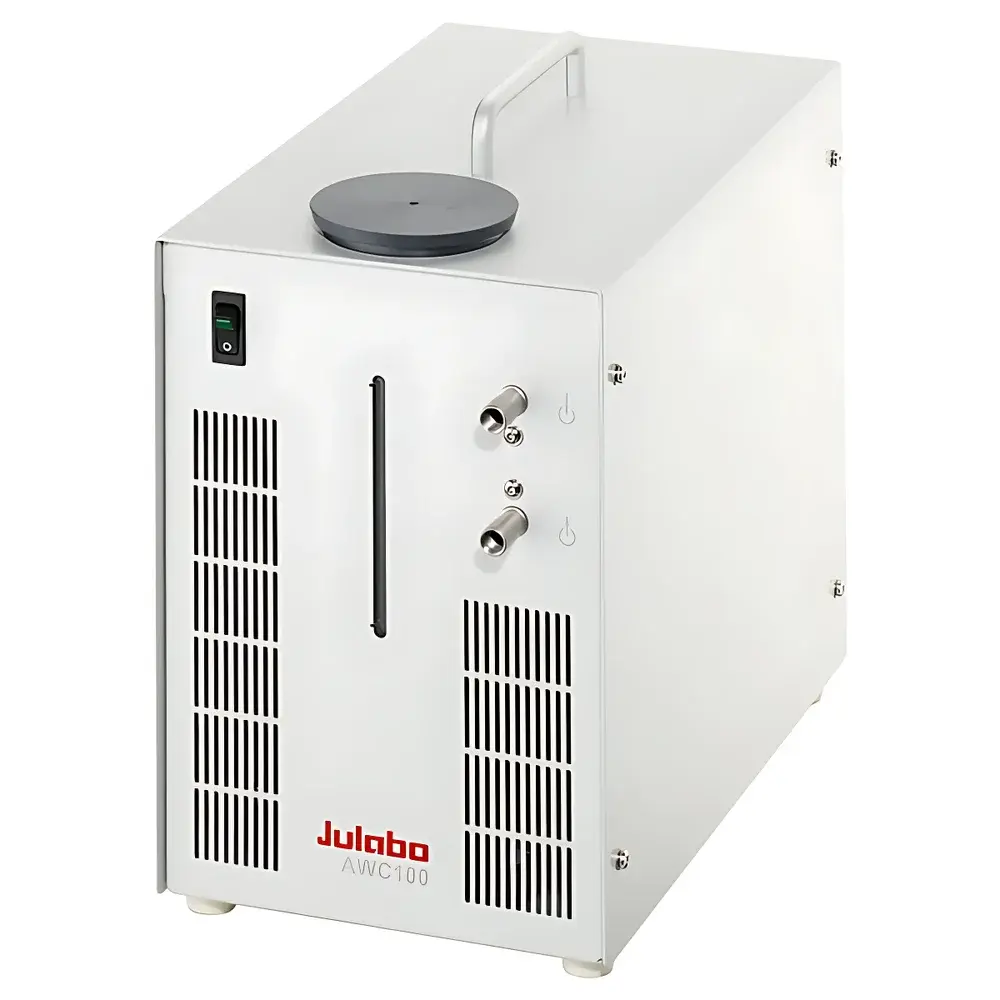
Julabo AWC100 Circulating Chiller
| Brand | Julabo |
|---|---|
| Origin | Germany |
| Model | AWC100 |
| Instrument Type | Split-type |
| Cooling Method | Water-cooled |
| Temperature Range | +20 °C to +40 °C |
| Temperature Stability | ±0.5 °C (at 25 °C ambient) |
| Refrigeration Power | 400–500 W (Stage 0: 220–300 W |
| Stage 1 | 120–180 W) |
| Circulating Pump Flow Rate | 2.9 L/min |
| Pump Pressure | 0.2 bar |
| Reservoir Volume | 0.9 L |
| Operating Mode | Continuous |
| Dimensions (W×L×H) | 20 × 34 × 30 cm |
| Weight | 18 kg |
| Power Supply | 230 V, 50/60 Hz |
| Noise Level | <45 dB(A) |
Overview
The Julabo AWC100 Circulating Chiller is a compact, water-cooled temperature control system engineered for stable, energy-efficient heat removal in laboratory applications requiring precise thermal management between +20 °C and +40 °C. Unlike compressor-based chillers, the AWC100 employs an absorption or thermosiphon-based cooling architecture—eliminating mechanical compression stages and significantly reducing acoustic emissions and electrical load fluctuations. Its design prioritizes integration into space-constrained environments, including fume hoods, analytical instrument enclosures (e.g., ICP-MS sample introduction systems, UV-Vis spectrophotometer Peltier housings), and small-scale reaction calorimetry setups. The unit maintains temperature stability within ±0.5 °C under steady-state conditions at ambient 25 °C, verified per ISO 17025-compliant calibration procedures traceable to PTB (Physikalisch-Technische Bundesanstalt) standards.
Key Features
- Split-system architecture enables remote placement of the condenser unit—ideal for noise-sensitive labs or installations where heat rejection must occur outside the main workspace.
- Two-stage refrigeration power modulation (Stage 0: 220–300 W; Stage 1: 120–180 W) allows dynamic adaptation to variable thermal loads without cycling or overshoot, enhancing long-term process repeatability.
- Integrated liquid-level indicator with low-level shutdown safeguard prevents dry-run operation and extends pump service life.
- Low-noise operation (<45 dB[A]) meets ISO 15710 requirements for laboratory acoustic environments, supporting compliance with occupational health and safety protocols (e.g., EU Directive 2003/10/EC).
- Front-panel LED display with intuitive single-knob interface enables immediate startup after power connection—no configuration or software initialization required.
- Stainless-steel reservoir and corrosion-resistant fluid path materials ensure compatibility with deionized water, 30% ethylene glycol/water mixtures, and other non-aggressive heat-transfer fluids per ASTM D1384 guidelines.
Sample Compatibility & Compliance
The AWC100 is designed for closed-loop circulation with external equipment featuring standard ¼” or 6 mm quick-connect fittings. It complies with EN 61000-6-3 (EMC emission limits) and EN 61000-6-2 (immunity), and carries CE marking under the EU Machinery Directive 2006/42/EC and Low Voltage Directive 2014/35/EU. While not certified for GMP environments per se, its passive cooling architecture, absence of oil-lubricated compressors, and sealed fluid circuit support use in GLP-regulated laboratories where documentation of maintenance intervals, fluid change logs, and temperature deviation records is maintained per internal SOPs.
Software & Data Management
The AWC100 operates as a standalone analog-controlled device without digital communication interfaces (e.g., RS232, USB, or Ethernet). Temperature setpoint and stage selection are managed locally via front-panel controls. For audit-trail requirements under FDA 21 CFR Part 11 or ISO/IEC 17025, users may integrate external data loggers (e.g., calibrated thermistor arrays with timestamped CSV export) connected to the chiller’s outlet port. Julabo provides traceable calibration certificates upon request, aligned with ISO/IEC 17025 Clause 6.5 and NIST-traceable reference standards.
Applications
- Cooling of high-intensity light sources in fluorescence microscopy and confocal imaging systems.
- Thermal stabilization of optical components in interferometry and laser alignment benches.
- Heat dissipation for benchtop mass spectrometers, particularly ESI and APCI ion sources operating continuously at elevated temperatures.
- Support of controlled-temperature solvent delivery in HPLC gradient systems where column oven heat load exceeds ambient dissipation capacity.
- Process cooling in small-volume bioreactors (≤5 L) where precise jacket temperature control is critical for cell culture viability studies.
FAQ
Does the AWC100 require refrigerant recharging during its service life?
No—its cooling cycle relies on a sealed, factory-charged absorption or thermochemical heat-transfer medium; no user-serviceable refrigerant circuits are present.
Can the AWC100 be used with tap water as the coolant?
Not recommended—tap water promotes scaling and microbial growth; use deionized water or a validated 30% ethylene glycol mixture per Julabo Technical Bulletin TB-AWC-02.
Is the pump flow rate adjustable?
No—the 2.9 L/min flow is fixed by hydraulic design; flow regulation must be implemented externally via bypass valves or flow restrictors.
What is the minimum ambient temperature for reliable operation?
+15 °C; operation below this threshold may impair heat rejection efficiency and trigger thermal protection shutdown.
How often should the heat-transfer fluid be replaced?
Annually under continuous operation, or every 18 months in intermittent use—documented per lab-specific maintenance SOPs to satisfy ISO/IEC 17025 Clause 6.4.6.



