
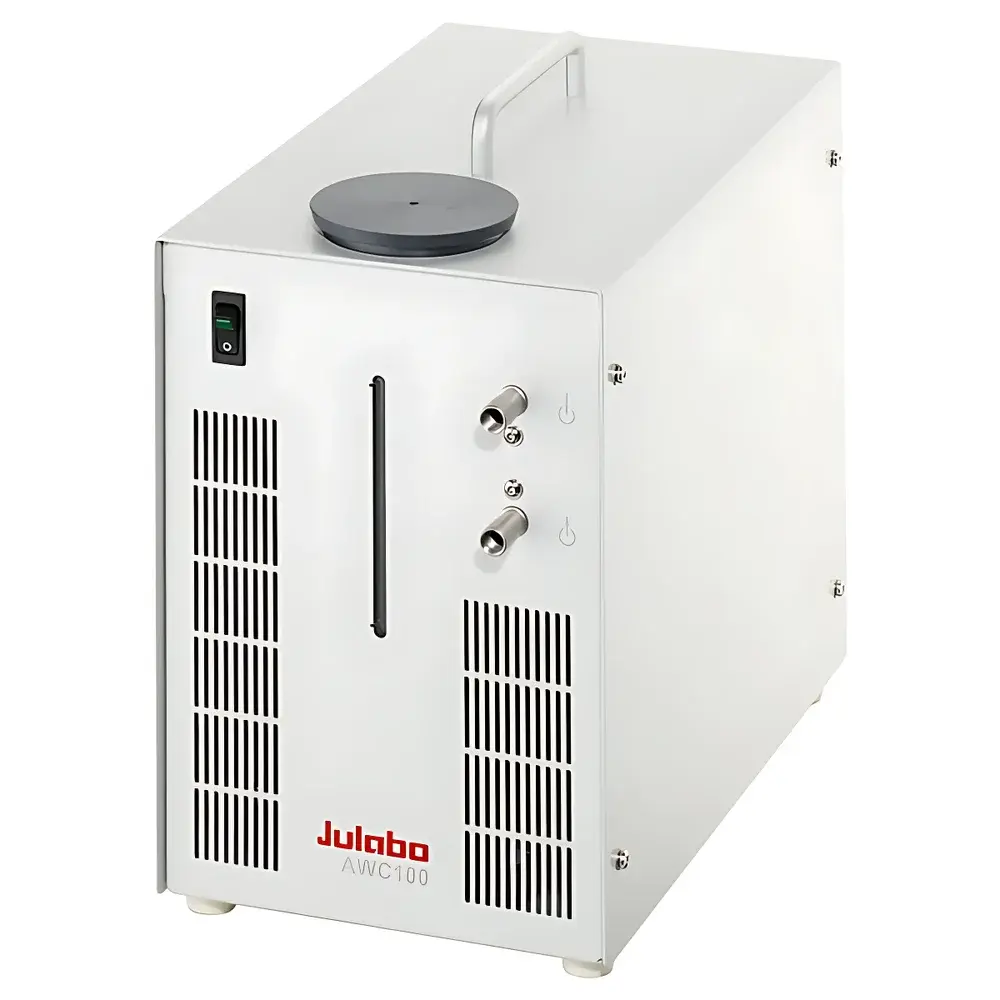
Julabo AWC100 Compact Heat Exchanger Chiller
| Brand | Julabo |
|---|---|
| Origin | Germany |
| Model | AWC100 |
| Cooling Type | Water-Cooled |
| Temperature Range | +20 to +40 °C |
| Temperature Stability | ±0.5 °C |
| Refrigeration Power | 550 W (Stage 0) / 1000 W (Stage 1) |
| Circulating Pump Flow Rate | 2.9 L/min |
| Pump Pressure | 0.2 bar |
| Reservoir Volume | 0.9 L |
| Dimensions (W×D×H) | 20 × 34 × 30 cm |
| Weight | 18 kg |
| Power Consumption | 630 W (Stage 0) / 1000 W (Stage 1) |
| Operating Mode | Continuous |
| Noise Level | <45 dB(A) |
| Energy Efficiency | Compressor-Free Thermoelectric Cooling |
Overview
The Julabo AWC100 Compact Heat Exchanger Chiller is an engineered solution for precise, low-noise temperature control in laboratory and analytical instrumentation applications requiring stable heat dissipation without refrigerant-based compression cycles. Unlike conventional vapor-compression chillers, the AWC100 employs thermoelectric (Peltier) cooling technology—enabling reliable operation within a tightly controlled ambient temperature window of +20 to +40 °C with ±0.5 °C stability. Its compact footprint (20 × 34 × 30 cm) and lightweight construction (18 kg) make it ideal for integration beneath fume hoods, inside instrument cabinets, or adjacent to spectrometers, laser systems, and chromatographic detectors where space and acoustic constraints are critical. Designed for continuous-duty operation, the unit delivers consistent thermal management with no moving parts in the cooling core—enhancing long-term reliability and minimizing maintenance requirements.
Key Features
- Compressor-free thermoelectric cooling architecture eliminates refrigerant handling, oil degradation, and mechanical wear associated with traditional compressors
- Dual-stage refrigeration power selection (550 W / 1000 W) enables optimization of cooling capacity versus energy consumption based on process load
- Integrated liquid-level indicator provides real-time visual monitoring of the 0.9 L reservoir volume, preventing dry-run conditions
- Low-noise design (<45 dB[A]) ensures compatibility with noise-sensitive environments such as electrophysiology labs and optical measurement setups
- Stable recirculation performance: constant flow rate of 2.9 L/min at 0.2 bar pressure head, supporting consistent thermal transfer across external loops
- Simple plug-and-play operation—requires only single-phase AC power (230 V, 50/60 Hz); no external water supply or drainage needed
- Front-panel digital interface with intuitive LED display for temperature setpoint, stage selection, and status indication
Sample Compatibility & Compliance
The AWC100 is designed for closed-loop circulation with deionized water or aqueous glycol mixtures (up to 30% v/v), ensuring compatibility with sensitive optical and electronic components. It meets IEC 61010-1 safety standards for laboratory electrical equipment and conforms to EN 61326-1 for electromagnetic compatibility (EMC) in industrial and laboratory settings. While not intended for regulated GxP environments requiring full 21 CFR Part 11 compliance, its stable thermal output supports method reproducibility in ISO/IEC 17025-accredited testing laboratories when used as ancillary cooling infrastructure for validated instruments (e.g., HPLC column ovens, FTIR beam path coolers, or CCD detector housings). The absence of refrigerants aligns with EU F-Gas Regulation (EU No 517/2014) and supports institutional sustainability goals.
Software & Data Management
The AWC100 operates as a standalone analog-controlled chiller without embedded digital communication interfaces (e.g., RS232, Ethernet, or USB). Temperature setpoints and stage selection are managed exclusively via front-panel controls. For integration into automated workflows, optional external analog voltage (0–10 V) or 4–20 mA input modules can be configured through third-party PLCs or DAQ systems to modulate cooling power in response to upstream sensor feedback (e.g., detector housing temperature). No proprietary software, cloud connectivity, or audit trail functionality is provided—consistent with its role as a deterministic, maintenance-light utility device rather than a data-generating analytical instrument.
Applications
- Cooling of high-power LED light sources and laser diodes in spectroscopic and imaging systems
- Thermal stabilization of photomultiplier tubes (PMTs), CCD/CMOS detectors, and infrared sensors
- Heat removal from electrophoresis power supplies, gel documentation systems, and microplate readers
- Supporting temperature-sensitive chromatography components including autosampler trays and detector flow cells
- Secondary cooling loop for larger chillers or HVAC systems in cleanroom or controlled-environment laboratories
- Prototyping and pilot-scale thermal management in materials science and photonics R&D
FAQ
Does the AWC100 require external water cooling or tap water connection?
No—it is a self-contained, water-cooled chiller that circulates internal coolant; no external water source or drain is needed.
Can the AWC100 operate below ambient temperature?
No—the unit is designed for heat rejection only and cannot cool below ambient +5 °C; its operational range is limited to +20 to +40 °C.
Is the reservoir fluid accessible for user replacement or additive introduction?
Yes—the transparent reservoir cap allows for manual refilling and compatibility verification with non-corrosive, low-conductivity coolants.
What is the expected service life of the thermoelectric modules under continuous operation?
Based on Julabo’s accelerated lifetime testing, Peltier elements maintain ≥90% nominal cooling efficiency after 20,000 hours of continuous use at rated load.
Can multiple AWC100 units be daisy-chained for higher total cooling capacity?
No—each unit operates independently; parallel operation requires external manifold design and flow balancing to avoid pressure imbalances.



