
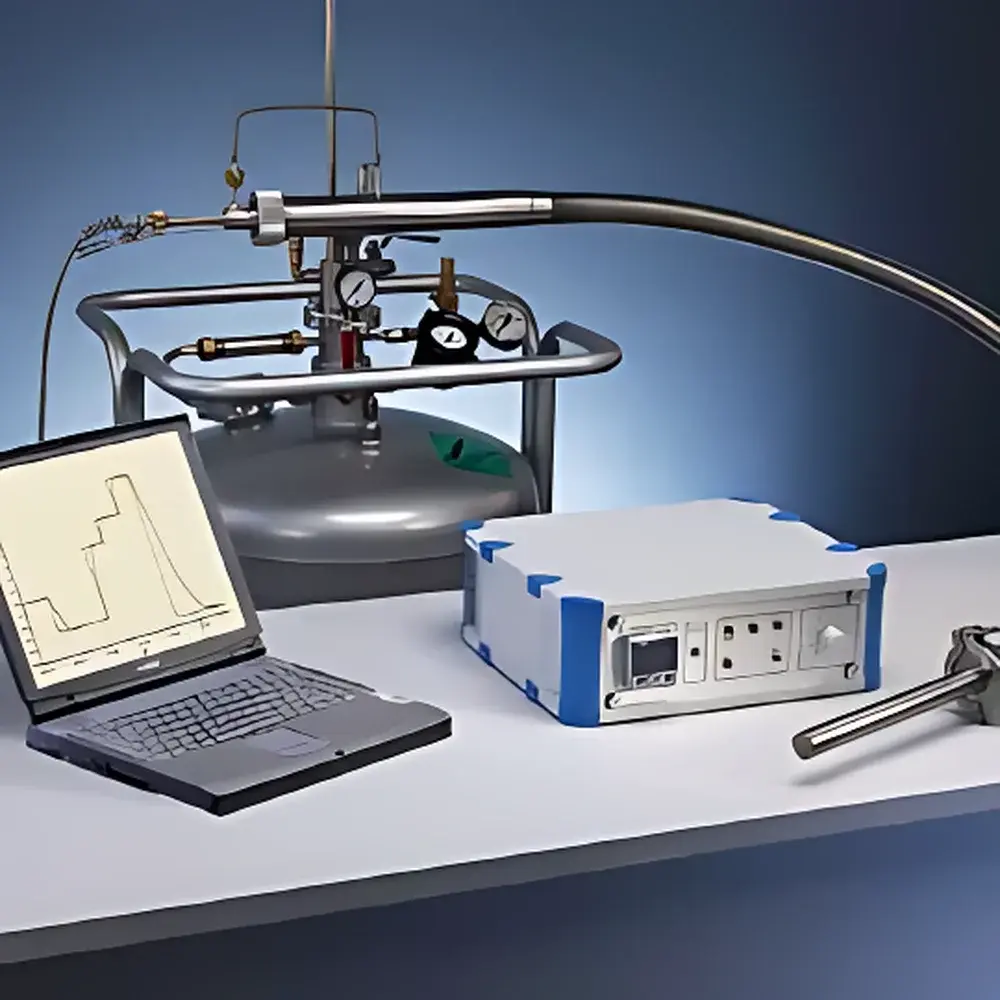
Julabo-Chemtron KALTGAS TG-LKF-H Cryogenic & Heating Gas Temperature Control System
| Brand | Julabo-Chemtron |
|---|---|
| Origin | Germany |
| Model | TG-LKF-H |
| Cooling Medium | Liquid Nitrogen (LN₂) |
| Minimum Operating Temperature | −180 °C |
| Heating Power | 630 W |
| Vaporizer Power Options | 500 W or 1000 W |
| LN₂ Consumption Range | 1.1–22 L/h |
| Flexible Vacuum-Insulated Delivery Hose | V2A Stainless Steel, 1.8 m |
| Standard Interface | KF NW 50 |
| Controller | SL5 Intelligent Temperature Controller (±0.2 °C accuracy, ±0.1 °C optimized) |
| Communication | RS485 with KALTGAS TOOL Software |
| Safety | Dual-Channel Overtemperature Protection |
| Flow Regulation | 0–100% Manual Evaporation Rate Control |
Overview
The Julabo-Chemtron KALTGAS TG-LKF-H is a modular, high-precision cryogenic and heating gas temperature control system engineered for rapid thermal conditioning of external experimental setups. Unlike conventional compressor-based chillers, the TG-LKF-H leverages controlled vaporization of liquid nitrogen (LN₂) to deliver stable, programmable gas-phase cooling down to −180 °C — enabling applications where extreme low-temperature ramp rates, tight thermal stability, and dynamic heat compensation are critical. The system operates on a closed-loop gas delivery principle: LN₂ is drawn from a standard dewar via a KF NW 50虹吸 connection, vaporized in a precisely regulated electric heater (500 W or 1000 W), and delivered as dry, particle-free cold nitrogen gas through a vacuum-insulated, flexible V2A stainless steel hose (1.8 m). Integrated resistive heating (630 W) allows seamless transition from cryogenic to elevated temperatures, supporting bidirectional thermal control without mechanical switching or fluid exchange. This architecture eliminates condensation risks, avoids thermal shock from direct LN₂ contact, and ensures reproducible thermal profiles across diverse sample environments — from vacuum chambers and tensile test frames to biological cryo-stages and reaction calorimeters.
Key Features
- Modular design: Interchangeable vaporizer, heater, and gas delivery modules enable configuration-specific optimization without replacing core infrastructure (dewar, vacuum pump, controller).
- High-speed thermal response: Achieves −180 °C gas output within minutes; typical temperature ramp rates exceed 10 °C/s in open-flow mode.
- Intelligent SL5 controller: Features dual-sensor input (internal + optional external PT100), auto-tuning PID algorithm, RS485 interface, and full programmability via KALTGAS TOOL software for multi-step thermal protocols.
- Precision temperature regulation: Standard control accuracy of ±0.2 °C; optimized operation achieves ±0.1 °C stability under steady-state conditions with external feedback.
- Energy-efficient LN₂ management: Adjustable evaporation rate (0–100%) synchronized with vaporizer power (100–1000 W); maximum gas output up to 14,000 L/h at 1000 W.
- Comprehensive safety architecture: Dual independent overtemperature monitoring of vaporizer and heater elements; automatic shutdown with audible alarm and manual reset requirement upon threshold violation.
- Vacuum-insulated delivery: Flexible V2A hose maintains thermal integrity during motion-critical applications (e.g., material testing rigs, robotic sample handling).
Sample Compatibility & Compliance
The TG-LKF-H interfaces seamlessly with a broad spectrum of analytical and mechanical test systems requiring non-contact, gas-mediated thermal control. It is routinely deployed in ASTM D648 (heat deflection temperature), ISO 75 (load-deflection temperature), and ASTM E228 (linear thermal expansion) testing of polymers, composites, and metals. In electronics reliability testing, it supports JEDEC JESD22-A119 (cold temperature storage) and MIL-STD-883 (temperature cycling). For materials science, the system enables controlled cooling during Charpy/Izod impact tests (ASTM E23), torsional fatigue studies, and DMA preconditioning per ISO 6721. Biomedical applications include rapid vitrification support, cryopreservation protocol development, and thermal stress assessment of tissue-engineered constructs. All configurations comply with CE marking requirements (2014/30/EU EMC Directive, 2014/35/EU LVD), and the SL5 controller supports audit-ready data logging aligned with GLP and FDA 21 CFR Part 11 when integrated with validated KALTGAS TOOL software deployments.
Software & Data Management
KALTGAS TOOL is a Windows-based control and data acquisition platform designed exclusively for Julabo-Chemtron gas temperature systems. It provides real-time visualization of setpoint vs. actual temperature (both internal and user-defined external sensor inputs), LN₂ consumption history, vaporizer power load, and evaporation rate settings. Users define multi-segment temperature ramps, hold times, and conditional triggers (e.g., “hold until external sensor reaches −100 °C ±0.15 °C”). All operational parameters — including controller firmware version, calibration timestamps, and safety event logs — are time-stamped and exportable in CSV or XML format. When configured in networked lab environments, KALTGAS TOOL supports OPC UA integration for centralized monitoring within LIMS or MES platforms. Data integrity is preserved via write-protected archives, electronic signatures, and configurable audit trails meeting ALCOA+ principles for regulated laboratories.
Applications
- Rapid thermal cycling of polymer specimens prior to DSC, TMA, or rheological analysis.
- Cryogenic conditioning of electronic assemblies before HALT/HASS testing.
- Controlled cooling of vacuum chamber interiors during thin-film deposition or surface analysis (XPS, AES).
- Thermal preconditioning of metal coupons for fracture toughness evaluation (ASTM E1820).
- Low-temperature stabilization of optical benches and interferometric measurement systems.
- Dynamic temperature control in custom-built bioreactors for extremophile culture studies.
- Gas-phase quenching in chemical process development to arrest intermediate reaction states.
- Calibration support for cryogenic thermocouples and RTDs traceable to NIST standards.
FAQ
What is the lowest achievable temperature at the sample interface?
Under optimal flow and insulation conditions, the system delivers stable gas-phase temperatures down to −180 °C at the hose outlet. Actual sample temperature depends on local heat transfer coefficients, geometry, and thermal mass — typically within ±2 °C of setpoint for well-characterized fixtures.
Can the TG-LKF-H be used for heating-only applications?
Yes. By disabling LN₂ supply and operating only the 630 W resistive heater, the system functions as a precision hot gas source up to +150 °C (dependent on flow rate and ambient conditions).
Is external temperature feedback mandatory for high-accuracy control?
No, but strongly recommended for applications demanding ≤±0.15 °C stability. The SL5 controller defaults to internal vaporizer temperature sensing; however, connecting an external PT100 sensor at the sample location enables true process-variable control.
How does the system minimize LN₂ waste during low-load operation?
Through coordinated modulation of both evaporation rate (%) and vaporizer power level. At partial load, the controller reduces electrical input while maintaining sufficient vapor pressure — achieving sub-1.5 L/h consumption in standby cooling modes without compromising responsiveness.
Are replacement hoses and vaporizers available as spare parts?
Yes. All major subsystems — including V2A vacuum hoses (custom lengths), KF NW 50-compatible vaporizers (500 W/1000 W), and SL5 controller modules — are stocked globally and supported by Julabo-Chemtron’s certified service network.
Related Products



