
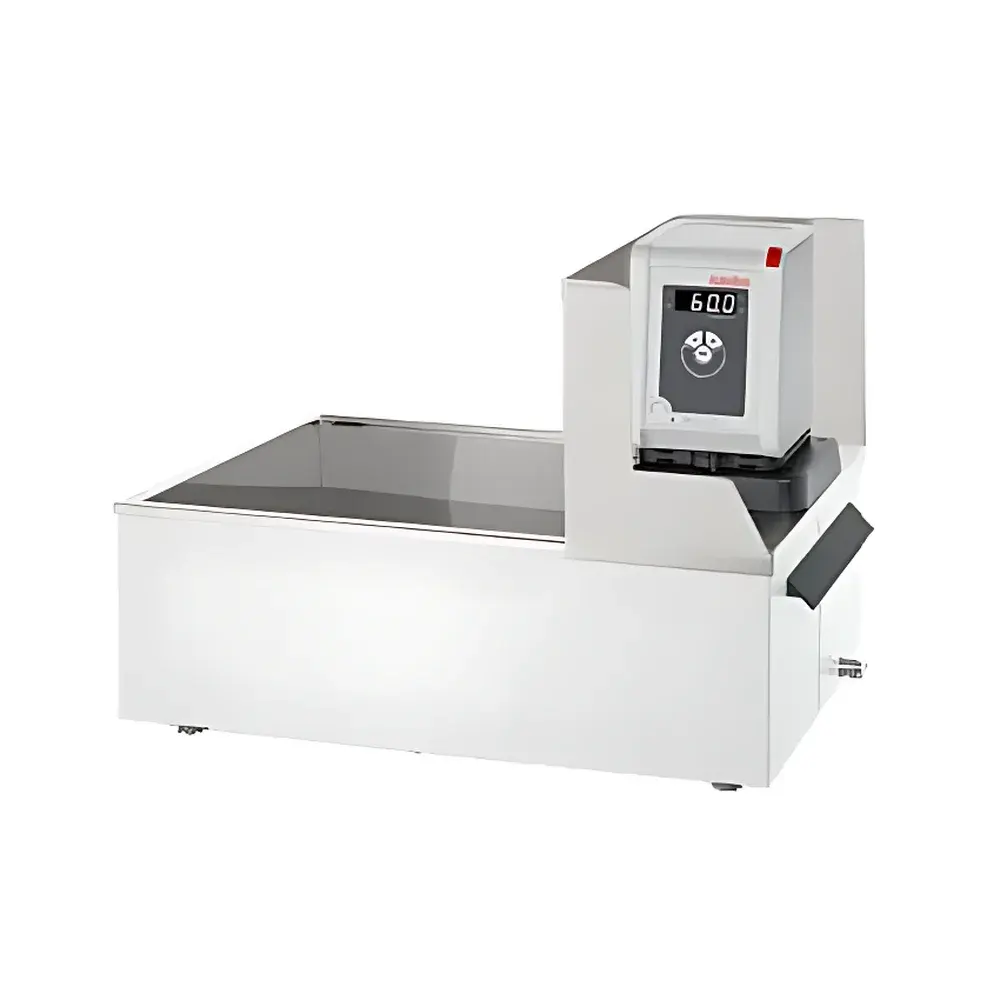
JULABO CS-5B Circulating Constant-Temperature Boiling Water Bath
| Brand | JULABO |
|---|---|
| Origin | Germany |
| Model | CS-5B |
| Temperature Stability | ±0.03 °C |
| Bath Volume | 4.5 L |
| Circulation Type | Internal & External |
| Temperature Control | Heating & Cooling |
| Heating Method | Stainless Steel Immersion Heater |
| Control Technology | PID1 + ACC Algorithm |
| Calibration | ATC1 Single-Point Self-Calibration |
| Safety Features | Overtemperature Protection, Low-Level Float Switch with Audio-Visual Alarm & Power Cut-off, Lockable Power Plug, Dry-Run Prevention |
| Noise Level | Low-Noise Design |
| Dimensions (W×L×H) | 17 × 33 × 36 cm |
| Bath Opening/Depth | 15 × 15 / 15 cm |
| Time to Boil | 15 min |
| Pump Flow Rate | 6 L/min at 0.1 bar |
Overview
The JULABO CS-5B Circulating Constant-Temperature Boiling Water Bath is a precision-engineered thermal management system designed for laboratories requiring stable, reproducible boiling-point conditions across extended operational cycles. Unlike conventional water baths, the CS-5B integrates active circulation, dual-mode (heating/cooling) temperature control, and real-time thermal safety protocols to maintain rigorous compliance with ISO/IEC 17025–aligned calibration practices. Its core operating principle relies on forced convection via an integrated centrifugal pump, ensuring uniform thermal distribution throughout the 4.5 L stainless-steel bath chamber — critical for applications demanding minimal spatial temperature gradients (<0.03 °C stability at setpoint). The unit operates across a full range from ambient +5 °C up to 100 °C (boiling point at sea level), with rapid heat-up performance (≤15 minutes to reach 100 °C from 20 °C) enabled by a corrosion-resistant, scale-inhibiting stainless steel heating coil. Engineered in Germany and compliant with IEC 61010-1 safety standards, the CS-5B serves as a foundational platform for standardized thermal testing, dissolution studies, sterilization validation, and reference material conditioning.
Key Features
- PID1 + ACC (Adaptive Control Compensation) digital temperature regulation for dynamic load compensation and minimized overshoot during ramping or setpoint changes
- ATC1 (Automatic Temperature Calibration) function enabling user-performed single-point calibration at any temperature within the operating range — traceable to NIST-traceable references
- Stainless steel immersion heater with optimized surface-area-to-volume ratio, eliminating scaling and facilitating routine decontamination without chemical descaling agents
- Low-noise pump assembly (<45 dB[A]) engineered for continuous operation in shared laboratory environments without acoustic interference
- Dual-circuit safety architecture: independent overtemperature cutoff (mechanical + electronic), liquid-level float switch with audible/visual alarm and automatic power disengagement, and keyed lockable IEC 60320 C14 power inlet
- Modular thermal enclosure design with enlarged rear ventilation zones and thermally isolated controller housing to sustain long-term stability under 24/7 duty cycles
- Configurable power-on behavior: selectable standby mode or auto-start at pre-defined setpoint upon mains restoration
Sample Compatibility & Compliance
The CS-5B accommodates standard laboratory glassware including 1-L Erlenmeyer flasks, USP Apparatus I/II dissolution vessels, and ASTM D1250-compliant hydrometer cylinders. Its open-bath geometry (15 × 15 cm aperture, 15 cm depth) permits unobstructed access for probe insertion, stirrer integration, or reflux condenser mounting. All wetted components meet FDA 21 CFR 177.2600 requirements for repeated contact with aqueous media. The system supports GLP/GMP workflows through audit-ready event logging (power-on/off, alarm triggers, setpoint modifications) and complies with EN 61326-1 (EMC) and EN 61010-1 (safety) directives. Optional accessories — including insulated bath covers and steam containment shields — enhance thermal efficiency and operator safety during prolonged boiling operations.
Software & Data Management
While the CS-5B operates autonomously via its front-panel interface, it supports analog output (0–10 V DC) for external data acquisition systems and optional RS232/RS485 serial communication (with JULABO’s LabSoft software suite). Logged parameters include real-time bath temperature, setpoint, pump status, alarm history, and cumulative runtime — all timestamped and exportable in CSV format. For regulated environments, the optional JULABO ComSoft 5 software provides 21 CFR Part 11–compliant electronic signatures, role-based access control, and encrypted audit trails suitable for FDA-submitted validation documentation.
Applications
- USP dissolution testing under controlled boiling conditions for poorly soluble APIs
- ASTM D92 Cleveland Open Cup flash point determinations requiring precise 100 °C pre-heating
- ISO 3104 kinematic viscosity measurements using calibrated capillary viscometers
- Thermal stability assessment of biological reagents, enzymes, or nucleic acid preparations
- Calibration of RTDs, thermistors, and liquid-in-glass thermometers per ISO/IEC 17025 Clause 6.5
- Boiling point elevation studies in physical chemistry education and research
FAQ
Does the CS-5B support external temperature probes for sample monitoring?
Yes — the unit features a dedicated Pt100 input channel for connecting an external sensor; the controller can display both bath and sample temperatures simultaneously and prioritize control based on either reading.
Is the pump flow rate adjustable?
No — the pump delivers a fixed 6 L/min at 0.1 bar to ensure consistent circulation velocity across all operating temperatures; variable-speed pumping is omitted to preserve long-term reliability and minimize cavitation risk.
Can the CS-5B be used with glycerol or silicone oil instead of water?
No — the CS-5B is validated exclusively for aqueous media; use of non-aqueous fluids voids warranty and compromises thermal safety logic calibrated for water’s specific heat capacity and boiling behavior.
What maintenance intervals are recommended for uninterrupted operation?
Daily visual inspection of fluid level and cleanliness; quarterly verification of ATC1 calibration at 100 °C using a certified reference thermometer; annual preventive service including pump impeller inspection and seal integrity check.
How does the low-level protection respond during rapid evaporation?
The float switch triggers immediately upon loss of buoyancy, initiating a 3-second delay before cutting power — sufficient to halt heating but allowing residual pump coast-down to prevent thermal shock to the heater coil.
Related Products



