
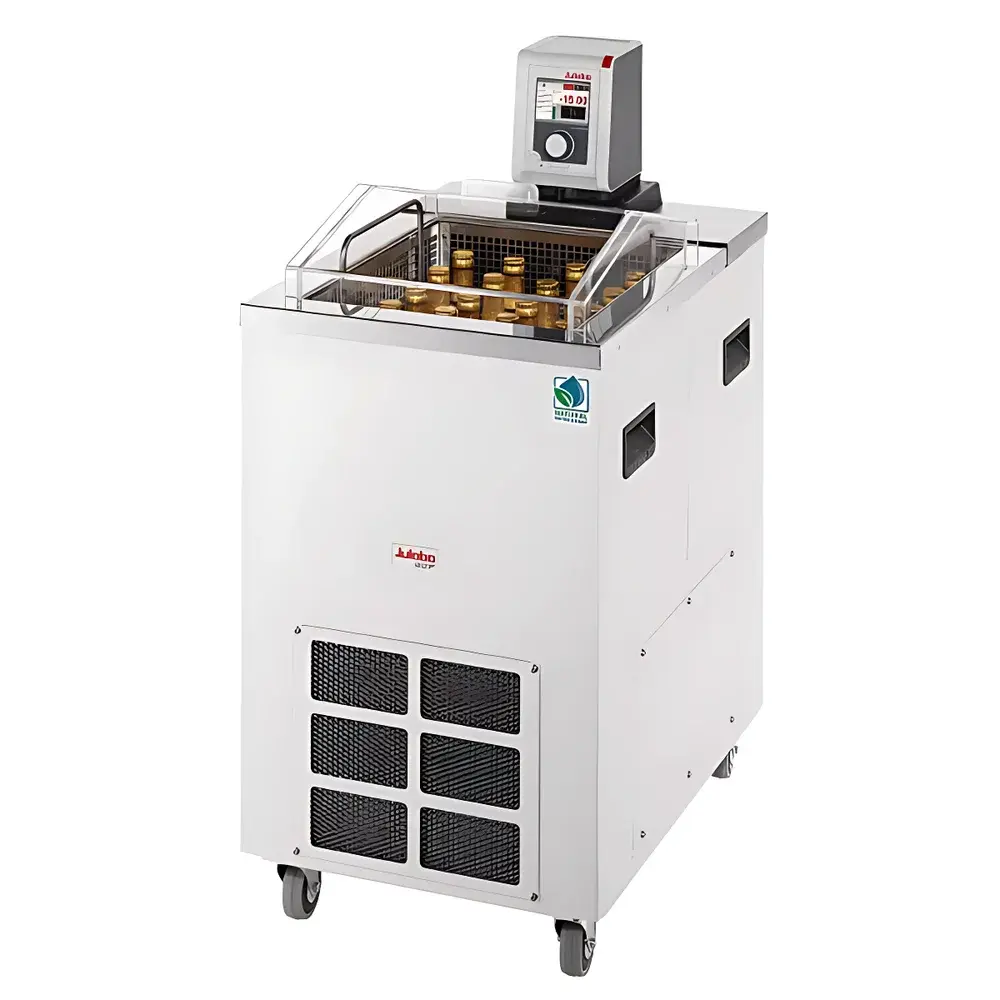
JULABO DD-1201F-BF Beer Shelf-Life Thermal Shock Bath
| Brand | JULABO |
|---|---|
| Origin | Germany |
| Model | DD-1201F-BF |
| Temperature Range | −40 to +100 °C |
| Temperature Stability | ±0.01 °C |
| Heating Power | 2 kW |
| Cooling Capacity | 1250 W at 20 °C, 1100 W at −20 °C, 540 W at −40 °C |
| Circulation Pump Flow Rate | 8–27 L/min |
| Pump Pressure | 0.1–0.7 bar |
| Bath Opening × Depth (W×L/D) | 35 × 40 × 30 cm |
| Bath Volume | 45–56 L |
| Sample Capacity | 20 bottles |
| Measurement Positions | 20 |
Overview
The JULABO DD-1201F-BF Beer Shelf-Life Thermal Shock Bath is a purpose-engineered temperature control system designed specifically for accelerated shelf-life testing in brewing science and quality assurance laboratories. It operates on the principle of controlled thermal cycling—rapid, programmable transitions between sub-zero and elevated temperatures—to simulate the cumulative stress effects that accelerate colloidal instability, protein aggregation, and oxidative degradation in beer over extended storage periods. Unlike generic recirculating chillers or standard water baths, the DD-1201F-BF integrates high-precision temperature regulation (±0.01 °C stability), wide-range thermal capability (−40 to +100 °C), and a large-volume, uniformly mixed bath chamber optimized for simultaneous conditioning of up to 20 standard beer bottles (e.g., 330 mL or 500 mL EU glass formats). Its architecture supports ISO 8549-compliant accelerated aging protocols and aligns with established industry practices defined in ASBC Methods of Analysis (Section Beer Stability) and EBC Analytica Chapter 9.4 (Chill Haze and Gushing).
Key Features
- High-stability dual-mode temperature control: Achieves ±0.01 °C setpoint accuracy across the full operating range using PID-controlled heating and cascade refrigeration with environmentally compliant R-449A refrigerant.
- Thermal shock performance: Programmable ramp rates from −40 °C to +100 °C in under 15 minutes (typical), enabling repeatable step-and-hold or sinusoidal cycling profiles per ASTM D7896-21 (Standard Practice for Accelerated Aging of Liquids).
- Dedicated bath geometry: 35 × 40 × 30 cm (W×L×D) open-top stainless steel tank with reinforced insulation, accommodating 20 vertically oriented beer bottles with unobstructed access for periodic sampling or in-bath turbidity measurement.
- High-capacity circulation system: Adjustable flow pump (8–27 L/min, 0.1–0.7 bar pressure) ensures homogeneous thermal distribution and eliminates stratification—critical for reproducible haze development kinetics.
- Robust industrial construction: IP54-rated enclosure, corrosion-resistant wetted parts (316 stainless steel bath, Viton seals), and integrated safety monitoring (overtemperature, low-level, refrigerant pressure, and motor overload protection).
Sample Compatibility & Compliance
The DD-1201F-BF accommodates standard commercial and laboratory-scale beer containers—including 330 mL crown-capped glass bottles, 500 mL swing-top bottles, and 1 L PET or glass carboys—without modification. Bottle holders (optional accessory, part no. 9021719.0.N1) ensure vertical alignment and minimize vibration-induced nucleation. The system complies with key regulatory and methodological frameworks for beverage stability testing: it supports GLP-aligned documentation when paired with JULABO’s optional data logging module; meets mechanical requirements for USP container compatibility studies; and facilitates audit-ready execution of EBC Method 9.42 (Forced Chill Haze Test) and ASBC Beer-37 (Accelerated Storage Test). All thermal profiles are traceable to NIST-traceable RTDs calibrated per ISO/IEC 17025.
Software & Data Management
The DD-1201F-BF operates via an intuitive front-panel interface with 7-inch capacitive touchscreen and real-time graphical display of temperature, setpoint, ramp rate, and elapsed cycle time. For advanced protocol automation, optional PC connectivity (RS485/Ethernet) enables integration with JULABO’s WinTemp Pro software—supporting multi-step thermal programs, event-triggered data export (CSV/TXT), alarm logging, and electronic signature-enabled user access control. When configured with audit trail and electronic record functionality, the system satisfies FDA 21 CFR Part 11 requirements for regulated environments, including full operator attribution, timestamped parameter changes, and immutable log archiving.
Applications
- Accelerated shelf-life prediction of lager, ale, and craft beers under variable storage conditions (e.g., warehouse cycling, retail chill/freeze exposure).
- Colloidal stability assessment: Correlating thermal shock-induced haze formation with turbidity (NTU), spectral absorbance (e.g., 600 nm), or light scattering metrics.
- Validation of filtration efficacy, antioxidant addition, or packaging barrier performance against cold-induced precipitation.
- QC/QA release testing for new brews, seasonal variants, or contract-manufactured batches prior to distribution.
- Research into protein-polyphenol interactions, β-glucan behavior, and Maillard-derived off-flavor precursors under thermal stress.
FAQ
What is the minimum temperature ramp rate achievable between −40 °C and +100 °C?
Typical ramp times from −40 °C to +100 °C are ≤15 minutes under standard load conditions (45 L bath volume, ambient 23 °C); exact rates depend on starting temperature, bath fill level, and ambient heat load.
Can the DD-1201F-BF be used for non-beverage applications?
Yes—its broad thermal range and precise stability make it suitable for accelerated aging of other sensitive liquids, including wine, plant-based beverages, functional drinks, and pharmaceutical suspensions requiring cold-chain validation.
Is external turbidity measurement supported during operation?
Yes—the open bath design and standardized bottle positioning allow direct insertion of benchtop turbidimeters (e.g., Hach 2100N, Lovibond TB-350) or fiber-optic probes without interrupting thermal cycles.
Does JULABO provide validation documentation for GMP environments?
Factory-installed IQ/OQ documentation packages are available upon request, including as-delivered calibration certificates, sensor linearity reports, and installation checklists compliant with ISO 9001 and EU Annex 15.






