
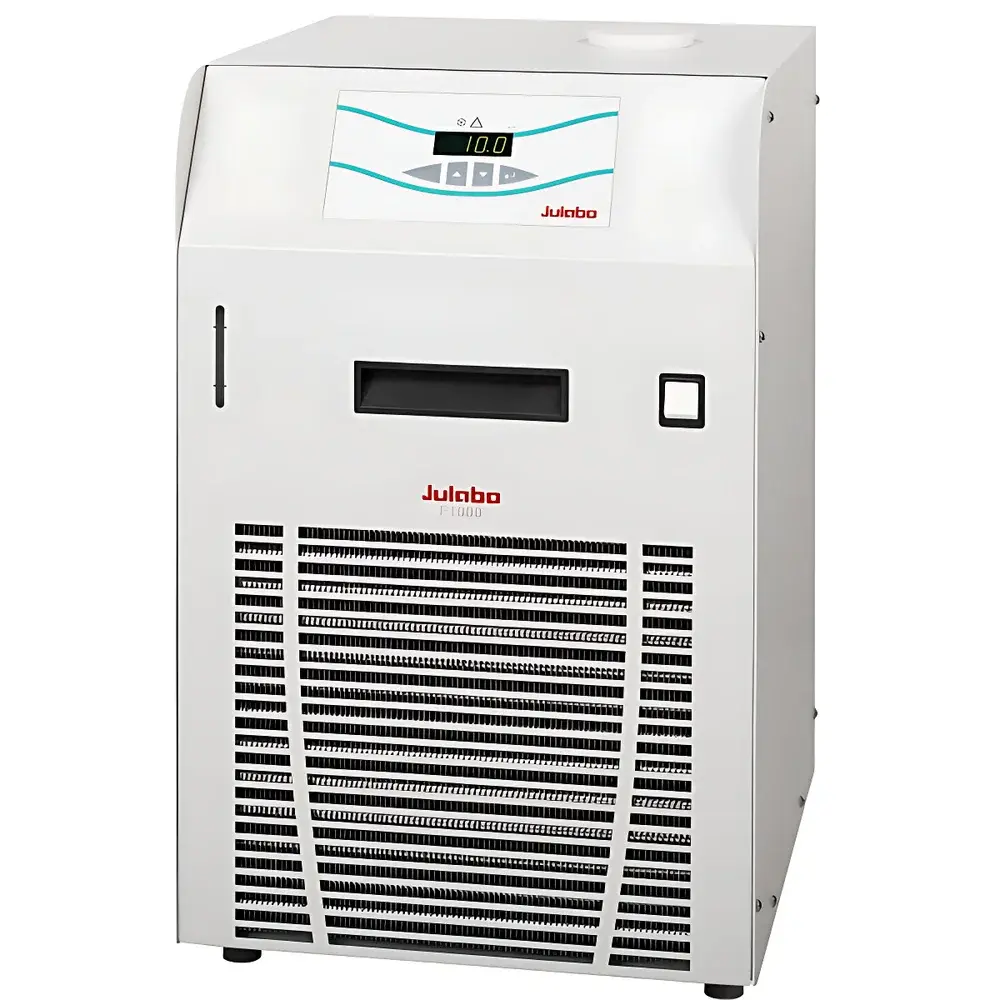
JULABO F1000 Circulating Chiller
| Brand | JULABO |
|---|---|
| Origin | Germany |
| Model | F1000 |
| Instrument Type | Integrated Circulating Chiller |
| Cooling Method | Air-Cooled |
| Temperature Range | 0 to +40 °C |
| Temperature Stability | ±0.5 °C |
| Pump Flow Rate | 23 L/min |
| Pump Pressure | 1.0 bar |
| Reservoir Volume | 7–9.5 L |
| Operating Mode | Continuous |
| Refrigerant | R134a (GWP = 1430) |
| Compressor | Single-Stage Hermetic |
| Ambient Operating Temperature | 5–40 °C |
| Dimensions (W×L×H) | 37.5 × 49 × 64 cm |
| Weight | 45 kg |
| Sound Pressure Level (1 m) | ≤62 dBA |
| Temperature Control | PID with 0.1 °C Setpoint/Display Resolution |
| Compatible Fluids | Water, Water-Glycol Mixtures, Thermal G |
Overview
The JULABO F1000 Circulating Chiller is a high-reliability, air-cooled temperature control system engineered for precise and stable thermal management of laboratory equipment requiring external cooling. Designed and manufactured in Germany, the F1000 operates on the principle of vapor-compression refrigeration using a single-stage hermetic compressor and R134a refrigerant—selected for its compatibility with standard laboratory infrastructure and adherence to current European environmental directives (EN 378-1, F-Gas Regulation EU No. 517/2014). It delivers continuous, closed-loop circulation of temperature-controlled fluid within a defined operating range of 0 to +40 °C, with a typical stability of ±0.5 °C under steady-state conditions. The unit integrates a high-efficiency centrifugal pump capable of sustaining 23 L/min flow at up to 1.0 bar pressure, enabling effective heat extraction from analytical instruments such as HPLC columns, spectrophotometer detectors, laser sources, and vacuum pumps. Its compact footprint (37.5 × 49 × 64 cm) and integrated reservoir (7–9.5 L capacity) support benchtop deployment without compromising serviceability or thermal performance.
Key Features
- German-engineered air-cooled refrigeration architecture with optimized heat exchange surface area and low-noise fan design (≤62 dBA at 1 m)
- PID-based digital temperature controller with 0.1 °C resolution for both setpoint and real-time display via LED interface
- Integrated level sensor and visual liquid-level indicator for safe, maintenance-aware operation
- Dual-port pump outlet with M16×1 internal thread, supplied with two conical adapters (for 8 mm and 12 mm ID tubing) to ensure leak-tight fluid coupling
- Refrigerant charge (295 g R134a) calibrated to minimize global warming impact while maintaining thermodynamic efficiency (CO₂-equivalent emissions: 0.422 t per unit)
- Robust stainless-steel and reinforced polymer housing rated for continuous operation at ambient temperatures between 5 °C and 40 °C
- Thermal fluid compatibility with deionized water, aqueous ethylene glycol solutions (up to 50 vol%), and JULABO-certified Thermal G heat-transfer fluids
Sample Compatibility & Compliance
The F1000 is not a sample-processing instrument but a utility-grade thermal management platform. As such, it does not interact directly with chemical or biological samples; instead, it ensures consistent thermal boundary conditions for downstream instrumentation. Its fluid circuit complies with ISO 8573-1:2010 (compressed air purity classes) for non-contaminating fluid handling when used with certified heat-transfer media. The unit meets CE marking requirements under the EU Machinery Directive 2006/42/EC and Low Voltage Directive 2014/35/EU. Electrical safety conforms to IEC 61010-1:2010 for laboratory equipment. While not intrinsically explosion-proof, it may be deployed in Class I, Division 2 environments when operated with non-flammable fluids and installed per local electrical codes. For GLP/GMP-regulated laboratories, the F1000 supports documented operational qualification (OQ) through its stable temperature output and traceable calibration points.
Software & Data Management
The F1000 operates as a standalone analog-digital hybrid controller with no built-in data logging or network interface. Temperature setpoints and real-time readings are accessible only via front-panel LED display and manual keypad input. For integration into automated workflows, optional analog voltage (0–10 V) or 4–20 mA process signals can be configured for remote setpoint modulation or status monitoring—compatible with PLCs, SCADA systems, or LabVIEW-based control architectures. Users performing IQ/OQ/PQ validation may record temperature stability data using external calibrated loggers (e.g., Fluke 179 or Omega OM-DAQPRO-5300), referenced against NIST-traceable RTD probes immersed in the reservoir. Audit trails, electronic signatures, or 21 CFR Part 11 compliance require third-party middleware—not native to the device.
Applications
- Active cooling of HPLC autosampler trays and column ovens to suppress retention time drift
- Stabilization of CCD and CMOS detectors in fluorescence and Raman spectrometers
- Thermal regulation of high-power laser diodes and optical parametric oscillators (OPOs)
- Condenser cooling for rotary evaporators operating under reduced pressure
- Temperature control of vacuum pump oil baths to maintain consistent ultimate vacuum
- Supporting calorimetry systems where constant jacket temperature improves baseline reproducibility
FAQ
What is the recommended maintenance schedule for the F1000 chiller?
Routine inspection every 6 months is advised: verify reservoir fluid level and clarity, inspect tubing for cracks or swelling, clean condenser fins with compressed air, and confirm pump priming integrity. Annual professional servicing includes refrigerant pressure verification, compressor current draw assessment, and PID controller calibration check.
Can the F1000 operate below 0 °C?
No—the F1000 model is specified for 0 to +40 °C operation. Sub-zero capability requires the F12-ED or F25-HL series, which incorporate cascade refrigeration and low-temperature heat-transfer fluids.
Is R134a refrigerant compliant with current EU F-Gas regulations?
Yes—R134a remains permitted for use in existing equipment under EU Regulation 517/2014, though new designs must transition to lower-GWP alternatives by 2027. The F1000’s 295 g charge falls well below the 5 kg threshold triggering mandatory leak-check reporting.
How does ambient temperature affect cooling capacity?
At ambient temperatures above 35 °C, maximum achievable cooling power declines approximately 1.2% per °C rise due to reduced condenser ΔT. Full 1000 W nominal cooling is guaranteed only at 25 °C ambient.
What certifications accompany the F1000 upon shipment?
Each unit ships with a CE Declaration of Conformity, Factory Calibration Certificate (covering temperature sensor and pressure transducer), and Material Safety Data Sheet (MSDS) for R134a and Thermal G fluid options.



