
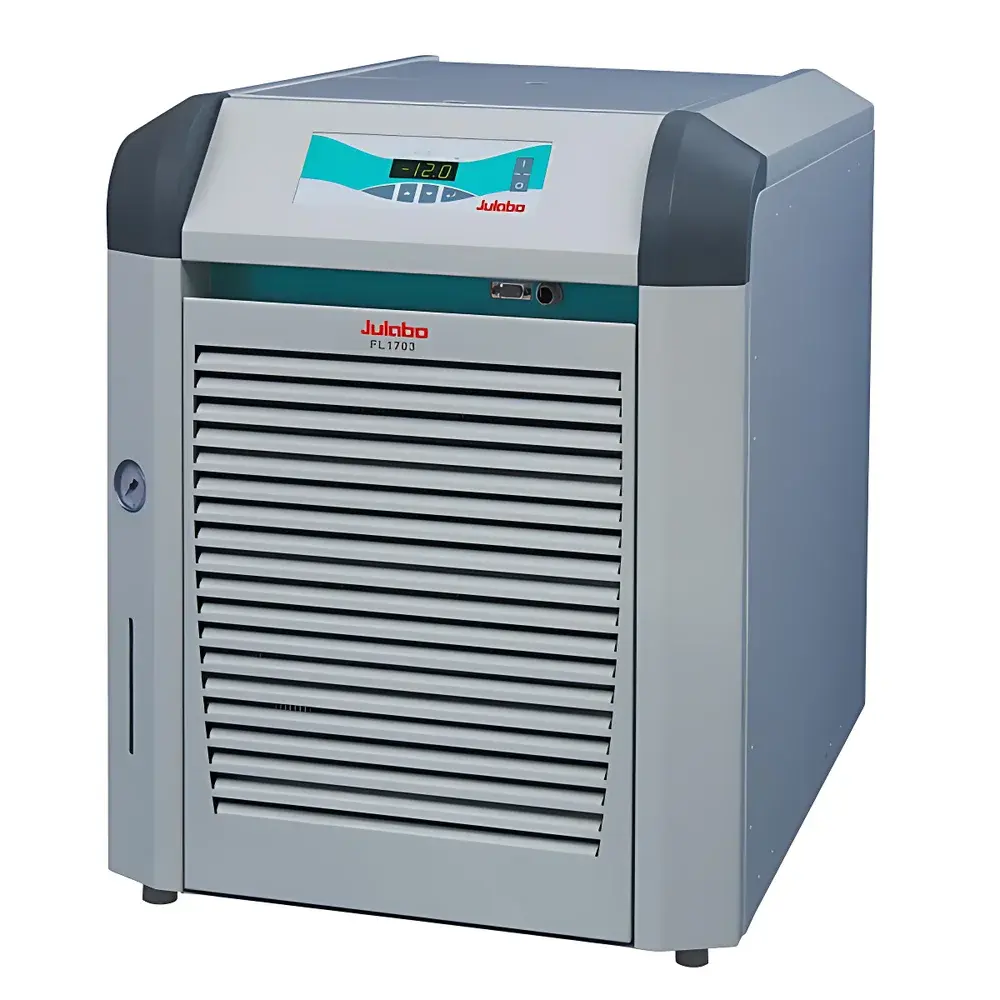
Julabo FL1703 Circulating Chiller
| Brand | Julabo |
|---|---|
| Origin | Germany |
| Model | FL1703 |
| Cooling Method | Air-Cooled |
| Temperature Range | -20 to +40 °C |
| Temperature Stability | ±0.5 °C |
| Refrigeration Capacity | 1.7 kW at 20 °C |
| Pump Flow Rate | 40 L/min |
| Pump Pressure | 0.5–3.0 bar |
| Reservoir Volume | 12–17 L |
| Operating Mode | Continuous |
| Refrigerant | R404A (GWP 3922) |
| Compressor | Single-Stage Hermetic |
| Communication Interface | RS232 (optional), Profibus (optional) |
| Ambient Operating Temperature | 5–40 °C |
| Dimensions (W×L×H) | 50 × 76 × 64 cm |
| Weight | 91 kg |
| Fluid Compatibility | Water, Water/Glycol Mixtures, JULABO Thermal Bath Fluids |
Overview
The Julabo FL1703 Circulating Chiller is a high-capacity, air-cooled laboratory chiller engineered for precision temperature control in demanding continuous-duty applications. It operates on the principle of vapor-compression refrigeration using a single-stage hermetic compressor and R404A refrigerant—selected for its thermal stability and compatibility with wide-range operation. Designed to replace municipal tap water cooling systems, the FL1703 eliminates water waste while delivering stable thermal management across a broad operating envelope of –20 °C to +40 °C. Its robust architecture supports integration with analytical instruments—including HPLC columns, rotary evaporators, laser sources, and spectrophotometers—where consistent coolant supply pressure (0.5–3.0 bar), high flow rate (40 L/min), and low temperature fluctuation (±0.5 °C) are critical for data integrity and system longevity.
Key Features
- Air-cooled condensation system eliminates dependency on external water infrastructure and enables flexible placement in laboratories without chilled-water loops.
- Large reservoir volume (12–17 L) minimizes refilling frequency and enhances thermal inertia for improved temperature stability during transient load conditions.
- High-flow, pressure-regulated circulation pump (G3/4″ inlet/outlet ports) ensures reliable delivery to multiple or high-backpressure devices.
- LED digital display with 0.1 °C resolution provides real-time monitoring of setpoint, actual bath temperature, and system status indicators.
- Liquid level sensor and optional pressure gauge (standard on FL1201 and above) support proactive maintenance and fault diagnostics.
- Compatible with aqueous, glycol-based, and JULABO-certified thermal fluids—enabling operation down to –20 °C without freezing risk or viscosity-induced pump strain.
- RS232 serial interface (optional) and Profibus connectivity (optional) enable remote parameter adjustment, logging, and integration into centralized lab automation platforms compliant with GLP/GMP workflows.
Sample Compatibility & Compliance
The FL1703 is validated for use with standard laboratory heat-transfer media including deionized water, 30–50% ethylene glycol/water mixtures, and JULABO Thermal G fluid. It accommodates return coolant temperatures up to 80 °C—making it suitable for coupling with exothermic equipment such as plasma etchers or high-power LED test rigs. The unit conforms to IEC 61000-6-3 (EMC emission standards) and IEC 61000-6-2 (immunity), carries CE marking per EU Machinery Directive 2006/42/EC, and meets RoHS 2011/65/EU requirements. While not intrinsically rated for hazardous locations, its sealed refrigeration circuit and non-sparking motor design support safe deployment in general-purpose laboratory and light industrial environments. Documentation packages include full Declaration of Conformity and refrigerant charge records required for F-Gas Regulation (EU No. 517/2014) compliance audits.
Software & Data Management
The FL1703 supports ASCII protocol over RS232 for bidirectional communication with host PCs or PLCs. Standard commands allow remote setting of target temperature, enabling/disabling pump and compressor, reading actual temperature and error codes, and querying operational hours. When integrated with Julabo’s optional LabSoft software or third-party SCADA systems (e.g., Siemens SIMATIC, National Instruments LabVIEW), users can configure automated temperature ramps, generate audit-trail logs with timestamps, and export CSV-formatted datasets traceable to ISO/IEC 17025 calibration records. All firmware updates preserve configuration memory and retain user-defined safety limits—ensuring continuity in regulated environments subject to FDA 21 CFR Part 11 requirements for electronic records and signatures.
Applications
- HPLC column ovens and detector cooling blocks requiring stable sub-ambient temperatures with minimal thermal drift.
- Rotor-stator homogenizers and ultrasonic processors where heat accumulation compromises sample integrity or emulsion stability.
- FTIR and Raman spectrometers with thermoelectrically cooled detectors demanding low-noise, vibration-dampened coolant delivery.
- Materials testing rigs (e.g., dynamic mechanical analyzers) requiring synchronized thermal conditioning of fixtures and specimens.
- Small-scale pilot reactors and jacketed glass vessels in process development labs where precise exotherm control is essential.
- Electronics reliability testing stations utilizing thermal cycling profiles within the –20 °C to +40 °C range.
FAQ
What is the maximum allowable return fluid temperature?
The FL1703 accepts return coolant up to 80 °C, allowing integration with equipment generating significant waste heat.
Can the unit operate continuously at –20 °C ambient temperature?
No—the recommended ambient operating range is 5–40 °C; operation below 5 °C may impair compressor oil viscosity and refrigerant return dynamics.
Is R404A refrigerant serviceable under current EU F-Gas regulations?
Yes, though R404A is subject to phase-down quotas; Julabo provides certified technicians for leak detection, recovery, and recharge in accordance with EN 378-1 and national licensing requirements.
Does the FL1703 support external temperature sensors for process feedback control?
Not natively—the unit regulates based on internal bath sensor input; however, external PID controllers can be interfaced via analog voltage signals using optional I/O modules.
What maintenance intervals are recommended for optimal performance?
Compressor oil and refrigerant levels should be verified annually; air filters require cleaning every 3 months in dusty environments; pump impeller inspection is advised every 24 months under continuous operation.



