
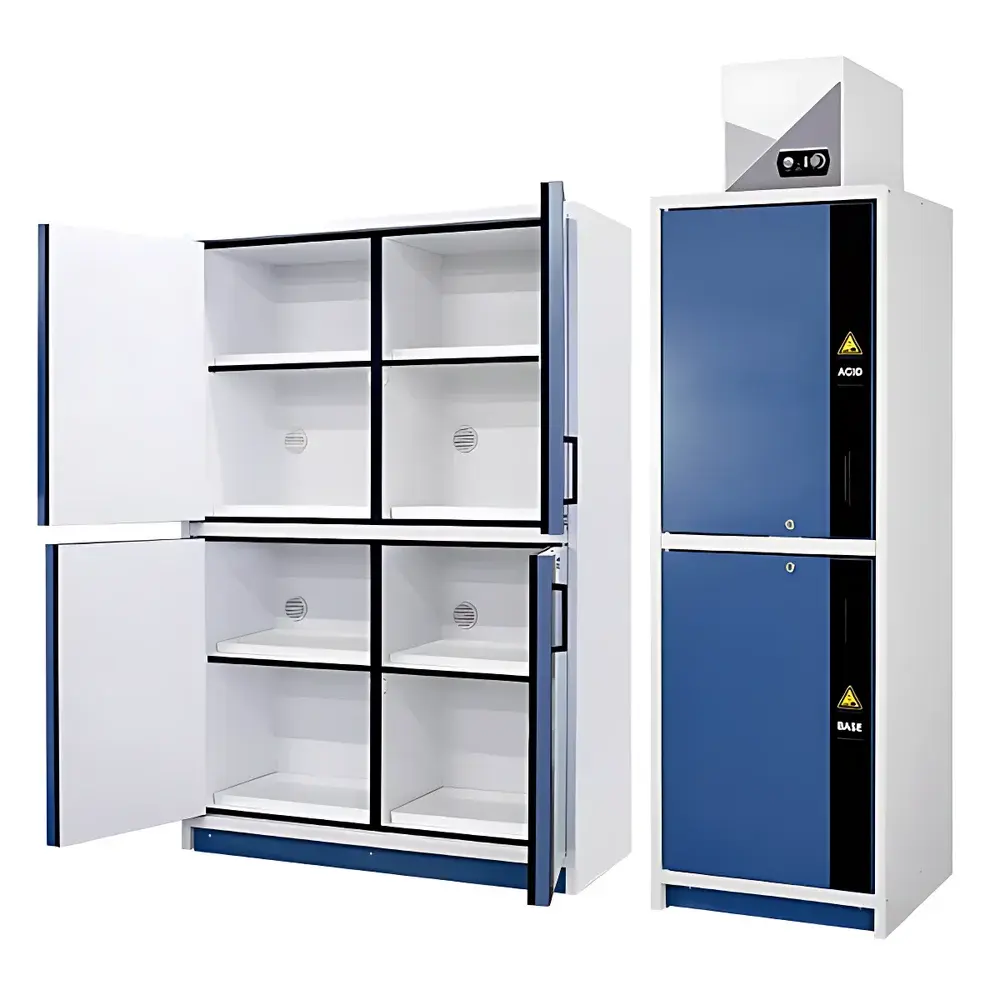
JULABO SC-C Series Acid- and Corrosion-Resistant Storage Cabinets
| Brand | JULABO |
|---|---|
| Origin | Germany |
| Model | SC-C-1912D4 / SC-C-0812D2 |
| Construction | Heavy-Duty Steel Frame with Phenolic Resin-Coated Exterior & Epoxy Powder-Coated Interior |
| Internal Volume | 852 L (SC-C-1912D4) / 312 L (SC-C-0812D2) |
| Shelf Load Capacity | ≤80 kg per shelf |
| Spill Containment | Integrated 30 mm raised lip +标配 PP spill trays |
| Compliance | Designed for ISO 15195, EN 14470-1, and OSHA 29 CFR 1910.1200 (HCS) requirements |
| Ventilation Interface | Top-mounted and rear exhaust ports compatible with lab ducted ventilation systems |
Overview
The JULABO SC-C Series Acid- and Corrosion-Resistant Storage Cabinets are engineered for the secure, long-term containment of aggressive chemicals—including mineral acids (e.g., HCl, HNO₃, H₂SO₄), organic acids (e.g., acetic, formic), halogenated solvents, and oxidizing agents—within regulated laboratory, pharmaceutical, and industrial R&D environments. These cabinets comply with fundamental safety principles outlined in EN 14470-1 (flammable and corrosive substance storage) and incorporate passive and active hazard mitigation strategies grounded in chemical hygiene best practices. Unlike standard steel cabinets, the SC-C series employs a dual-material architecture: an exterior clad in phenolic resin—a thermoset polymer renowned for its exceptional resistance to strong acids, alkalis, and thermal degradation—and an interior surface finished with industrial-grade epoxy powder coating, which provides uniform, pinhole-free protection against corrosion-induced pitting and delamination. The structural integrity is reinforced by a welded cold-rolled steel frame, ensuring dimensional stability under sustained mechanical load and thermal cycling. All models feature integrated ventilation interfaces enabling connection to centralized exhaust systems—critical for preventing accumulation of volatile acidic vapors (e.g., HCl fumes) and maintaining ambient air quality below TLV thresholds.
Key Features
- Chemical-resistant construction: Phenolic resin-coated exterior panels resist degradation from splashes, mists, and prolonged exposure to concentrated acids; epoxy powder-coated interior surfaces withstand repeated cleaning with neutralizing agents without compromising barrier integrity.
- Engineered spill containment: Each adjustable shelf features a 30 mm raised perimeter lip to retain accidental spills; standard polypropylene (PP) spill trays—chemically inert toward >95% of common corrosives—are included in all models except SC-C-0706D1.
- Modular shelving system: Fully adjustable shelves (spacing: 100–130 mm depending on model) support up to 80 kg uniformly distributed load; shelves mount securely into reinforced side rails via precision-machined slots, eliminating lateral shift under dynamic loading.
- Dual-point ventilation interface: Top-mounted louvered vent and rear exhaust port (Ø100 mm) allow flexible integration with Type I or Type II ducted ventilation systems—enabling continuous vapor extraction while maintaining negative pressure within the cabinet chamber.
- Ergonomic access design: Full-height doors open 180°; external dimensions include allowance for door swing clearance (e.g., SC-C-1912D4: 1255 × 1110 × 1900 mm), facilitating safe material handling in constrained lab corridors.
Sample Compatibility & Compliance
The SC-C cabinets accommodate glass, HDPE, PTFE, and borosilicate containers used for storing hydrochloric acid (37%), nitric acid (69%), sulfuric acid (96%), phosphoric acid (85%), chromic acid solutions, and bromine-based reagents. They are not intended for storage of sodium metal, white phosphorus, or anhydrous HF—substances requiring specialized inert-atmosphere or cryogenic containment. Regulatory alignment includes adherence to EN 14470-1 Annex A (corrosive substance classification), ISO 15195 (laboratory quality management for chemical safety), and OSHA Hazard Communication Standard (29 CFR 1910.1200) labeling and SDS integration requirements. While not certified for explosion-proof operation (per ATEX/IECEx), their ventilation-ready design supports compliance with NFPA 45 (Standard on Fire Protection for Laboratories Using Chemicals) when integrated into a facility-wide exhaust strategy.
Software & Data Management
The SC-C Series is a standalone mechanical storage solution with no embedded electronics, firmware, or software components. As such, it does not generate operational data, require calibration records, or support digital audit trails. However, its physical design facilitates seamless integration into laboratory quality management systems (QMS): standardized mounting points enable attachment of RFID-tagged inventory labels; consistent external dimensions simplify CAD-based lab layout planning; and full compatibility with electronic logbook platforms (e.g., LabArchives, Benchling) allows linkage of cabinet location IDs to chemical inventory entries, expiration tracking, and GLP/GMP-compliant storage logs. No FDA 21 CFR Part 11 functionality applies, as no electronic records are produced.
Applications
These cabinets serve critical roles across multiple domains: in analytical chemistry labs, they house titrants, digestion reagents, and ICP-MS calibration standards; in pharmaceutical QC laboratories, they store HPLC mobile phase components (e.g., TFA, phosphoric buffer) and synthesis intermediates; in university teaching labs, they provide safe staging areas for undergraduate acid-base experiments; and in battery R&D facilities, they contain electrolyte precursors (e.g., LiPF₆ in EC/DMC) and etching solutions (e.g., HF/HNO₃ mixtures). Their robustness makes them suitable for high-frequency access environments where daily chemical retrieval and replenishment occur under strict SOP-controlled conditions.
FAQ
Can the SC-C cabinet be used for storing flammable liquids?
No. The SC-C series is specifically engineered for corrosive substances—not flammables. Flammable liquid storage requires UL 30 or FM-approved fire-rated cabinets with self-closing doors and static-dissipative grounding provisions.
Is optional ventilation ducting supplied with the cabinet?
No. Ducting, fans, and balancing dampers must be specified separately per local HVAC engineering specifications and installed by qualified personnel in accordance with ASHRAE 110 and ANSI Z9.5.
What maintenance is required to preserve chemical resistance?
Wipe interior surfaces weekly with deionized water; avoid abrasive cleaners or chlorine-based disinfectants. Inspect epoxy coating annually for micro-cracking using 10× magnification; recoating is possible but must be performed by JULABO-certified service technicians.
Does the cabinet meet GMP requirements for pharmaceutical manufacturing?
Yes—as a passive storage component, it satisfies EU GMP Annex 15 and USP criteria for equipment qualification when included in a documented risk assessment, installation qualification (IQ), and operational qualification (OQ) protocol.
Are replacement spill trays available as spare parts?
Yes. PP trays (Part No. F60100-TRAY-PP) and epoxy-coated steel shelves (F60100-SHELF-EC) are stocked globally and ship within 5 business days upon order confirmation.



